What Is a Robo-Advisor? (And Should You Use One in 2026)
A robo-advisor is an automated investment platform that builds and manages a diversified portfolio for you — no stock-picking required. Here's how they work and whether one is right for you.
KatchingStacks is reader-supported. When you open an account through links on this page, we may earn a commission at no extra cost to you. See our affiliate disclosure and editorial policy.
A robo-advisor is an automated investment platform that builds and manages a diversified portfolio for you. Instead of picking stocks yourself, you answer a few questions about your goals and risk tolerance, and the platform does the rest — automatically investing your money in a mix of low-cost index funds.
The term “robo-advisor” can sound intimidating, but the concept is refreshingly simple: it’s software that handles the boring but critical work of portfolio management so you don’t have to. And over the past decade, robo-advisors have shifted from a niche fintech experiment to the default choice for millions of everyday investors.
How Does a Robo-Advisor Work?
When you sign up, you’ll go through an onboarding questionnaire that asks things like: What are you investing for? When do you plan to use this money? How would you feel if your portfolio dropped 20% in a month?
Based on your answers, the platform assigns you a portfolio — usually a mix of stock ETFs and bond ETFs calibrated to your risk tolerance. From there, it automatically rebalances when market movements throw your allocation off target, and reinvests dividends for you.
Some robo-advisors like Wealthfront and Betterment also offer tax-loss harvesting — a strategy that sells losing positions to offset gains and reduce your tax bill. That feature used to require a professional financial advisor charging 1%+ per year. Now you get it automatically for a fraction of the cost.
The History Behind Robo-Advisors
Betterment and Wealthfront launched in 2010 as the first true robo-advisors aimed at retail investors. At the time, the idea that software could manage a portfolio just as well as a human advisor — at 1/10th the cost — was genuinely radical. Traditional advisors dismissed it. Then the assets under management numbers started coming in.
By 2015, robo-advisors collectively managed over $60 billion. By 2024, that figure had surpassed $2 trillion globally. Every major brokerage — Schwab, Fidelity, Vanguard — now offers its own robo-advisory service. What started as a disruption is now mainstream infrastructure.
What Actually Goes Into Your Portfolio?
Most robo-advisors build portfolios using ETFs (exchange-traded funds) — specifically low-cost index ETFs that track broad market benchmarks like the S&P 500, total bond market, or international stocks. These aren’t exotic instruments. They’re the same tools institutional investors use.
A typical aggressive portfolio (suitable for a 25-year-old with a long time horizon) might look like this:
- 60–70% US stocks (total market or S&P 500 ETF)
- 15–20% international stocks
- 5–10% bonds
- 0–5% real estate (REITs)
A conservative portfolio (for someone close to retirement) might flip that ratio — 40% stocks, 50% bonds, 10% cash or short-term treasuries. The specific funds vary by platform, but the underlying philosophy is the same: broad diversification, low expense ratios, automatic rebalancing.
What Is Automatic Rebalancing?
Rebalancing is what keeps your portfolio aligned with your target allocation. Suppose your target is 60% stocks / 40% bonds, but stocks have a great quarter and grow to 70% of your portfolio. Without intervention, you’re now taking on more risk than you intended. Rebalancing sells some of the overweight asset and buys the underweight one to restore your target.
With a human advisor, this might happen once a year, if you remember to ask. With a robo-advisor, it happens automatically — triggered either by time (monthly, quarterly) or by drift thresholds (when any asset class strays more than 5% from target). You never think about it. The math just happens in the background.
What Is Tax-Loss Harvesting?
Tax-loss harvesting is one of the most valuable features offered by premium robo-advisors like Wealthfront and Betterment. Here’s how it works:
Say your US stock ETF is down 8% for the year. A tax-loss harvesting algorithm will sell that ETF, immediately buy a similar (but not identical) ETF to maintain your market exposure, and book the loss. That paper loss can offset capital gains elsewhere in your portfolio — or offset up to $3,000 in ordinary income per year. The IRS calls it a tax benefit; your robo-advisor does it automatically.
Studies suggest tax-loss harvesting can add 0.10%–0.77% in after-tax returns annually, depending on your tax bracket and market conditions. For high earners in a volatile market, that’s meaningful money. And it used to require a sophisticated, expensive advisor to do it for you.
Robo-Advisor vs. Traditional Investing
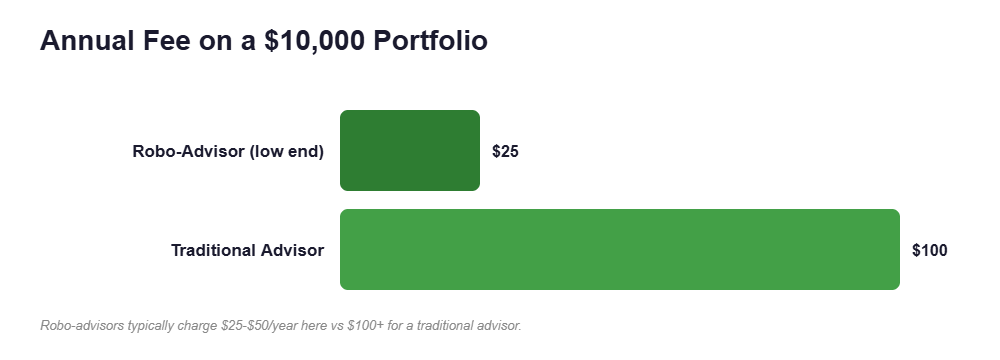
Most robo-advisors charge an annual management fee of 0.25%–0.50%. On a $10,000 portfolio, that’s $25–$50 per year — compared to $100+ annually with a traditional financial advisor who charges 1%+. Robo-advisors also typically require much lower minimums (often $0–$500) vs. the $100K+ minimums common with human advisors.
But the comparison goes deeper than fees. A traditional human advisor provides personalized financial planning — estate planning, insurance analysis, complex tax strategy, behavioral coaching during market downturns. A robo-advisor provides none of that. It’s excellent at execution. It’s not a financial therapist.
The honest take: for most people with straightforward investment goals (retirement, wealth building, college savings), a robo-advisor delivers 90% of the outcome at 10% of the cost. For people with complex situations — business ownership, significant inheritance, multiple income streams — the human advisor earns their fee.
Who Should Use a Robo-Advisor?
Robo-advisors are a great fit if you:
- Are just starting out and want low minimums
- Don’t want to think about managing investments
- Are saving for retirement and want IRA integration
- Have money sitting in a low-yield savings account and want it working harder
- Want tax-loss harvesting without paying for a human advisor
They’re less ideal if you want to hand-pick individual stocks, need highly personalized financial planning, or have a very complex tax situation that requires CPA-level strategy.
The Main Types of Robo-Advisors
Not all robo-advisors are the same. They broadly fall into a few categories:
Pure robo-advisors (Betterment, Wealthfront, Acorns) — fully automated, no human advisor option. These are the original robo-advisors and typically offer the lowest fees.
Hybrid robo-advisors (Betterment Premium, Schwab Intelligent Portfolios Premium, Personal Capital) — automated portfolio management plus access to human CFPs for questions. Fees are higher but still well below traditional advisory rates.
Brokerage-owned robo-advisors (Fidelity Go, Schwab Intelligent Portfolios, Vanguard Digital Advisor) — built by established brokerages. Often have no management fee (Fidelity Go, Schwab) but may use proprietary funds. Worth comparing expense ratios carefully.
Are Robo-Advisors Safe?
Yes — the major robo-advisors are regulated, insured, and built on solid financial infrastructure. Your investments are held at SIPC-insured brokerage accounts, protecting you up to $500,000 if the broker fails. Most also carry additional private insurance on top of the SIPC baseline.
The risk with robo-advisors isn’t the platform — it’s the market itself. They manage allocation and rebalancing; they don’t eliminate investment risk. If the market drops 30%, your portfolio drops too. No algorithm can prevent that. What the algorithm does is keep you properly allocated through the volatility instead of panic-selling at the bottom.
Common Misconceptions
“Robo-advisors guarantee returns.” No. They invest in market securities. Returns are not guaranteed and portfolios can lose value. The benefit is disciplined, diversified investing — not capital protection.
“The fees are too small to matter.” The opposite is true. A 0.25% annual fee vs. a 1% fee on a $100,000 portfolio growing at 7% annually for 30 years results in a $200,000+ difference in final balance. Fees compound negatively just as returns compound positively.
“Robo-advisors are only for small accounts.” Wrong. Wealthfront and Betterment manage accounts in the millions. Tax-loss harvesting becomes more valuable — not less — as balances grow.
The Bottom Line
If you’ve been putting off investing because it feels complicated, a robo-advisor removes almost all of the friction. You don’t need to know how to pick stocks or calculate rebalancing ratios. You just need to start — and the platform handles everything from there.
The compounding math doesn’t care whether a human or an algorithm managed your portfolio. It cares whether you started. Robo-advisors make starting easier than it’s ever been.
Ready to compare the top options? Check out our full robo-advisor reviews — or start with our breakdown of Acorns, Wealthfront, and Betterment.
Frequently Asked Questions
Can I withdraw my money from a robo-advisor at any time?
Yes. Robo-advisor accounts at reputable platforms like Betterment or Wealthfront are standard brokerage accounts. You can initiate a withdrawal at any time. Funds typically settle in 3–5 business days. The one caveat: if you’re in a taxable account, selling investments to fund a withdrawal may trigger capital gains taxes.
Do robo-advisors work for retirement accounts?
Absolutely — and this is one of their best use cases. Most major robo-advisors support Traditional IRAs, Roth IRAs, and SEP IRAs. Betterment and Wealthfront both offer IRA accounts with the same automatic rebalancing and tax-optimization features as their taxable accounts. This makes them an excellent alternative to a target-date fund inside a 401(k).
What’s the minimum amount to start?
It varies by platform. Acorns has no minimum — you can start with $5. Betterment also has no minimum. Wealthfront requires $500. Schwab Intelligent Portfolios requires $5,000. The lower the minimum, the better for absolute beginners. You can always add more over time.