Do You Need Life Insurance If You’re Already Investing?
You're building wealth through a robo-advisor or Roth IRA — so do you still need life insurance? The answer depends on a few key factors most financial sites gloss over.
You’ve got a Roth IRA, a robo-advisor account, maybe a brokerage portfolio on the side. You’re doing the right things. So when someone brings up life insurance, a reasonable question pops up: isn’t my portfolio basically doing the same job?
This is one of the most common — and understandable — misunderstandings in personal finance. Your investments and your life insurance serve related but fundamentally different purposes. Understanding the difference can save your family from a financial disaster that your portfolio alone couldn’t prevent.
KatchingStacks is reader-supported. When you purchase a policy through links on this page, we may earn a commission at no extra cost to you. See our affiliate disclosure and editorial policy.
What Term Life Insurance Actually Is
Term life insurance is simple: you pay a monthly or annual premium, and if you die during the policy term (typically 10, 20, or 30 years), your beneficiaries receive a tax-free lump sum called the death benefit. That’s it. No investment component, no cash value, no complexity.
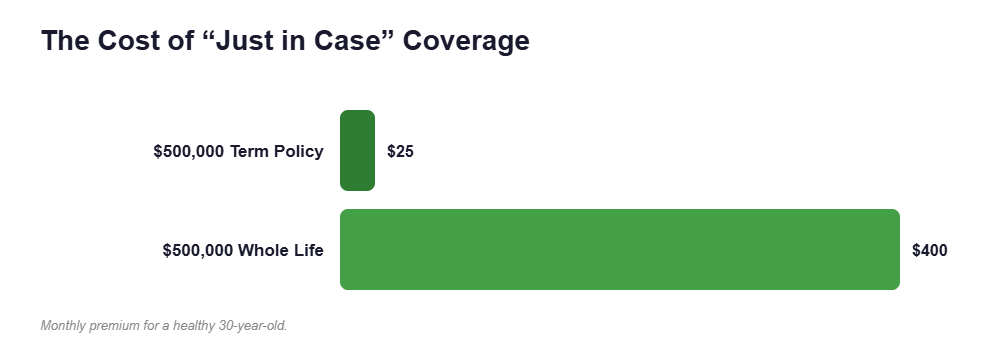
A healthy 30-year-old can get a 20-year, $500,000 term policy for roughly $20–30 per month. That’s the cost of a couple of streaming subscriptions to protect your family’s financial future for two decades.
What Your Investments Actually Protect Against
Your investment portfolio is doing something valuable — building wealth over time through compounding returns. A robo-advisor like Betterment or Wealthfront is excellent at growing money you don’t need for 10–30 years.
But here’s what your portfolio can’t do: it can’t replace your income the day after you die. If you have $80,000 in your Roth IRA and you pass away tomorrow, that $80,000 goes to your beneficiary — but it doesn’t replace the $75,000/year salary you were earning, the mortgage payments you were making, or the childcare costs your partner now faces alone.
Your portfolio protects your future self. Life insurance protects the people who depend on your present income.
Why Investors Still Need Life Insurance
Income Replacement
The primary purpose of life insurance is income replacement. Your family doesn’t just lose you — they lose years of future earnings. A $1,000,000 death benefit invested conservatively can generate roughly $40,000/year indefinitely. For many families, that’s the difference between staying in their home and making a devastating financial pivot during an already devastating time.
Debt Coverage
If you have a mortgage, car loans, student loans, or other debt, those obligations don’t disappear when you do. Life insurance ensures your family isn’t forced to liquidate assets or take on debt to cover what you owe.
Protecting Dependents During the Accumulation Phase
Most people reading this are in the wealth-building phase — still growing their portfolio, not yet living off it. During this phase, your family is most vulnerable. If your portfolio is $50,000 and your annual income is $90,000, your portfolio represents less than seven months of income. Life insurance bridges the gap between where your portfolio is now and where it needs to be to sustain your family without you.
Tax-Free Death Benefit
Life insurance death benefits are generally income-tax-free to beneficiaries. Retirement account withdrawals, by contrast, can be taxable depending on account type. This makes life insurance uniquely efficient as a financial safety net.
When You Might Not Need Life Insurance
There are legitimate scenarios where life insurance is less critical:
- No financial dependents: If no one depends on your income — no children, no non-working spouse, no one you’re financially supporting — the income replacement argument doesn’t apply.
- High net worth with liquid assets: If your portfolio is already large enough to generate income that covers your family’s needs without you, you may be “self-insured.” This is rare for people under 50, but it does happen.
- Single with no debt: If you’re single, debt-free, and have no dependents, term life insurance is less urgent — though it’s worth considering as a low-cost hedge if that situation changes.
How Much Life Insurance Do You Need?
The most common rule of thumb is 10–12 times your annual income. If you earn $75,000/year, you’d want $750,000 to $900,000 in coverage. This gives your family enough to invest conservatively and replace your income indefinitely.
A more precise calculation adds:
- Outstanding debts (mortgage balance, loans)
- Future education costs for children
- Final expenses (funeral, estate settlement: typically $15,000–25,000)
- Minus existing liquid assets and any other life insurance
For a deeper look, see our guide: How Much Life Insurance Do You Need?
The Right Way to Think About It
Think of investing and life insurance as two separate financial tools, each solving a different problem. Investing builds wealth for your future self. Life insurance protects your family if there is no future self to show up for. Both are necessary during the accumulation phase of wealth-building. The good news: term life insurance is cheap enough that you can afford both without meaningfully slowing your investment contributions.
Frequently Asked Questions
Does life insurance count as an investment?
Term life insurance is not an investment — it has no cash value and pays out only if you die during the term. Whole life and universal life policies have an investment/savings component, but most financial planners recommend term life for pure income protection and investing separately through low-cost index funds or a robo-advisor.
If I max out my Roth IRA every year, do I still need life insurance?
Yes, for most people. A maxed Roth IRA ($7,000/year in 2026) builds roughly $285,000 over 20 years at 7% average annual returns — which is meaningful but unlikely to fully replace your income for a surviving spouse or children. Life insurance fills the gap between where your portfolio is today and the financial security your family needs.
What type of life insurance is best for investors?
Term life insurance is almost always the right answer for investors. It’s the most cost-effective form of coverage, and the premium savings versus whole life can be invested separately — a strategy known as ‘buy term and invest the difference.’ For most wealth-building investors, term + a robo-advisor beats whole life on both protection and growth.
At what age does life insurance become less important?
Life insurance becomes less critical as your net worth grows and dependents age out of financial reliance on you. Many people reach a point in their 50s or 60s where their portfolio is large enough to self-insure. Until that point — especially if you have a mortgage, young children, or a non-working partner — life insurance is essential.
How does life insurance interact with my estate plan?
Life insurance proceeds pass directly to your named beneficiary, bypassing probate and often avoiding estate taxes. This makes it one of the most efficient estate planning tools available. For investors building wealth, naming the right beneficiary on your life insurance policy is as important as naming the right beneficiary on your IRA.
Already investing and want to compare robo-advisor options too? See our Best Robo-Advisors 2026 comparison for the full lineup.