Best Robo-Advisors of 2026: Ranked and Reviewed
The six best robo-advisors of 2026 ranked by fees, minimums, tax efficiency, and who each one is actually built for.
KatchingStacks is reader-supported. When you open an account through links on this page, we may earn a commission at no extra cost to you. See our affiliate disclosure and editorial policy.
Robo-advisors invest your money automatically in diversified ETF portfolios — no stock picking, no guesswork, no financial advisor meetings. They’ve become the default starting point for millions of investors who want to build wealth without managing it themselves.
But they’re not all the same. Some are better for beginners. Some are better for tax efficiency. Some let you customize; others don’t. Here’s how the top options compare in 2026.
A note on methodology: this ranking weighs the full picture — fees at every balance tier, tax efficiency, customization, and human-advisor access — rather than optimizing for any one investor profile. If you’re brand new to investing and want the simplest, lowest-cost starting point specifically, see our Best Robo-Advisors for Beginners in 2026 ranking. If you’re also comparing robo-advisors against other investing apps, see Best Investment Apps for Beginners 2026. Rankings can differ slightly between these guides because each one is answering a different question.
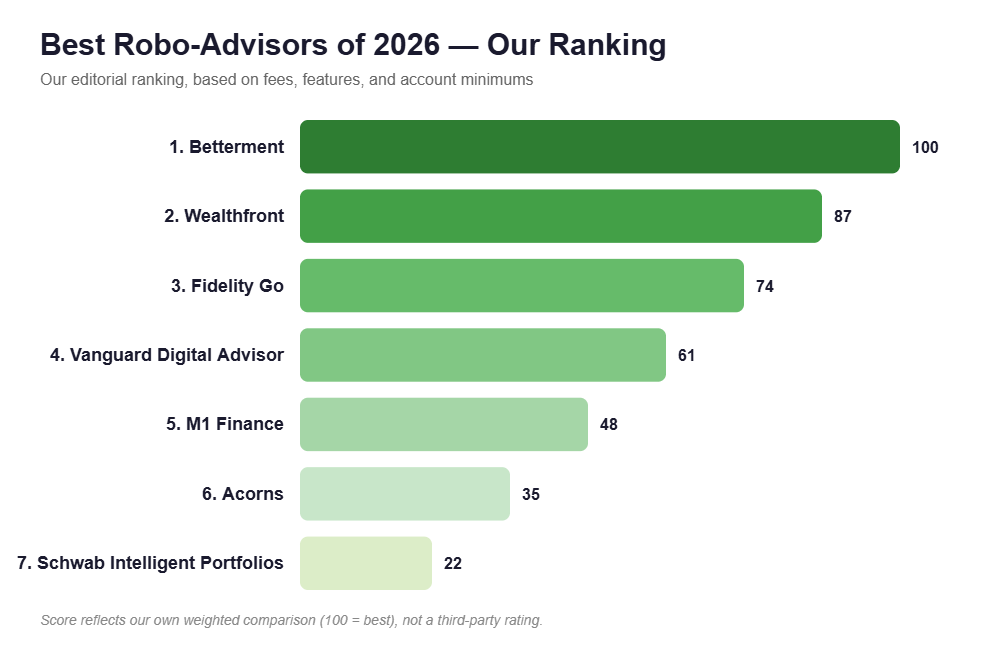
Why this order differs from our other lists: this ranking covers the widest range of investors and weighs cost, features and tax tools most heavily. Our beginner ranking instead favors low minimums and habit-building features (which is why Acorns ranks higher there), and our investment apps roundup also includes brokerages. Different audiences, different orders.
The Best Robo-Advisors of 2026
- Betterment — Best overall for most investors
- Wealthfront — Best for tax efficiency ($100K+ taxable accounts)
- Fidelity Go — Best for keeping costs at zero
- Vanguard Digital Advisor — Best for low-cost, long-term index investing
- M1 Finance — Best for investors who want portfolio control
- Acorns — Best for spare-change micro-investing
Quick Comparison Table
| Platform | Annual Fee | Minimum | Tax-Loss Harvesting | Human Advisors |
|---|---|---|---|---|
| Betterment | 0.25% (or $5/mo under $24K) | $0 | Yes | Yes (Premium) |
| Wealthfront | 0.25% | $500 | Yes + Direct Indexing | No |
| Fidelity Go | 0% under $25K; 0.35% above | $0 | No | Yes (coaching) |
| Vanguard Digital | ~0.20% | $100 | No | Yes |
| M1 Finance | $3/mo (free at $10K+) | $100 | No | No |
| Acorns | $4/mo | $0 | No | No |
1. Betterment — Best Overall
Betterment is the largest independent robo-advisor for a reason. It hits every major checkbox: no minimum to start, automated tax-loss harvesting on all taxable accounts, a high-yield cash account (4.75% APY), goal-based planning tools, and optional access to Certified Financial Planners through its Premium plan.
The 0.25% fee is competitive, and the flat $5/month option (for balances under $24,000) makes it affordable for small accounts. It’s the best all-around choice for investors who want a fully automated, thoughtfully designed platform without having to think about what to buy.
Best for: Most investors — especially beginners who want automation with real tax efficiency built in.
Read our full Betterment review.
2. Wealthfront — Best for Tax Efficiency
Wealthfront edges out Betterment on tax efficiency, particularly for high earners with large taxable accounts. Its standard tax-loss harvesting is comparable to Betterment’s — but its direct indexing feature (available at $100K+) is a genuine differentiator.
Direct indexing means Wealthfront buys the individual stocks in an index instead of a single ETF. This creates far more tax-loss harvesting opportunities — Wealthfront estimates 1.8% in additional after-tax returns annually vs 0.77% from ETF-level harvesting. On a $200K portfolio, that difference compounds into tens of thousands of dollars over a decade.
The $500 minimum is a minor downside. No human advisors at any price tier.
Best for: Investors with $100K+ in a taxable account who want maximum tax efficiency.
See how it stacks up in our Betterment vs Wealthfront comparison.
3. Fidelity Go — Best for Zero Fees
Fidelity Go is genuinely free for accounts under $25,000 — no management fee, no expense ratios on its proprietary Flex funds. Above $25K it charges 0.35%, which is slightly higher than Betterment and Wealthfront.
The platform is simple and clean. You get automatic rebalancing, a straightforward risk questionnaire, and access to Fidelity’s robust customer support and branch network. No tax-loss harvesting, but for a $0-fee account, that’s an easy tradeoff for most beginners.
Best for: Cost-conscious investors under $25K who want zero fees and the backing of a major brokerage.
4. Vanguard Digital Advisor — Best for Low-Cost Index Investing
Vanguard invented index investing and its Digital Advisor reflects that heritage. You get a diversified portfolio of Vanguard’s legendary low-cost ETFs (Total Stock Market, Total Bond Market, etc.) at an all-in cost of around 0.20% — lower than Betterment or Wealthfront.
The tradeoff is a less polished experience. The interface is functional but dated. No tax-loss harvesting, limited goal tracking, and the $100 minimum is low but the product feels designed for existing Vanguard clients rather than new investors.
Best for: Existing Vanguard customers and cost-focused long-term investors who want the lowest possible expense ratios.
5. M1 Finance — Best for Portfolio Control
M1 Finance isn’t a traditional robo-advisor — it’s closer to a self-directed broker with automation built in. Its “Pie” system lets you build a custom portfolio of any stocks and ETFs you choose, then automates buying and rebalancing to maintain your target allocations.
The $3/month fee disappears entirely at $10K+, making it free for most serious investors. Its margin borrowing rate (~4.4%) is among the lowest available for retail investors. The main downsides: no automated tax-loss harvesting and more setup work than a pure robo-advisor.
Best for: Investors who want to hold individual stocks or build a custom portfolio with automated execution and zero fees at scale.
See our full M1 Finance vs Betterment comparison.
6. Acorns — Best for Micro-Investing
Acorns takes a unique approach: it rounds up your everyday purchases to the nearest dollar and invests the spare change automatically. Spend $3.40 on coffee, and $0.60 goes into your investment account. It’s frictionless saving for people who struggle to invest consistently.
The $4/month fee is expensive as a percentage on small balances — on $500, that’s 9.6%/year. But if Round-Ups keep you investing when you otherwise wouldn’t, the behavioral benefit outweighs the cost. Acorns also offers a 3% IRA match for Gold subscribers, one of the best retirement match rates outside of employer plans.
Best for: Beginners who struggle to save consistently and want investing on autopilot from day one.
See how Acorns compares head-to-head in our Acorns vs Betterment comparison and Acorns vs Wealthfront vs Betterment three-way breakdown.
7. Schwab Intelligent Portfolios — Best for $0 Fees at Scale
Charles Schwab charges no management fee at all on its robo-advisor — genuinely $0, not a promotional rate. The tradeoff is a mandatory cash allocation (6–29% of your portfolio, depending on risk level) that earns interest for Schwab rather than being invested in the market. For larger, more aggressive portfolios, the math still favors Schwab over a 0.25% competitor. For smaller or more conservative accounts, the cash drag can cost more than you’d save.
The $5,000 minimum is a real barrier for beginners, and tax-loss harvesting doesn’t kick in until $50,000. But if you already bank with Schwab or you’re investing $25,000+, Intelligent Portfolios is one of the few genuinely free options in the category.
Read our full Schwab Intelligent Portfolios review for the complete cash-drag math.
How to Choose the Right Robo-Advisor
The right choice depends on where you are financially and what you want from your portfolio.
If you’re just starting out with under $500, Betterment or Fidelity Go are the clear answers — no minimum, no guesswork, automated from the start. If you have $10K+ and want to pay zero management fees with the ability to customize, M1 Finance makes a strong case. If you have $100K+ in a taxable account, Wealthfront’s direct indexing is worth the $500 minimum and the lack of human advisors.
All six platforms here are legitimate, safe options. The differences come down to fees at your specific balance, how much control you want, and whether tax efficiency or human access matters more to you.
Once you’ve chosen a robo-advisor and started building wealth, consider whether your financial plan includes adequate protection. For most investors with dependents, a term life insurance policy is an essential — and affordable — complement to a robo-advisor strategy. Learn more: Do You Need Life Insurance If You’re Already Investing?