How Much Life Insurance Do You Need? A Guide for Investors

The 10x income rule is a starting point, not the answer. Here's how to calculate the right amount of life insurance coverage for your actual financial situation.
Most people who think about life insurance get stuck at the same question: how much is enough? The standard advice — “10 times your income” — is a reasonable starting point, but it leaves out critical variables that can mean the difference between your family being financially secure and coming up short.
This guide walks through a more precise method, calibrated for people who are actively investing and building wealth.
KatchingStacks is reader-supported. When you purchase a policy through links on this page, we may earn a commission at no extra cost to you. See our affiliate disclosure and editorial policy.
Why the 10x Rule Is Just a Starting Point
The “10 times your annual income” rule is designed to give your beneficiaries enough capital to invest and replace your income indefinitely. At a 4% safe withdrawal rate, $1 million generates $40,000/year. For a $100,000 earner, $1 million (10x) replaces their income conservatively.
But this rule doesn’t account for:
- Your outstanding mortgage balance
- Other debts (student loans, car loans, personal debt)
- Number and ages of your children
- Anticipated education costs
- Your existing savings and investments
- Whether your spouse also earns income
Two people earning the same income can have wildly different insurance needs based on these variables.
The DIME Method: A More Precise Formula
A better framework is the DIME method, which accounts for the four key financial obligations most families have:
- D — Debt: Add up all outstanding debts: mortgage balance, car loans, student loans, credit cards, any other liabilities your family would inherit.
- I — Income: Multiply your annual income by the number of years your family will need support. If you have a 10-year-old child, that might be 15 years until they’re financially independent.
- M — Mortgage: Your mortgage balance if not already counted in Debt above.
- E — Education: Estimated cost of college for each child. Current average 4-year cost at a public university: ~$110,000; private: ~$230,000.
Add those four numbers together, then subtract your existing savings and investments (what your family would inherit immediately). The result is your target coverage amount.
A Real-World Example
Consider a 34-year-old earning $90,000/year with:
- Mortgage balance: $280,000
- Car loan: $18,000
- Student loans: $22,000
- Two children, ages 5 and 7
- Estimated education costs: $220,000 (two kids, public university)
- Current savings/investments: $65,000
DIME calculation:
- Debt: $280,000 + $18,000 + $22,000 = $320,000
- Income: $90,000 × 18 years = $1,620,000
- Mortgage: already counted
- Education: $220,000
- Total: $2,160,000
- Minus existing assets: −$65,000
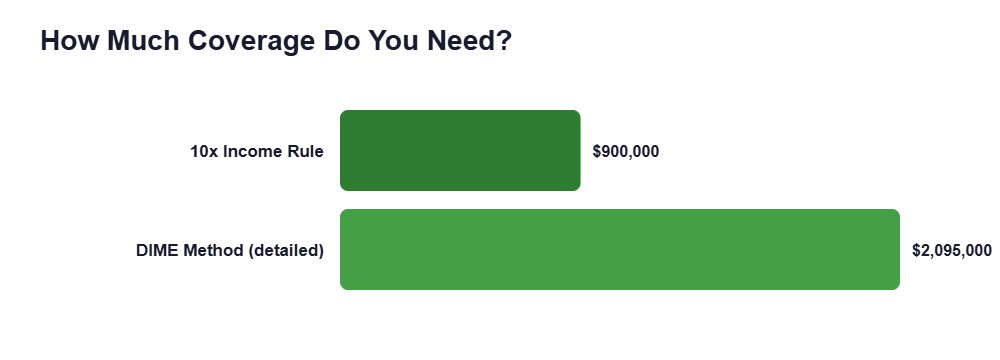
- Target coverage: ~$2,095,000
The 10x rule would suggest $900,000. The DIME method suggests over $2 million. That gap is why the simple rule can leave families underinsured.
How Your Investment Portfolio Factors In
Your existing investments reduce the coverage you need. A portfolio of $200,000 at a 4% safe withdrawal rate generates $8,000/year — which reduces the income replacement portion of your insurance need proportionally.
This is one of the reasons life insurance needs naturally decrease as wealth grows. An investor with $800,000 saved has a built-in financial cushion that someone with $20,000 does not. Review and adjust your coverage as your portfolio grows — you may be able to reduce coverage (and premiums) over time as your self-insurance capacity increases.
Dual-Income Households
If both partners earn income, each needs separate coverage. Calculate coverage for each person based on their own income and the obligations that would fall entirely on the other if they passed away. In many dual-income households, each partner needs less coverage than a sole breadwinner in the same income bracket — but both still need meaningful protection.
Don’t Forget Final Expenses
Funeral and burial costs average $7,000–$12,000. Estate settlement, legal fees, and other end-of-life costs can add another $5,000–$15,000. Adding $20,000–$25,000 to your target coverage amount ensures your family isn’t cash-strapped during an already difficult time.
Reviewing Your Coverage Over Time
Life insurance isn’t a set-it-and-forget-it decision. Your needs change as your life changes. Review your coverage after:
- Marriage or divorce
- The birth or adoption of a child
- Buying or paying off a home
- A significant income change
- Reaching a major investment milestone (e.g., portfolio crosses $500K, $1M)
Many people find they need more coverage in their 30s than in their 20s (more obligations) and less in their 50s (portfolio has grown, obligations shrinking). An annual review of 10 minutes is enough to catch when your coverage is out of step with your situation.
Frequently Asked Questions
Is $500,000 in life insurance enough?
$500,000 is enough for some situations and woefully inadequate for others. For a single person with no dependents, it’s generous. For a parent of two young children with a $350,000 mortgage, it may replace only 5–6 years of income. Use the DIME method above to calculate your actual need rather than anchoring on a round number.
Should I count my 401(k) as part of my life insurance calculation?
Your 401(k) and other investment accounts reduce your insurance need, but with a caveat: retirement accounts have restrictions on early withdrawal and are designed for long-term growth. When calculating how much life insurance you need, credit your investable assets — but be conservative about how much your family could realistically access and live on immediately after your death.
Do I need more coverage if I’m the only income earner?
Yes, significantly more. Sole breadwinners need to replace 100% of household income rather than one of two income streams. If your spouse would need to re-enter the workforce, also factor in transition costs — job training, childcare during that period, and the time it takes to reach earning capacity.
Can I have multiple life insurance policies?
Yes, and it’s common. You might have a base policy covering your core income replacement need and a smaller policy specifically for your mortgage. Or employer-provided group life insurance (typically 1–2x salary) supplemented by a personal term policy. Having multiple policies is perfectly legal and can make coverage more flexible.
What if I can’t afford the full coverage I need?
Some coverage is always better than none. If the premium for your ideal coverage amount is a budget stretch, start with what you can afford — even a $500,000 policy is meaningful protection. Many insurers allow you to increase coverage later, though you’ll need to re-qualify medically. Locking in what you can afford now while you’re young and healthy is better than waiting for the ‘perfect’ amount.
Already investing and want to compare robo-advisor options too? See our Best Robo-Advisors 2026 comparison for the full lineup.
The Coverage Gap Nobody Talks About: Stay-at-Home Parents
The DIME method above works well when you’re calculating coverage for the household’s primary earner. It breaks down when applied to a stay-at-home parent, because “income” isn’t the obligation that disappears — labor is. And replacing that labor costs real money.
If a stay-at-home parent dies or becomes unable to work, the surviving parent typically needs to pay for what that parent was doing for free: childcare, household management, and often reduced work hours to cover the gap. A rough replacement-cost estimate for a family with two young children:
| Replacement need | Estimated annual cost |
|---|---|
| Full-time childcare (2 children) | $24,000-$36,000 |
| Housekeeping / household management | $5,000-$10,000 |
| Reduced work hours / lost income for surviving parent | Varies widely |
Multiply the childcare and housekeeping estimate by the number of years until the youngest child is in school full-time (or old enough to need less supervision), and you’ll typically land on a coverage need of $200,000-$500,000 for a stay-at-home parent — even though that parent has no salary to plug into the DIME formula’s Income component. Many families insure only the earning spouse and leave the stay-at-home parent completely uncovered, which is one of the more common and expensive gaps in household financial planning.
My Honest Take
I get why this gap exists — it’s counterintuitive to buy a policy on someone with a $0 salary. But I’ve seen the aftermath of this specific oversight, and it’s ugly: a surviving parent forced to choose between an expensive childcare bill and cutting their own work hours right when they can least afford to. If your household has a stay-at-home parent, a modest term policy on that parent (often surprisingly cheap, since term rates are driven by health and age, not income) closes a gap that the standard 10x-income or even DIME framework will otherwise miss entirely.