Is Whole Life Insurance a Good Investment?

Insurance agents pitch whole life as an investment. Financial advisors usually disagree. Here's an honest breakdown of what whole life actually delivers — and when it might make sense.
Few financial products generate more debate than whole life insurance. On one side, insurance agents tout it as a tax-advantaged, guaranteed-growth investment that also provides a death benefit. On the other, fee-only financial advisors and personal finance educators criticize it as overpriced, underperforming, and commission-laden.
Both sides have points worth understanding. Here’s an honest, numbers-driven look at whether whole life insurance belongs in an investor’s portfolio.
KatchingStacks is reader-supported. When you purchase a policy through links on this page, we may earn a commission at no extra cost to you. See our affiliate disclosure and editorial policy.
How Whole Life Insurance Works as an “Investment”
Whole life policies build cash value over time. A portion of each premium payment goes toward the death benefit cost, insurance company expenses, and agent commissions — with the remainder credited to a cash value account that grows at a guaranteed rate, typically 2–4% annually.
This cash value grows tax-deferred, can be borrowed against tax-free (as a policy loan), and can be withdrawn (with potential tax consequences depending on the amount). Policyholders at mutual companies like New York Life and Northwestern Mutual may also receive dividends — a portion of the company’s profits — which can be used to purchase additional coverage or reduce premiums.
Those features sound appealing in the abstract. The challenge is the cost structure.
The Cost Problem
Whole life premiums are typically 10–15 times higher than term life for the same death benefit. A significant portion of early premiums goes toward agent commissions — often 50–100% of the first year’s premium — and administrative costs. This means cash value builds slowly in the early years; many policies take 10–15 years to accumulate cash value equal to total premiums paid.
The guaranteed growth rate of 2–4% compares unfavorably to long-term historical stock market returns of approximately 7–10% annually (after inflation: ~5–7%). Over a 30-year horizon, this difference compounds dramatically.
Buy Term and Invest the Difference: The Math
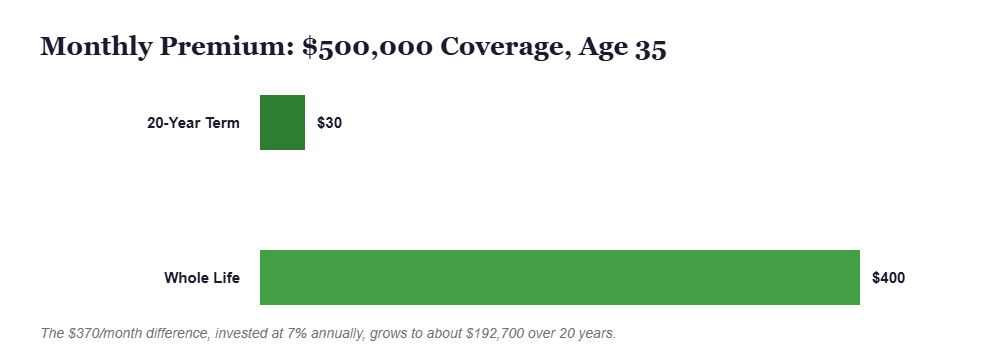
Consider a 35-year-old buying $500,000 in coverage:
- Whole life premium: ~$400/month ($4,800/year)
- Term life (20-year) premium: ~$30/month ($360/year)
- Difference: $370/month ($4,440/year)
If the $370/month difference is invested in a robo-advisor earning 7% annually over 20 years, it grows to approximately $228,000 — far exceeding most whole life cash value accumulation over the same period, and far exceeding the investment returns of the whole life policy’s savings component.
This is the mathematical foundation of “buy term and invest the difference” — and it’s why most fee-only financial advisors (who are not compensated by insurance commissions) recommend term life for the vast majority of clients.
Where Whole Life Legitimately Adds Value
Despite the math favoring term for most investors, whole life serves genuine planning needs in specific circumstances:
Estate Planning for High-Net-Worth Individuals
Estates above the federal exemption ($13.6 million per individual in 2026) may face estate taxes. A whole life policy held in an irrevocable life insurance trust (ILIT) can provide liquidity to pay estate taxes without forcing heirs to liquidate assets. This is a legitimate, common use of whole life that has nothing to do with investment returns.
Guaranteed Insurability
Whole life locks in coverage permanently. If you develop health conditions that would make you uninsurable, your whole life policy continues as long as premiums are paid. This insurance against future uninsurability has real value for some people.
Supplemental Tax-Deferred Savings After Maxing Other Accounts
For very high earners who’ve maxed their 401(k), Roth IRA, HSA, and other tax-advantaged accounts, whole life’s tax-deferred cash value accumulation offers another vehicle for tax-sheltered growth. This applies to a small percentage of earners.
The Verdict for Investors
For the typical investor in their 30s–40s who is building wealth through a robo-advisor, retirement accounts, and regular investing: term life is the right choice. The premium savings can be redirected into investments that will almost certainly outperform whole life cash value over any meaningful time horizon.
Whole life makes sense for specific estate planning scenarios, guaranteed insurability needs, and supplemental savings for very high earners. For everyone else, the combination of term life and disciplined investing is a more efficient path to financial security.
Frequently Asked Questions
What is the return on investment for whole life insurance?
The internal rate of return on whole life insurance cash value is typically 2–4% in guaranteed growth. When factoring in dividends from mutual insurers, returns may reach 4–6% — but these dividends are not guaranteed. By comparison, a diversified stock portfolio has historically returned 7–10% annually. Whole life underperforms broad market investing over long time horizons for most policyholders.
Can I use whole life insurance as a retirement savings vehicle?
Some advisors market whole life as a ‘bank on yourself’ or retirement savings strategy. While the tax-deferred growth and tax-free loan provisions have merit, the high premium costs and lower growth rates make it inferior to maxing tax-advantaged retirement accounts first. Only consider whole life for retirement savings after fully funding a 401(k), IRA, and HSA.
Is the cash value of whole life insurance taxable?
Cash value grows tax-deferred inside the policy. Policy loans are generally tax-free. Withdrawals up to your cost basis (premiums paid) are tax-free; withdrawals above that are taxable as ordinary income. If the policy lapses with an outstanding loan, the loan amount may become taxable income. Death benefits are generally income-tax-free to beneficiaries.
What happens to whole life cash value when you die?
In most whole life policies, the insurance company keeps the cash value and pays only the death benefit. The cash value is not paid in addition to the death benefit — it’s used to fund the guaranteed death benefit. Some policies offer an ‘increasing death benefit’ option where the cash value is added to the base death benefit, but this typically costs more in premiums.
Should I surrender my whole life policy?
This depends on how long you’ve held the policy, its current cash value, and your current needs. Surrendering a policy in its early years typically results in a loss, as surrender charges and low early cash value mean you may receive less than you’ve paid in. If you’ve held the policy 10+ years and the cash value has grown meaningfully, a financial advisor can model whether surrendering and reinvesting makes sense for your situation.
Already investing and want to compare robo-advisor options too? See our Best Robo-Advisors 2026 comparison for the full lineup.
Why the Break-Even Point Takes So Long
The “10-15 years to break even” figure mentioned above isn’t a random number — it’s a direct result of how whole life premiums are structured. In year one, a large share of your premium (often 50-100% of it) goes straight to the agent’s commission before a dollar touches your cash value. Years two and three still carry meaningful commission and administrative load, just smaller. It isn’t until the policy is roughly a decade old that the commission drag becomes a small enough share of each premium for cash value to start compounding at something close to its stated guaranteed rate.
This is structurally different from investing in a robo-advisor, where roughly 100% of your contribution is invested from day one and the expense ratio is a fraction of a percent rather than a multi-year commission. The “cost” of whole life isn’t the 2-4% guaranteed rate itself — it’s everything that happens before that rate starts working for you.
My Honest Take
I don’t think whole life insurance is a scam, and I don’t think the agents selling it are lying to people. I think it’s a product with a genuinely narrow use case that gets marketed to a much broader audience than it should, because the commission on a whole life policy dwarfs the commission on a term policy for the same coverage — sometimes by 10x or more. That commission structure is exactly why you’ll rarely meet an insurance agent who leads with term life, even when term is mathematically the better fit for the person sitting across from them.
If someone is pitching you whole life as a way to “beat the market safely” or as your primary retirement vehicle, and you haven’t already maxed a 401(k), Roth IRA, and HSA, that’s worth pushing back on. If they’re pitching it for estate planning or guaranteed insurability and those genuinely apply to your situation, that’s a different conversation entirely.