Ellevest Review 2026: What Happened, and Where to Go Instead

Ellevest builds portfolios around the realities of women's financial lives. Here's how it works and whether the approach matters for your money.
KatchingStacks is reader-supported. When you open an account through links on this page, we may earn a commission at no extra cost to you. See our affiliate disclosure and editorial policy.
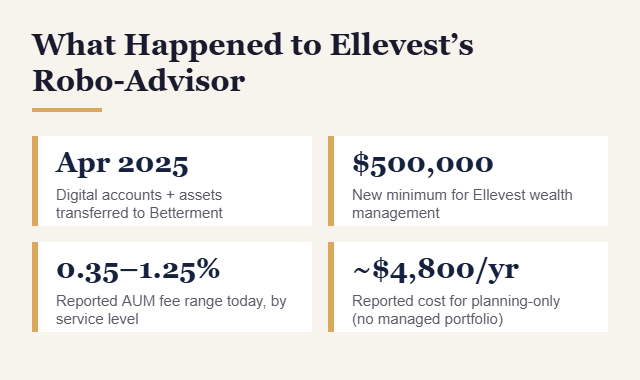
Update (September 2026): Ellevest no longer offers the retail robo-advisor this review used to cover. In April 2025, Ellevest exited the automated-investing business entirely and transferred its digital investing accounts and assets to Betterment. Ellevest now serves only clients with at least $500,000 in investable assets, through traditional wealth management and financial planning — not the low-minimum, algorithm-driven product that made it popular with beginner investors. We’re keeping this page up because people still search for “Ellevest review,” but the honest answer for most readers is: this isn’t the product you’re looking for anymore, and we explain what to do instead below.
What Happened to Ellevest’s Robo-Advisor
Ellevest launched in 2016 with a specific pitch: build a robo-advisor around the way women’s financial lives actually look — longer lifespans, career breaks, and a persistent pay gap — rather than reusing a generic risk questionnaire built around a default (often male) earning and longevity curve. For years it ran a low-minimum digital investing product alongside its wealth management arm.
That changed on February 26, 2025, when Ellevest announced it was exiting the automated-investing business. CEO Sylvia Kwan said the company was refocusing on its “growing wealth management and financial planning business,” and that Betterment was “the natural home” for its digital-first clients. The transfer of accounts and assets to Betterment took effect around April 17, 2025; existing clients could opt out if they didn’t want their account moved.
Technology, employees, and day-to-day operations were not part of the deal — only the robo-advisory client accounts and assets under management moved to Betterment.
What This Means If You’re an Existing (or Former) Ellevest Client
If you opened a digital Ellevest account before spring 2025 and didn’t opt out, your account is very likely at Betterment now, not Ellevest. Log into Betterment directly to check your holdings, and confirm your cost basis and tax lots carried over correctly if you plan to sell anything. If you did opt out, or you’re not sure what happened to an old account, Ellevest’s support team can look up your specific situation — we can’t do that for you here.
One question we get a lot: is the Ellevest-to-Betterment transfer a taxable event? Transfers like this are typically structured as in-kind moves between custodians — your existing holdings move over without being sold, which generally avoids triggering capital gains. That said, tax treatment can depend on your specific account type and situation, so it’s worth confirming with Betterment or a tax professional rather than assuming, especially if any part of your account required liquidation instead of an in-kind transfer.
What Ellevest Is Today
Ellevest now operates exclusively as a wealth management and financial planning firm for high-net-worth clients:
- Minimum: $500,000 in investable assets
- Fees: Reported in the range of roughly 0.35%–1.25% of assets under management annually, depending on the service level and portfolio complexity
- Planning-only option: Financial planning without a managed portfolio has been reported around $4,800/year, for clients who want advice without moving their assets
- Focus: Comprehensive wealth management — tax strategy, estate planning coordination, and dedicated advisor access — rather than a self-serve app
If you have $500,000 or more and want the gender-lens financial planning approach Ellevest pioneered, delivered through a human advisory relationship rather than an app, it’s worth a conversation with their team directly. That’s a genuinely different product from the one this page originally reviewed, aimed at a different investor entirely.
If You Wanted the Original Ellevest, Here’s Where to Go
Most people who land on this page are looking for what Ellevest used to be: a low-minimum, algorithm-driven robo-advisor. Here’s how to think about your options now:
- Betterment is the most direct successor — it’s literally where Ellevest’s digital accounts went. See our full Betterment review for current fees and features. Note that Betterment’s own fee structure is tiered ($5/month under $24,000 without recurring deposits, or 0.25%/year above that), so it’s not identical to what Ellevest charged.
- Wealthfront is another low-minimum option with a straightforward flat 0.25%/year fee at any balance — see our Wealthfront review.
- Fidelity Go is free under $25,000, which may suit someone just starting out — see our Fidelity Go review.
None of these build a portfolio around gender-specific longevity and earnings assumptions the way Ellevest’s original algorithm did — that specific approach isn’t available in a low-minimum robo-advisor product anymore, as far as we’ve found. If that gender-aware methodology was the whole reason you wanted Ellevest, the honest answer is that the market doesn’t currently have a direct replacement at a low minimum.
Frequently Asked Questions About Ellevest
Can I still open a low-minimum Ellevest investing account?
No. Ellevest exited the retail robo-advisor business in April 2025 and transferred existing digital accounts to Betterment. Ellevest now only accepts wealth management clients with at least $500,000 in investable assets.
What happened to my money if I had an Ellevest account?
If you didn’t opt out of the transfer, your account and assets were moved to Betterment around April 17, 2025. Log into Betterment to view your holdings, or contact Ellevest support if you’re unsure what happened to your specific account.
Does Betterment use the same gender-aware investing approach as Ellevest did?
No. Betterment received Ellevest’s robo-advisory accounts and assets, not its investment methodology or technology. Betterment uses its own standard goal-based investing approach for all clients.
What does Ellevest cost now?
Ellevest’s current wealth management service is reported to charge roughly 0.35%–1.25% of assets under management annually depending on service level, with a $500,000 minimum. A planning-only option without a managed portfolio has been reported around $4,800/year. Contact Ellevest directly for current pricing, since it can vary by client situation.
My Honest Take
Ellevest’s exit says less about the merits of gender-aware investing and more about the economics of running a low-minimum robo-advisor. Digital investing platforms make money on scale, and margins on small accounts are thin — several robo-advisors have consolidated or shut down retail products over the past few years for the same reason, not because the underlying idea was wrong. If you came to Ellevest specifically because you wanted a platform built around women’s longer lifespans and different earning curves, that’s a legitimate gap in the market right now — none of the mainstream low-minimum robo-advisors build that assumption into their algorithm by default. The practical move today is picking the best generic low-cost robo-advisor for your balance and fee preference, then adjusting your own goals and time horizon manually to account for those factors, since you won’t get that built in automatically at a $0–$500k account size anymore.
The Bottom Line
Ellevest’s original thesis — that a robo-advisor built around women’s actual financial lives beats a one-size-fits-all algorithm — was a genuinely interesting idea, and this page used to make the case for it. That product doesn’t exist anymore. If you have $500,000+ and want Ellevest’s planning philosophy delivered by human advisors, it’s worth a conversation with their current team. If you’re looking for a low-minimum, low-cost automated investing account, Betterment or Wealthfront are the more relevant reviews on this site today.