Acorns Review 2026: Is the Spare Change App Still Worth It?
Acorns makes investing effortless with its Round-Ups feature — but the flat monthly fee can eat into small accounts. Here's our full Acorns review for 2026.
Acorns is the robo-advisor built for people who struggle to save in the first place. Its signature feature — Round-Ups — rounds up your everyday purchases to the nearest dollar and automatically invests the spare change. Buy a $3.75 coffee and Acorns invests $0.25. It’s not glamorous, but it’s one of the most effective behavioral tricks in personal finance: it makes investing invisible.
KatchingStacks is reader-supported. When you open an account through links on this page, we may earn a commission at no extra cost to you. See our affiliate disclosure and editorial policy.
What Is Acorns?
Acorns launched in 2014 with a single mission: remove every possible barrier to investing. No minimums, no complex decisions, no spreadsheets. Just link your debit or credit card, choose a risk level (Conservative to Aggressive), and Acorns does the rest.
Today Acorns has grown into a full financial ecosystem. Beyond the core investment account (Acorns Invest), it offers Acorns Later (IRA), Acorns Checking (a debit account with Round-Ups built in), and Acorns Early (investment accounts for kids). The whole suite is bundled into a flat monthly subscription rather than a percentage-based fee.
Acorns Pricing in 2026
- Bronze — $4/month: Acorns Invest + Acorns Later (IRA)
- Silver — $8/month: Everything in Bronze + Acorns Checking + a matching 25% on contributions up to $200/month
- Gold — $12/month: Everything in Silver + Acorns Early (kids’ accounts) + premium perks
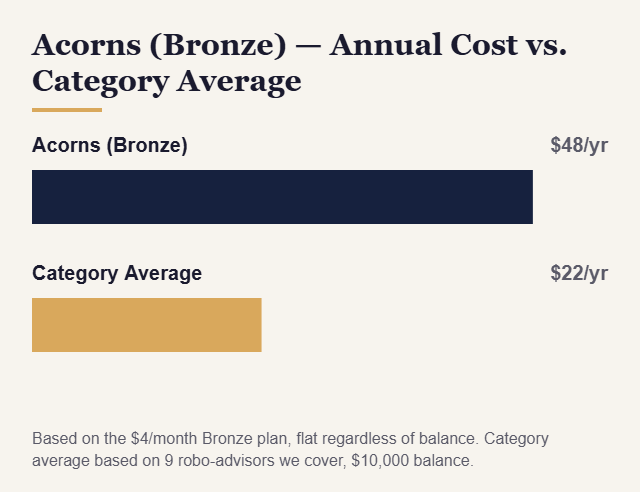
Here’s the catch with flat fees: $4/month is $48/year. On a $500 balance, that’s a 9.6% effective fee — far higher than any percentage-based robo-advisor. Acorns makes much more financial sense once your balance is $5,000+, where the effective fee drops below 1%.
Acorns Investment Portfolios
Acorns keeps it simple with 5 pre-built portfolios ranging from Conservative (heavy bonds) to Aggressive (heavy stocks). Each portfolio is built from a small set of low-cost Vanguard and BlackRock ETFs. You don’t get to customize your portfolio beyond choosing your risk level — which is a feature for some users and a limitation for others.
Acorns recently added ESG (sustainable investing) portfolio options as well, letting you invest in companies screened for environmental and social factors.
What Acorns Does Well
- Round-Ups — The best micro-investing feature in the industry. Genuinely helps people who wouldn’t otherwise invest
- Simplicity — Dead simple setup and zero investing knowledge required
- Found Money — Partner brands (like Nike, Airbnb) invest cash back directly into your Acorns account when you shop through the app
- All-in-one bundles — The Silver and Gold tiers bundle checking, IRA, and kids accounts under one roof
Where Acorns Falls Short
- Flat fees hurt small accounts — $4/month on a $200 balance is a 24% effective annual fee. That’s brutal.
- No tax-loss harvesting — Unlike Wealthfront and Betterment, Acorns doesn’t offer this valuable tax optimization feature
- Limited portfolio customization — You pick a risk level and that’s it. No ability to tilt toward specific sectors or asset classes
- No financial planning tools — Acorns is purely an investment platform, not a holistic financial planning tool
Who Is Acorns Best For?
Acorns is the best robo-advisor for true beginners — specifically people who find it hard to save and need automation to force the habit. The Round-Ups feature is genuinely effective psychology. If you have trouble putting money aside, Acorns’ approach of investing your spare change invisibly is one of the best on-ramps to building wealth.
It’s less compelling for people who already have a savings habit, have larger account balances where the flat fee becomes expensive relative to percentage-based alternatives, or want sophisticated features like tax-loss harvesting.
Acorns Review Verdict
Acorns earns its reputation as the best starter investing app. The Round-Ups feature is genuinely clever, the setup is effortless, and the expanding ecosystem makes it a solid choice for beginners who want everything in one place. Just be aware of the fee math — if your balance stays small, you’re overpaying. Once you’ve built a solid foundation, consider graduating to a lower-fee alternative like Wealthfront or Betterment.
Frequently Asked Questions About Acorns
Is Acorns worth it in 2026?
Acorns is worth it for people who struggle to save consistently. The Round-Ups feature removes friction from investing by automating small contributions from everyday purchases. However, the flat monthly fee ($4/month for the Bronze tier) is proportionally expensive for very small balances — if you have less than $1,000 invested, you’re paying a high effective fee rate. If you’re disciplined enough to invest manually, a fee-free alternative like Fidelity Go or SoFi may serve you better.
How does Acorns make money?
Acorns makes money through subscription fees: $4/month for its Bronze tier, $8/month for Silver, and $12/month for Gold (which adds family accounts). It does not charge a percentage of assets under management, which means the fee structure favors larger balances. The app also earns revenue through its Earn rewards program, where partner brands pay Acorns when users shop with them.
Is Acorns FDIC insured?
Acorns investment accounts are not FDIC insured — they are brokerage accounts covered by SIPC insurance up to $500,000, which protects against broker failure (not investment losses). Acorns Checking accounts are FDIC insured up to $250,000.
What is the minimum balance for Acorns?
Acorns has no minimum balance requirement to open an account. You can start investing with as little as $5, making it one of the most accessible robo-advisors for beginners.
Can you withdraw money from Acorns anytime?
Yes, you can withdraw from Acorns at any time. Withdrawal requests from taxable accounts typically take 3–6 business days to process. However, withdrawing from an Acorns Later (IRA) account before age 59½ may trigger taxes and a 10% early withdrawal penalty.
The Fee Math at Different Balance Levels
Acorns’ flat-fee model is the most important thing to understand about this platform. At $4/month ($48/year), here’s what you’re paying as a percentage of your portfolio:
- $500 balance: 9.6% annually — extremely expensive
- $1,000 balance: 4.8% annually — very expensive
- $3,000 balance: 1.6% annually — above market rate
- $10,000 balance: 0.48% annually — competitive but not the cheapest
- $25,000 balance: 0.19% annually — genuinely cheap
The implication is clear: Acorns is best when you’re just starting and investing small amounts. As your balance grows, the economics shift in favor of percentage-fee platforms like Betterment (0.25%) or Wealthfront (0.25%). Many Acorns users do exactly this — use Acorns to build the saving habit, then migrate to a different platform once they’ve crossed $10,000–$25,000.
Acorns vs. Betterment for New Investors
If you can commit to automatic monthly contributions from day one, Betterment is more cost-efficient than Acorns at almost every balance level above $1,000. The reason to choose Acorns over Betterment is specifically the Round-Ups behavioral mechanism — if you genuinely struggle to save and the passive, automated nature of Round-Ups is what gets you investing, that has real value that a lower fee alone can’t replicate. Choose the platform you’ll actually use consistently. For habit-builders: Acorns. For committed savers: Betterment.
Check our full breakdown of the best robo-advisors for beginners to see how Acorns stacks up against the full field.
Comparing Acorns to other robo-advisors? Read our head-to-head Acorns vs Betterment comparison to see which one wins for beginners.
The Round-Ups Math: How Much Spare Change Actually Adds Up
Round-Ups is the feature that makes Acorns Acorns — every debit or credit card purchase gets rounded up to the nearest dollar, and the difference gets invested automatically. It sounds trivial. The numbers say otherwise.
The average round-up on a linked card is somewhere between $0.40 and $0.60. Someone using a card for most day-to-day spending — coffee, gas, groceries, the occasional Amazon order — typically racks up 15 to 25 card swipes a week. Here’s what that turns into:
| Weekly card transactions | Avg. round-up | Invested per month | Invested per year |
|---|---|---|---|
| 10 | $0.50 | ~$22 | ~$260 |
| 15 | $0.50 | ~$33 | ~$390 |
| 20 | $0.50 | ~$43 | ~$520 |
| 25 | $0.50 | ~$54 | ~$650 |
None of that requires a single deliberate decision once it’s set up — which is exactly the point. Acorns also offers a Round-Ups Multiplier (2x, 3x, or 10x), so someone who wants to accelerate past the passive amount can turn a $520/year habit into $1,000–$5,200/year without changing a single spending habit.
The catch is the flat fee sits on top of this, not inside it. At $4/month, the Bronze tier costs $48/year regardless of whether your Round-Ups add up to $260 or $650. That’s the same math from the fee section above — the more your Round-Ups generate, the less that flat fee matters as a percentage of what’s coming in.
My Honest Take on Acorns
I’d recommend Acorns to exactly one type of person: someone who has tried to build a saving habit and failed, not because they don’t understand compound interest, but because deliberately moving money into an investment account every month never actually happens. Round-Ups solves a behavior problem, not a math problem, and for that specific person it’s worth paying a flat fee that looks expensive on a spreadsheet.
I wouldn’t recommend it to someone who already has the discipline to set up a recurring $100 or $200 monthly transfer on their own. That person is better off at Betterment or Wealthfront from day one — same 0.25% fee structure, no flat-fee penalty on small balances, and tax-loss harvesting once the account grows.
The honest middle path, and the one I’ve seen work in practice: use Acorns for the first $5,000–$10,000 to build the habit, then migrate the balance to a percentage-fee platform once the flat fee stops making sense. See our Acorns vs. Betterment breakdown for exactly where that line is, or check the full field in our Best Robo-Advisors for Beginners guide.
Sources: Fees and terms: Acorns pricing (last verified September 2026).