Fidelity Go Review: Fidelity’s Simple, Low-Cost Robo-Advisor
Fidelity Go is free under $25,000 and uses zero-expense-ratio funds. Here's the full breakdown of how it works.
Fidelity is the quiet giant of American finance. While newer players spend heavily on marketing and flashy app design, Fidelity has spent decades doing something boring and effective: lowering costs to near zero and serving tens of millions of investors without much fanfare.
Fidelity Go is the robo-advisor extension of that playbook. It’s not the fanciest product. The app is fine, not remarkable. The portfolio is simple, not exotic. But the price is genuinely low and the underlying funds are some of the cheapest available anywhere.
For a lot of investors, that’s the whole ballgame.
(Standard disclosure: we may earn a commission if you open an account via our links. It doesn’t change the review. Fidelity Go has clear strengths and clear limits, and we’re covering both.)
KatchingStacks is reader-supported. When you open an account through links on this page, we may earn a commission at no extra cost to you. See our affiliate disclosure and editorial policy.
What Fidelity Go Is
Fidelity Go is a digital advice product that invests your money in a portfolio of Fidelity Flex mutual funds. You answer a short questionnaire about goals and risk tolerance, and the system assigns you to one of several portfolio tracks ranging from conservative to aggressive growth.
Fidelity handles rebalancing automatically. There’s no account minimum to open. You can invest in a taxable account, Traditional IRA, Roth IRA, or rollover IRA.
The Flex funds used in the portfolios have 0% expense ratios. That’s not marketing — it’s literally zero. Fidelity covers the operating costs of those funds through its broader business rather than charging you directly.
The Fee Structure
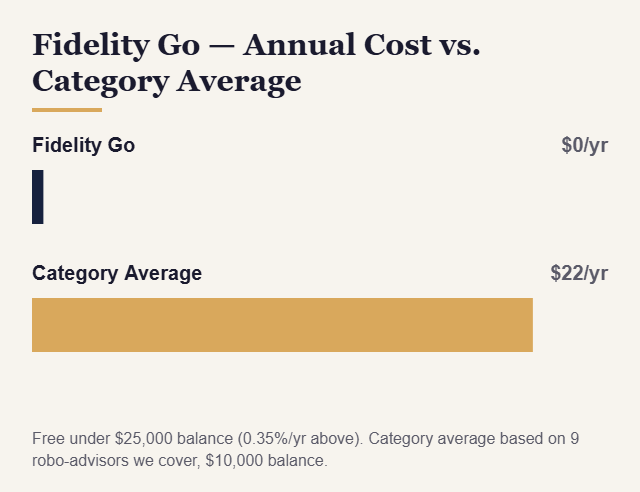
Fidelity Go is free for balances under $25,000. That’s the entire story — no management fee, no advisory fee, no hidden cash drag.
Once your balance crosses $25,000, the fee is 0.35% per year, charged on your whole balance (not just the portion above $25,000). That’s higher than Betterment or Wealthfront, which charge 0.25% at all balance levels.
So the math is interesting. If you have $20,000, Fidelity Go is the cheapest robo-advisor on the market. If you have $100,000, you’d pay $350 a year at Fidelity vs. $250 at Betterment. The crossover point where Fidelity becomes the more expensive option is $25,000.
One thing that narrows the gap: because the underlying Flex funds have 0% expense ratios, your total cost at Fidelity Go is just the management fee. At Betterment or Wealthfront, you pay their management fee plus the expense ratios of the ETFs inside your portfolio (usually another 0.05% to 0.15%). So the real total cost gap is smaller than the headline management fees suggest.
What You Get
The portfolios are straightforward. Depending on risk tolerance, you’ll get a mix of US stocks, international stocks, investment-grade bonds, and short-term bonds, all held through Fidelity Flex funds. The number of underlying funds is small — usually four or five — which some see as a feature and some see as a limit.
Automatic rebalancing runs whenever your allocation drifts. There’s no tax-loss harvesting at any balance level, which is a meaningful gap compared to Betterment, Wealthfront, and Schwab.
At $25,000 and above, Fidelity Go includes access to one-on-one coaching with Fidelity advisors. This isn’t unlimited hand-holding, but it’s meaningful access for a 0.35% fee.
Where Fidelity Go Shines
For investors building their first $25,000, Fidelity Go is hard to beat. No management fee, no expense ratios inside the funds, no account minimum. The total cost is as close to zero as it gets in a managed product. If you’re 25 years old with $2,000 and you want to start investing, this is a defensible pick.
The underlying Fidelity ecosystem is another strength. If you already have a Fidelity 401(k) through work, a Fidelity HSA, or a Fidelity brokerage, consolidating feels seamless. Customer service is historically strong.
Simplicity is the third win. The Flex funds are boringly well-diversified. The interface isn’t trying to sell you crypto, margin, or options. It’s a robo that does robo things.
Where Fidelity Go Falls Short
No tax-loss harvesting is the big one. For taxable accounts above $50,000 or so, TLH can meaningfully improve after-tax returns. Fidelity Go doesn’t offer it. If you’re planning to build a large taxable balance, this is a real consideration.
The fee structure above $25,000 is also not competitive. At $100,000, you’d pay $350 at Fidelity vs. $250 at Betterment or Wealthfront. Minus the expense ratio difference, the gap is probably $40 to $70 a year in Betterment’s favor. Small, but real, and it compounds.
Portfolio customization is minimal. You get the portfolio the algorithm assigns. You can’t swap funds, tilt toward ESG, or build custom weights like you can at M1 or even Betterment.
Who Should Sign Up
Fidelity Go is a strong pick if you’re starting with a small balance and want the lowest possible total cost on a managed product. It’s also strong if you already live inside Fidelity’s ecosystem and want your investing in the same app as the rest of your finances.
It’s a weaker pick once your taxable balance grows past $50,000 and the lack of tax-loss harvesting starts to matter more than the minor fee difference.
Bottom Line
Fidelity Go is a pure, low-cost robo-advisor that works best for investors in the early stages of building wealth. It’s not flashy, it doesn’t have every feature, and it isn’t trying to win design awards. What it does well is get you invested in a diversified portfolio with as close to zero cost as anyone offers.
If that’s what you need, sign up. If you need more sophisticated tax features or more customization, look elsewhere.
Quick Links
You can open a Fidelity Go account with zero minimum and start investing in minutes through Fidelity’s site.
For more no-nonsense reviews and the occasional deep dive into compound math, subscribe to the KatchingStacks newsletter — one short email a week. If you want to see how Fidelity compares against index fund alternatives outside the robo world, our What Is an Index Fund? guide lays out the fundamentals.
What’s Actually in a Fidelity Go Portfolio?
Fidelity Go invests exclusively in Fidelity Flex mutual funds — zero-expense-ratio funds that Fidelity manages in-house. These are not ETFs you can buy elsewhere; they’re institutional share classes only available inside Fidelity products. The absence of an expense ratio means there are genuinely no underlying fund costs on top of the management fee (which is itself zero for balances under $25,000).
A typical aggressive Fidelity Go portfolio might include:
- Fidelity Flex 500 Index Fund (US large-cap stocks)
- Fidelity Flex International Index Fund (international stocks)
- Fidelity Flex US Bond Index Fund (domestic bonds)
- Fidelity Flex Short-Term Bond Fund (short-duration bonds)
The exact mix depends on your risk score from the onboarding questionnaire. Fidelity uses 5 risk-based models ranging from conservative (mostly bonds) to aggressive (mostly stocks). There’s no customization beyond choosing your risk level.
How Fidelity Go Compares to Betterment and Wealthfront
The most important comparison for most investors is cost. Fidelity Go charges nothing under $25,000 and 0.35% above that (with coach access). Betterment and Wealthfront both charge 0.25% across the board. So at lower balances, Fidelity Go is cheaper. At balances above $25,000, Betterment and Wealthfront pull ahead on price — and offer tax-loss harvesting, which Fidelity Go does not.
For tax-loss harvesting specifically, the absence in Fidelity Go is the biggest tradeoff. Studies estimate tax-loss harvesting adds 0.10%–0.77% in after-tax returns annually. Over a decade on a $50,000 portfolio, that gap in tax efficiency can dwarf the fee difference.
Who Fidelity Go Is Best For
Fidelity Go makes the most sense if you already use Fidelity for your 401(k) or brokerage account. Having your investments all in one dashboard — your robo-advisor, your self-directed brokerage, and your retirement accounts — is genuinely valuable. The integrated view and seamless transfers between accounts are underrated features that Betterment and Wealthfront can’t replicate for Fidelity customers.
It’s also a natural choice for investors with under $25,000 who want fully managed investing at zero cost. The Fidelity Flex funds have no expense ratio, and management is free. For that audience — a young investor with $1,000–$25,000 and no need for tax-loss harvesting — Fidelity Go is hard to beat on pure economics.
What Fidelity Go Doesn’t Offer
No tax-loss harvesting. No direct indexing. No socially responsible investing portfolios. No crypto. No 529 plan. No self-directed investing alongside the robo-advisor. No joint accounts (only individual taxable and IRAs). The product is genuinely simple — which is a feature for some investors and a dealbreaker for others.
The Verdict
Fidelity Go earns its place as a legitimate robo-advisor for the right investor profile: someone who wants simple, low-cost managed investing inside the Fidelity ecosystem. It’s not trying to be Wealthfront, and it doesn’t need to be. For new investors and Fidelity loyalists, it’s an excellent, no-fuss starting point.
For investors approaching $25,000 and above, the fee comparison shifts in favor of Betterment or Wealthfront — especially once you factor in the tax-loss harvesting those platforms provide and Fidelity Go does not.
Fidelity Go is a strong pick if you already bank with Fidelity or want a fee-free tier under $25,000. See how it stacks up in our Best Robo-Advisors 2026 comparison.
The $25,000 Cliff: Why Crossing the Line Costs More Than You’d Think
Fidelity Go’s fee isn’t a gradual crossover — it’s a cliff. Below $25,000, management is free. The moment your balance crosses $25,000, the 0.35% fee applies to your entire balance, not just the amount above the threshold. That’s a meaningfully different structure than a marginal tax bracket, and it catches people off guard.
| Balance | Fidelity Go fee | Betterment fee (0.25%) |
|---|---|---|
| $24,999 | $0 | $62.50 |
| $25,001 | $87.50 (0.35% of full balance) | $62.50 |
| $50,000 | $175 | $125 |
| $100,000 | $350 | $250 |
| $250,000 | $875 | $625 |
Notice what happens right at the line: a single dollar of growth can flip you from paying $0 to paying $87.50 a year. That’s not a rounding error — it’s the entire point of understanding this fee structure before you cross it. Once you’re meaningfully past $25,000, Fidelity Go is consistently the more expensive of the two on the headline number, though the gap narrows somewhat because Fidelity’s Flex funds carry a 0% expense ratio while Betterment’s ETFs typically add another 0.05%–0.15% on top of its 0.25% fee.
My Honest Take on Fidelity Go
For anyone starting out with under $20,000, Fidelity Go is one of the best deals in the industry — genuinely free management, zero-expense-ratio funds, and a clean, boring, well-diversified portfolio. If you already have a Fidelity 401(k) or HSA, the single-dashboard convenience is a real reason to consolidate here first.
Where I’d change course is as your balance approaches $25,000. Rather than let the cliff hit you passively, decide ahead of time: either keep contributions flowing into a separate account once you’re near the threshold, or accept the 0.35% fee and stay for the ecosystem convenience. If cost is your only priority past that point, Betterment or Wealthfront will be cheaper at every balance above $25,000, plus they offer tax-loss harvesting Fidelity Go doesn’t have. See the full lineup in our Best Robo-Advisors 2026 comparison.
Sources: Fees and terms: Fidelity Go overview (last verified September 2026).