Best Term Life Insurance Companies of 2026

Not all term life insurance is created equal. Here are the top companies for 2026, evaluated on financial strength, pricing, policy flexibility, and ease of application.
Term life insurance is a commodity in the best sense — the core product is straightforward, which means the differences between insurers come down to price, financial strength, underwriting, and policy features. This guide cuts through the noise to identify the companies that consistently rank at the top for investors and wealth-builders shopping for term coverage in 2026.
KatchingStacks is reader-supported. When you purchase a policy through links on this page, we may earn a commission at no extra cost to you. See our affiliate disclosure and editorial policy.
What to Look for in a Term Life Insurer
Before diving into specific companies, here’s what actually matters when comparing term life insurers:
- Financial strength ratings: Check AM Best, Moody’s, or S&P ratings. You’re choosing a company that needs to pay out potentially decades from now — solvency matters.
- Price for your profile: Premiums vary significantly by company. Get quotes from multiple insurers, as pricing can differ by 30–40% for identical coverage.
- Policy features: Conversion options, waiver of premium riders, accelerated death benefit riders, and return-of-premium options vary by insurer and add meaningful flexibility.
- Underwriting approach: Some companies are more lenient on specific health conditions. If you have a managed health condition, certain insurers may offer significantly better rates.
- Application process: No-exam policies are increasingly common and can dramatically speed up the process, though they typically cost slightly more.
Top Term Life Insurance Companies of 2026
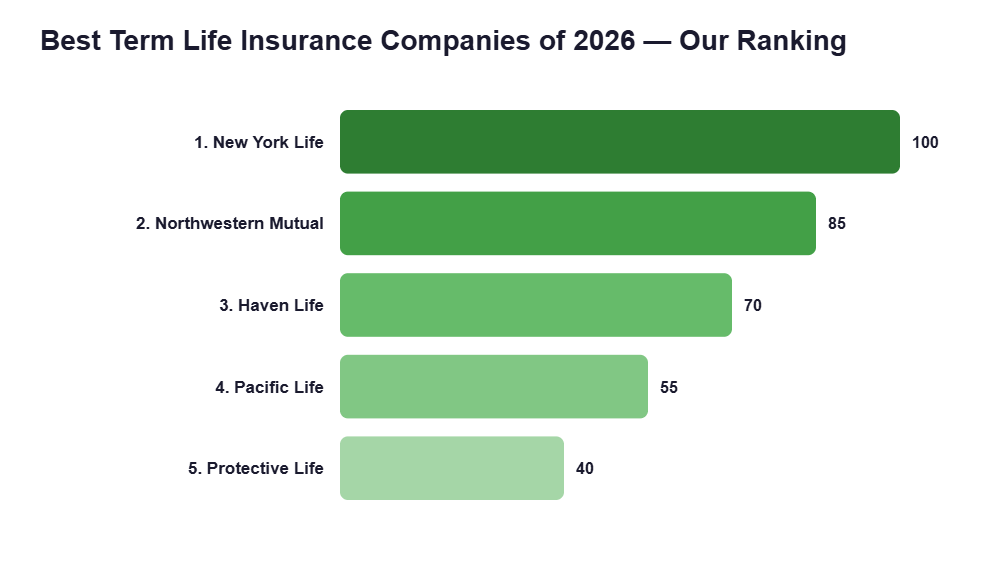
New York Life — Best Overall for Financial Strength
New York Life is one of the oldest and most financially stable insurers in the United States, with an AM Best rating of A++ (Superior) — the highest available. As a mutual company (owned by policyholders, not shareholders), it has no obligation to maximize quarterly profits at the expense of policyholder value. New York Life offers term policies from 10 to 20 years, with conversion options to permanent coverage. Its CustomTerm product allows for flexible coverage periods. Pricing is competitive for healthy applicants, and its financial track record is second to none.
Northwestern Mutual — Best for Long-Term Relationships
Northwestern Mutual also holds an AM Best A++ rating and has paid dividends to policyholders for over 150 consecutive years. It’s best known for whole life insurance, but its term life offerings are strong, particularly for applicants who may eventually want to convert to permanent coverage or work with a financial advisor long-term. Northwestern Mutual operates through a network of financial representatives who provide personalized guidance — ideal if you want an advisor relationship rather than a purely transactional purchase.
Haven Life — Best for Online Convenience
Haven Life (backed by MassMutual) pioneered the online term life experience and remains one of the best for applicants who want a fast, digital-first process. Policies are issued by MassMutual (AM Best A++ rated), which provides the financial backing you’d expect from a major insurer. Haven Life offers coverage up to $3 million for qualified applicants, with many getting approved without a medical exam. Pricing is transparent and highly competitive. If you want to get covered in days rather than weeks, Haven Life is the benchmark.
Pacific Life — Best for Large Coverage Amounts
Pacific Life is an excellent choice for applicants needing $1 million or more in coverage, with AM Best A+ ratings and competitive pricing for high-coverage policies. Its PL Promise Term product is straightforward and priced well for healthy applicants at higher coverage tiers. Pacific Life is one of the few carriers that regularly competes on price for the $1M+ market without sacrificing financial strength.
Protective Life — Best Budget Option
Protective Life (AM Best A+) consistently offers some of the lowest term premiums in the market, particularly for applicants in excellent health. Its Classic Choice Term product is a no-frills, competitively priced option for shoppers who want the best price for straightforward coverage. If budget is the primary concern and you’re in excellent health, get a Protective quote alongside others — it frequently comes in lowest.
How to Get the Best Rate
Your premium is primarily determined by your age, health, gender, coverage amount, and term length. To get the best rate:
- Buy younger: Every year you wait increases your premium. A 30-year-old pays significantly less than a 40-year-old for identical coverage.
- Improve health before applying: If you smoke, quitting at least 12 months before applying can dramatically lower your rate. Losing weight, controlling blood pressure, and managing cholesterol all improve your health classification.
- Get multiple quotes: Pricing varies enough between carriers that shopping is worth it. Use an independent broker or comparison tool to see multiple quotes simultaneously.
- Apply for more than you need: Counterintuitively, the per-dollar cost of life insurance decreases at higher coverage amounts. Getting $1M may cost only slightly more than $750K.
Frequently Asked Questions
Which life insurance company has the best financial strength rating?
New York Life, Northwestern Mutual, MassMutual, and USAA all hold AM Best’s highest rating of A++ (Superior). These companies have the strongest track record of financial stability and ability to pay claims, which matters most given that term policies may need to pay out 10–30 years in the future.
Can I switch life insurance companies?
You can apply to a new company and, once approved, cancel your existing policy. There’s no direct transfer — you go through a new application and underwriting process. If your health has changed since your original policy, you may not qualify for the same rates or coverage at a new insurer, so think carefully before canceling an existing policy.
What is a no-exam life insurance policy?
No-exam policies (also called simplified issue or accelerated underwriting) use data from your application, prescription history, and public records rather than requiring a paramedical exam with blood and urine samples. They’re faster (days vs. weeks) and slightly more convenient, though they may cost 5–15% more than fully underwritten policies and often have lower maximum coverage amounts.
Is employer-provided life insurance enough?
Group life insurance through your employer is typically 1–2x your salary — far less than most families need. It also doesn’t follow you if you change jobs, and you can’t always convert it to an individual policy. Employer coverage is a valuable supplement but shouldn’t be your primary protection strategy.
How do I know if my life insurance company is financially sound?
Check ratings from AM Best (the insurance industry’s primary rating agency), S&P, and Moody’s. Any company rated A or above from AM Best is financially sound. Companies rated B+ or below carry meaningful risk of insolvency. All of the companies on this list are A-rated or better.
Already investing and want to compare robo-advisor options too? See our Best Robo-Advisors 2026 comparison for the full lineup.
Side-by-Side: How the Top 5 Compare
| Company | AM Best rating | Best for | No-exam option |
|---|---|---|---|
| New York Life | A++ | Financial strength / long-term reliability | Limited |
| Northwestern Mutual | A++ | Advisor relationship, future conversion | Limited |
| Haven Life | A++ (via MassMutual) | Fast, fully online applications | Yes, up to $3M |
| Pacific Life | A+ | Large coverage amounts ($1M+) | Limited |
| Protective Life | A+ | Lowest price for healthy applicants | Limited |
Laid out this way, the pattern is clear: there’s no single “best” company, only a best fit for what you’re optimizing. Want the fastest approval with the least hassle? Haven Life. Want the strongest possible guarantee that the company will still be around in 30 years? New York Life or Northwestern Mutual. Want the cheapest premium and you’re in excellent health? Get a Protective quote before anything else.
My Honest Take
Don’t overthink the financial-strength ratings once a company clears A- or better — all five companies above are financially sound enough that the practical difference between A+ and A++ almost never matters for a typical term policy. What actually moves the needle is getting quotes from at least three of these and comparing your specific price, because underwriting varies more than people expect. I’ve seen identical health profiles get meaningfully different offers between two A++ rated companies, simply because one underwrites a particular condition (like well-controlled high blood pressure) more favorably than the other. The “best” company is often just whichever one likes your specific health profile that year.