SoFi Automated Investing Review: Is It Still Worth It Now That It’s Not Free?
SoFi charges $0 management fees on its robo-advisor. Here's what you get, what you give up, and whether the math works.
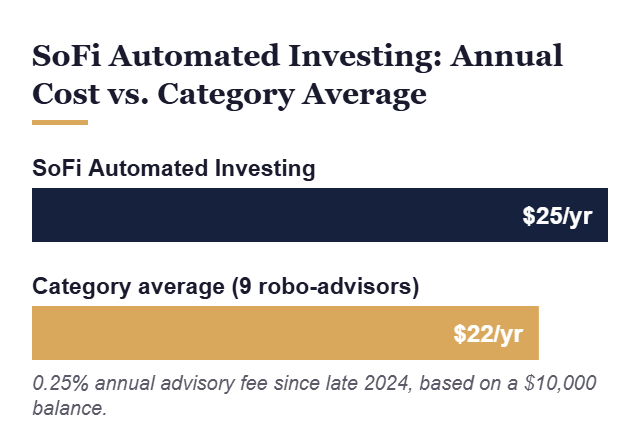
SoFi Automated Investing spent years marketing itself as the free robo-advisor while Betterment and Wealthfront charged 0.25%. That changed in late 2024: SoFi now charges the same 0.25% annual advisory fee as most of the category. A lot of “SoFi is free” content online — including, until this update, this page — never caught up to that change.
So what’s the catch? There are a few. Some are fair tradeoffs, some are worth thinking about, and one is genuinely sneaky. Let’s get into it.
(Heads up: we may earn a commission if you open an account through a link below. It doesn’t shape what we say. SoFi has real strengths and real limitations, and we’re covering both.)
KatchingStacks is reader-supported. When you open an account through links on this page, we may earn a commission at no extra cost to you. See our affiliate disclosure and editorial policy.
What SoFi Automated Investing Is
SoFi started life as a student loan refinancer. It’s since turned into a one-stop financial app — banking, loans, credit cards, crypto, investing. Automated Investing is the robo-advisor piece of that stack.
The experience is familiar if you’ve used any robo before. You answer a questionnaire about your goals and risk tolerance, SoFi builds you a portfolio of low-cost ETFs, and it rebalances automatically as markets move. Contributions can be automated on whatever schedule you pick.
The ETFs inside your portfolio have their own expense ratios (which is unavoidable), and since late 2024 SoFi also charges a 0.25% annual advisory fee on top — the same as most of the category.
The Fee Story, Honestly
Here’s the part the marketing doesn’t explain as clearly. SoFi’s portfolios historically included several SoFi-branded ETFs alongside broader-market funds like those from Vanguard and iShares. Some of those SoFi-branded ETFs have higher expense ratios than the alternatives you’d find on a competing robo.
That used to be part of the business model — SoFi could afford to skip the advisory fee partly because it earns money on its own funds sitting inside your portfolio. It still does that, but as of late 2024 it also charges the standard 0.25% advisory fee on top, same as Wealthfront, Betterment, and Robinhood Strategies.
Over the last couple of years, SoFi has reduced how heavily it leans on its own funds, and the total expense burden on a SoFi Automated portfolio is now genuinely competitive with Wealthfront or Betterment. But it’s worth knowing the story so you can check the expense ratios on your actual holdings once you’re in.
Account Minimums and Access
You can open a SoFi Automated Investing account with $1. That’s not a typo — it’s $1. You can start investing for real with a $5 deposit (since that’s the minimum buy for fractional shares on the platform).
That’s aggressive in the best way. If you’re 22 and you’ve got $50 a month to invest, SoFi removes every excuse. Taxable brokerage, Roth IRA, Traditional IRA, and SEP IRA are all supported.
What You Actually Get
A SoFi Automated portfolio is built from a handful of ETFs covering US stocks, international stocks, bonds, and sometimes REITs or high-yield bonds depending on your risk tolerance. Allocations are straightforward and automatic rebalancing keeps things on target.
You also get access to SoFi’s ecosystem — free financial planning calls with actual humans (a real perk for new investors), discounts on other SoFi products, and the ability to see your investing, saving, and loans all in one app. For someone who wants a single financial home, that’s appealing.
What you don’t get, at least not in the robust form competitors offer, is tax-loss harvesting. SoFi introduced a version of it, but it’s not as sophisticated as what Wealthfront or Betterment run. If you have a large taxable balance, this is a real consideration.
Where SoFi Makes Sense
If you’re just getting started and the idea of paying 0.25% a year feels like it’s eating your returns, SoFi’s model removes that mental barrier entirely. For small accounts — under $20,000 or so — the difference between SoFi and a competitor that charges a fee is measured in tens of dollars per year. It’s not going to make or break your future. But the psychology of “no fee” does matter for a lot of new investors, and if it gets you to start, that’s worth more than any fee comparison.
The human financial planning sessions are another genuine draw. Most robos don’t include unlimited access to a real advisor at the free tier. SoFi does.
Where SoFi Falls Short
The ETF composition is the main reason to pause. Before committing a large amount, check what’s actually in your portfolio and compare expense ratios to what you’d pay elsewhere. If SoFi’s branded funds dominate your allocation and their expense ratios are notably higher than equivalent broad-market funds, your “free” robo-advisor isn’t as cheap as it looks.
Tax-loss harvesting is weaker than at the top competitors. Not a dealbreaker for small accounts, but important as balances grow.
And the cross-sell pressure is real. SoFi is going to show you its credit card, its personal loans, its crypto. If you’re easily tempted, that might be a problem. If you can ignore marketing, it’s not.
Who Should Sign Up
SoFi Automated Investing is a strong pick for beginners with small balances who want access to human advisors without a management fee. It’s also a reasonable pick for anyone already inside the SoFi ecosystem who wants to consolidate.
It’s a weaker pick for investors with larger taxable balances where tax-loss harvesting really matters, or for anyone who wants the absolute cheapest total expense ratio and is willing to pay a small management fee to get it.
Bottom Line
SoFi Automated Investing delivers on the promise of a no-management-fee robo-advisor, with the caveat that you should double-check the expense ratios of the underlying funds. For small and mid-sized accounts, it’s genuinely competitive, and the access to human advisors is a meaningful perk.
If you’re just starting out and you want the friction as close to zero as possible, it’s hard to say no.
Quick Links
Curious whether SoFi fits your situation? You can open a SoFi Automated Investing account with a single dollar and explore the portfolio yourself before committing.
For more robo-advisor comparisons and the occasional rant about fees, subscribe to the KatchingStacks newsletter — one email a week, zero fluff. You might also like our Betterment Review if you want to see how a paid competitor stacks up.
What’s Actually in a SoFi Automated Portfolio?
SoFi uses a mix of its own SoFi-branded ETFs and third-party ETFs from iShares and other providers. The SoFi-branded ETFs have low expense ratios (typically 0.03%–0.09%), which helps offset the fact that SoFi keeps a cash allocation in your portfolio. A standard SoFi portfolio might include SoFi Weekly Dividend ETF, iShares Core S&P 500 ETF, and SoFi Weekly Income ETF, among others.
The cash allocation ranges from 1%–3% depending on your risk profile. At low interest rate environments, this cash earns very little and represents a real drag on returns. At higher rate environments (like 2024–2026), it earns more — but still less than it would invested in the market for a long-term investor.
SoFi’s Ecosystem Advantage
Where SoFi genuinely shines is its integrated financial ecosystem. Alongside Automated Investing, SoFi offers: a high-yield savings account, personal loans at competitive rates, student loan refinancing, a credit card, and banking. If you’re already a SoFi customer for any of these, adding automated investing is frictionless. Your financial picture lives in one dashboard.
For someone managing debt alongside building investments, this integration is particularly useful. You can see your loan balances, savings, and investment portfolio side by side — which provides a more complete view of your net worth than siloed apps can offer.
The Tax-Loss Harvesting Gap
SoFi Automated Investing does not offer tax-loss harvesting. For investors in taxable accounts, this is the single largest competitive disadvantage versus Betterment and Wealthfront. Tax-loss harvesting can add 0.10%–0.77% in after-tax returns annually. On a $50,000 taxable account over 10 years, that gap compounds into a meaningful dollar difference over time — a real cost, and one SoFi no longer offsets with a lower advisory fee, since it charges the same 0.25% as Betterment and Wealthfront.
If your SoFi investing is entirely inside a Roth IRA or Traditional IRA (where there are no capital gains taxes), the tax-loss harvesting gap is irrelevant either way — but so is any fee advantage. On the advisory fee alone, SoFi is a wash against Wealthfront and Robinhood Strategies, not a discount.
Who SoFi Automated Investing Is Best For
SoFi Automated Investing makes the most sense for existing SoFi customers who want to consolidate loans, banking, and investing into one app, and for beginners who want the simplest possible setup with a $1-$5 minimum and free human financial planning calls. It makes less sense for taxable account investors planning to hold significant assets long-term, where the missing tax-loss harvesting will cost more than the 0.25% fee itself over time — and it no longer makes sense to choose SoFi specifically to save on fees, since it charges the same 0.25% as Betterment, Wealthfront, and Robinhood Strategies.
Final Verdict
SoFi Automated Investing is a solid, simple robo-advisor with a genuinely useful ecosystem around it — but the “free” reputation it built years ago is out of date. Choose it for the low minimum, the one-app convenience, and the beginner-friendly setup, not for the price, because on price alone it’s tied with most of the category. For taxable accounts where tax-loss harvesting matters, run the math against Betterment or Wealthfront before deciding.
SoFi is one of the few genuinely $0-fee robo-advisors, but it is worth comparing against the field. See the full lineup in our Best Robo-Advisors 2026 comparison, or read our M1 Finance review if you want more control over your own portfolio.
The Tax-Loss Harvesting Gap in Real Dollars
Now that SoFi charges the same 0.25% advisory fee as everyone else, there’s no fee discount to weigh against this. The number that matters for taxable accounts is what you give up outright: automated tax-loss harvesting, which Betterment and Wealthfront both include at the same price. Industry estimates put the after-tax value of tax-loss harvesting somewhere between 0.10% and 0.77% annually, depending on market volatility and your tax bracket — a wide range, but worth pricing out.
| Taxable balance | TLH value at 0.10%/yr | TLH value at 0.77%/yr | SoFi’s advisory fee (same 0.25% as competitors) |
|---|---|---|---|
| $25,000 | $25/yr | $192.50/yr | $62.50/yr |
| $50,000 | $50/yr | $385/yr | $125/yr |
| $100,000 | $100/yr | $770/yr | $250/yr |
Read that table carefully: at the low end of the TLH range, SoFi’s $0 fee still comes out ahead. At the high end — which tends to show up in volatile years, exactly when harvesting opportunities are most plentiful — the tax benefit you’re missing at SoFi can exceed what you saved by not paying a management fee at all. There’s no single right answer here; it depends on your tax bracket and how volatile the years ahead turn out to be.
My Honest Take on SoFi Automated Investing
For a Roth or Traditional IRA, this math doesn’t apply — there’s no tax-loss harvesting to miss inside a tax-advantaged account, so SoFi’s $0 fee is close to a free lunch. That’s where I’d point a beginner without hesitation, especially if they’re already a SoFi member for banking or loans.
For a large taxable brokerage account, I’d take the tax-loss harvesting gap seriously rather than assume the free fee automatically wins. If you’re building a taxable account past $50,000 and expect to hold it for a decade or more, Betterment or M1 Finance are worth comparing directly against what you’d actually keep at SoFi after taxes. Our Best Robo-Advisors 2026 roundup breaks down where each platform’s tax features actually apply.
Sources: Fees and terms: SoFi Automated Investing (last verified September 2026).