Term Life vs. Whole Life Insurance: What Investors Need to Know
Term life or whole life? For investors, this decision is more straightforward than the insurance industry wants you to think. Here's the clear-eyed breakdown.
Few personal finance debates generate more confusion — and more commission-motivated advice — than term life versus whole life insurance. Insurance agents have financial incentives to recommend whole life. Personal finance educators tend to push back hard toward term. The truth is more nuanced, but for most investors, the math points clearly in one direction.
KatchingStacks is reader-supported. When you purchase a policy through links on this page, we may earn a commission at no extra cost to you. See our affiliate disclosure and editorial policy.
The Core Difference
Term life insurance covers you for a set period — typically 10, 20, or 30 years. If you die during the term, your beneficiaries receive the death benefit. If the term ends and you’re still alive, the policy expires with no payout. That’s it. No frills, no complexity, no cash value.
Whole life insurance covers you for your entire life, as long as you pay premiums. It also builds cash value over time — a savings component that grows at a guaranteed rate and can be borrowed against or withdrawn. Whole life premiums are dramatically higher than term for the same death benefit: often 10–15 times more.
The Premium Gap Is Significant
A 35-year-old in good health might pay:
- Term life (20-year, $500K): ~$25–35/month
- Whole life ($500K): ~$300–500/month
That’s a difference of roughly $265–465/month. Over 20 years, that’s $63,600–$111,600 in extra premiums. If you invested that difference in a robo-advisor earning 7% annually, you’d have roughly $165,000–$290,000 in additional savings at the end of 20 years.
This is the foundation of the “buy term and invest the difference” strategy — and it’s why most fee-only financial advisors recommend term life for investors who are already building wealth.
The Case for Term Life (For Most Investors)
Pure Protection During the Critical Years
For most families, the financial risk of premature death is highest during a 20–30 year window: when you have a mortgage, young children, and haven’t yet accumulated enough wealth to self-insure. Term life covers exactly that window. Once your kids are grown, your mortgage is paid off, and your portfolio is large enough to sustain your family without your income, the need for life insurance diminishes significantly.
Invest the Difference
The $265–465/month you save by choosing term over whole life can be directed into a robo-advisor, a Roth IRA, or a brokerage account. These grow at market rates — historically 7–10% annually — compared to whole life’s guaranteed cash value growth of 2–4%. Over decades, the difference in wealth accumulation is substantial.
Simplicity and Transparency
Term life does one thing: pays a death benefit if you die during the term. Whole life mixes insurance with a savings/investment product, making it harder to evaluate whether you’re getting a good deal on either component. When you separate insurance and investing, you can optimize each independently.
When Whole Life Can Make Sense
Whole life insurance isn’t always the wrong answer. There are specific situations where it adds genuine value:
- Permanent estate planning needs: If you have a large estate and want a guaranteed death benefit to cover estate taxes or provide a legacy regardless of when you die, whole life delivers permanent coverage term can’t.
- Business succession planning: Whole life is often used in buy-sell agreements between business partners where a permanent, guaranteed payout is required.
- High-income earners who’ve maxed all tax-advantaged accounts: After maxing a 401(k), Roth IRA, HSA, and other accounts, whole life’s tax-deferred cash value growth can serve as a supplemental savings vehicle — but this applies to a small minority of earners.
- Insurability concerns: If you have health conditions that make future insurability uncertain, locking in permanent coverage now has value.
Universal Life and Variable Life: A Quick Note
Beyond term and whole life, there are hybrid products: universal life (flexible premiums, adjustable death benefit), variable life (cash value invested in sub-accounts), and indexed universal life (cash value tied to a market index). These add complexity without necessarily adding value for the typical wealth-building investor. Most financial planners recommend avoiding these unless you have a specific, well-understood need for them.
The Verdict for Investors
If you’re in the wealth-building phase — saving regularly, invested in a robo-advisor or retirement accounts, with dependents who rely on your income — term life is almost certainly the right answer. The lower premium frees up capital to invest, the coverage matches the window of your highest financial risk, and you avoid the complexity and cost of a hybrid insurance/investment product.
The exceptions are real but narrow: estate planning for high-net-worth individuals, business succession structures, and specific insurability situations. For everyone else, the math strongly favors term.
Frequently Asked Questions
Is term life insurance worth it if I never use it?
Yes — and that’s actually the goal. Term life insurance is like car insurance: you pay for protection you hope to never need. If your 20-year term expires and you’re still alive, you’ve successfully protected your family through their most financially vulnerable years while building wealth in parallel. The ‘cost’ of outliving your term is peace of mind during those years.
Can I convert term life to whole life?
Many term life policies include a conversion option that lets you convert to a permanent policy without a new medical exam. This is valuable if your health changes during the term. Check your policy’s conversion provisions — conversion windows are typically limited to the first 10 years or before a certain age.
Does whole life insurance build enough cash value to matter?
For most people, no. Whole life cash value grows at a guaranteed 2–4% annually, with the first several years going mostly to agent commissions and administrative fees. The same premium invested in a low-cost index fund would grow significantly faster over 20–30 years. Whole life cash value is best thought of as a feature for specific planning needs, not a wealth-building strategy for most investors.
What happens to my term life policy if I stop paying?
If you stop paying premiums on a term life policy, the policy lapses and coverage ends. There is no cash value to fall back on. Some policies have a grace period (typically 30 days) after a missed payment before lapsing. If your policy lapses, you may be able to reinstate it within a certain period by paying back premiums, but you’ll need to prove insurability again.
How long of a term should I get?
Match the term length to your period of financial vulnerability. If you have young children and a 30-year mortgage, a 30-year term makes sense. If your youngest child will be financially independent in 15 years and your mortgage is nearly paid, a 20-year term may be sufficient. The goal is to have coverage until your portfolio and reduced obligations make life insurance unnecessary.
The Same Math at Three Different Ages
The “buy term and invest the difference” example above uses a 35-year-old as the case study. Here’s how the same logic plays out at three different starting ages, using the same $500,000 death benefit and the same 7% assumed return on the invested difference:
| Starting age | Premium gap (term vs. whole life) | Years held | Total premium difference | If invested instead |
|---|---|---|---|---|
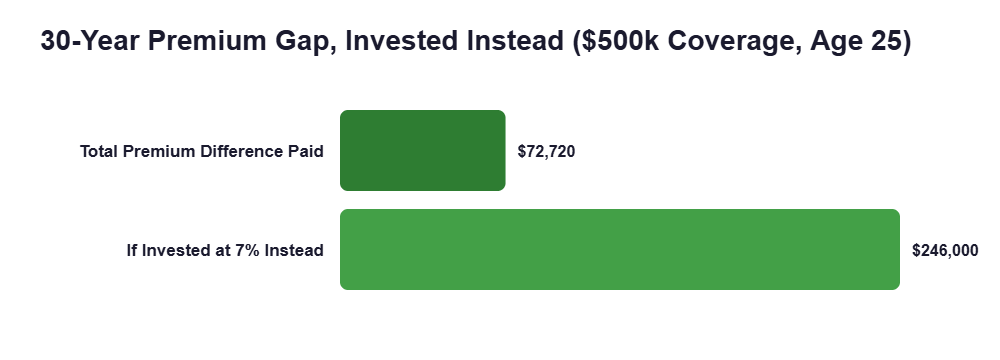
| 25 | ~$202/mo | 30 years | $72,720 | ~$246,000 |
| 35 | ~$350/mo | 25 years | $105,000 | ~$284,000 |
| 45 | ~$485/mo | 15 years | $87,300 | ~$154,000 |
Two things stand out. First, the 25-year-old ends up with the largest invested balance despite the smallest monthly gap, purely because of time in the market — three extra decades of compounding beats a bigger monthly contribution over a shorter window. Second, even the 45-year-old buyer, starting late with a shorter runway, still comes out tens of thousands ahead of what whole life’s guaranteed cash value would have produced over the same 15 years.
My Honest Take
The younger you are when you make this decision, the more this table should influence you — not because the choice is different at 45, but because the cost of getting it wrong compounds longer. If you’re in your 20s and someone is pitching you whole life as a “start early” strategy, that pitch has it backwards. Starting early is exactly the argument for term plus investing, not against it. The one exception I’d flag: if you already know you want permanent coverage for an estate planning reason, starting a whole life policy young does lock in a lower premium for life — but that’s a narrow, specific case, not a reason to default to whole life at 25 just because you can afford the premium.