Robo-Advisor vs Financial Advisor: Which One Do You Actually Need?
Robo-advisor vs financial advisor: a clear breakdown of costs, capabilities, and when each option makes sense for your financial situation.
Robo-advisor vs financial advisor is one of the most common decisions investors face today — and both the answer and the cost implications have shifted dramatically over the last decade. Robo-advisors now manage over $1 trillion in assets. Human financial advisors still serve millions more. Which one is right for you depends less on which is “better” and more on what you actually need.
This guide breaks down the real differences: cost, investment approach, personalization, tax planning, behavioral coaching, and who each solution genuinely serves.
The Core Difference
A robo-advisor is software. It builds and manages a diversified investment portfolio for you automatically, based on your answers to a questionnaire about your timeline, risk tolerance, and goals. It rebalances when markets drift your allocation, and the better ones harvest tax losses automatically. You interact with it through an app. It doesn’t know your name, your family situation, or the fact that you’re nervous about a job change.
A financial advisor is a person. A fiduciary financial advisor — one legally required to act in your interest — can assess your complete financial picture: income, debts, taxes, insurance, estate planning, behavioral tendencies, family dynamics, and career trajectory. They can answer questions in real time, push back when you’re about to make a costly mistake, and coordinate across different aspects of your financial life in ways no algorithm currently can.
The Cost Gap Is Real — and Large
Robo-advisors typically charge 0.00–0.50% annually, depending on the platform. Fidelity Go is free for accounts under $25,000. Betterment and Wealthfront charge 0.25%. Some platforms have no minimum balance.
Human financial advisors typically charge 0.75–1.50% annually for AUM (assets under management) models, with a $100,000–$500,000 typical minimum. Fee-only planners may charge $2,000–$10,000+ for a comprehensive financial plan, or $250–$500/hour for ongoing advice. The median fee for a comprehensive financial plan is around $2,500 according to industry surveys.
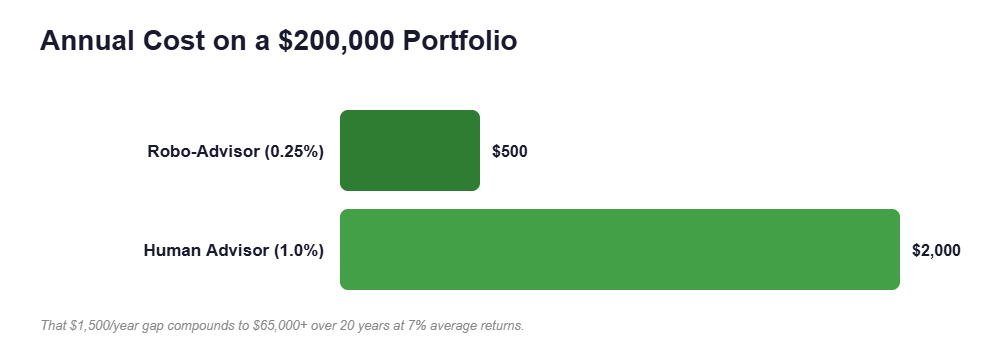
On a $200,000 portfolio, the annual cost difference between a 0.25% robo-advisor and a 1.0% human advisor is $1,500 per year. Over 20 years with 7% average annual returns, that $1,500 annual difference compounds to over $65,000 in foregone growth. Cost matters enormously in long-run wealth building.
What Robo-Advisors Do Well
Robo-advisors excel at disciplined, low-cost, rules-based investing. They will never panic-sell during a correction because they don’t have emotions. They rebalance automatically, which enforces buy-low-sell-high discipline you’d struggle to maintain manually. Tax-loss harvesting (where available) optimizes after-tax returns. And they’re accessible at any account size — you can start with $500 or nothing at all.
For investors with a single primary goal (retirement savings), a long time horizon, and a reasonably simple financial picture, robo-advisors deliver excellent value. Research consistently shows that most actively managed portfolios underperform low-cost index funds over time. A robo-advisor charging 0.25% to hold index ETFs is a genuinely smart long-term strategy for most people.
What Human Advisors Do Well
The case for a human advisor shines in complexity and behavior. A good advisor earns their fee during market crashes when clients want to sell everything — talking someone out of a panic-driven decision can preserve tens of thousands of dollars of wealth. No app does this effectively.
Human advisors also handle things algorithms fundamentally can’t: coordinating tax strategy across a business, investment portfolio, and estate plan; advising on whether to do a Roth conversion in a lower-income year; guiding a widow through inherited account decisions; managing the financial side of a divorce; advising on Social Security timing; evaluating a pension vs. lump sum offer. If your financial life has these kinds of intersecting complexities, a human advisor isn’t a luxury — it’s likely a net positive on wealth.
The Middle Ground: Hybrid Models
Several platforms now offer robo-advisor portfolios with human advisor access layered on top. Vanguard Personal Advisor Services (0.30% fee, $50,000 minimum) provides human advisors who guide your overall strategy while robo-allocation handles day-to-day management. Betterment Premium (0.40% fee, $100,000 minimum) offers unlimited CFP access. Schwab Intelligent Portfolios Premium ($30/month after a one-time $300 fee) includes a dedicated financial planner. These hybrids are worth serious consideration: you get most of the behavioral and planning benefits of a human advisor at a fraction of traditional AUM fees.
When to Use a Robo-Advisor
A robo-advisor is the right choice when your financial picture is relatively straightforward — you’re saving for retirement, you have a single taxable brokerage account, and your primary goal is long-term wealth accumulation. It’s also the right choice when your investable assets don’t yet meet most advisors’ minimums, or when you want to minimize investment costs over a multi-decade horizon. Most people in their 20s, 30s, and early 40s with clean financial situations will do well with a robo-advisor and a once-a-year check-in on their goals.
When to Use a Human Advisor
Consider a human advisor when your financial situation involves real complexity: a business, significant equity compensation (RSUs, stock options), an inheritance, estate planning needs, a pension decision, or a major life transition. Also consider one if you’ve struggled with investment behavior — selling in downturns, chasing performance, avoiding your finances entirely. A fiduciary advisor who charges a flat fee or a low AUM rate can be worth far more than they cost in these scenarios.
The Bottom Line
For most investors with straightforward goals and modest complexity, a robo-advisor is the better financial choice: lower cost, disciplined execution, and excellent long-run performance for what they do. For investors navigating real financial complexity or prone to behavioral mistakes during volatile markets, a human advisor’s value proposition is genuine. The right answer for many is to start with a robo-advisor, use it until your wealth grows and your financial picture becomes more complex, and then add human advice when the math justifies it.
Frequently Asked Questions
Are robo-advisors safe?
Yes. Robo-advisors are regulated investment advisors (RIAs) required to register with the SEC or state regulators. Accounts are held in your name at a custodian, and most are covered by SIPC insurance up to $500,000 for securities.
Can a robo-advisor replace a financial advisor?
For straightforward investment management — building a diversified portfolio, rebalancing, tax-loss harvesting — yes. For complex financial planning involving taxes, estate planning, business finances, or major life decisions, a human advisor provides value a robo-advisor cannot replicate.
How much does a human financial advisor cost?
AUM-based advisors typically charge 0.75–1.50% annually, often with a $100,000–$500,000 minimum. Fee-only planners may charge $2,000–$10,000 for a comprehensive plan, or $250–$500/hour for ongoing work.
What is a fiduciary financial advisor?
A fiduciary financial advisor is legally required to act in your best interest, rather than just recommending “suitable” investments. Fee-only advisors are typically fiduciaries. You can search for fiduciary advisors at NAPFA.org.
Is a robo-advisor good for beginners?
Yes — robo-advisors are one of the best options for beginning investors. Low minimums, automated rebalancing, and diversified portfolios remove most of the complexity from investing. You don’t need to know which ETFs to buy or when to rebalance.