HSA vs. 401(k): Which Should You Max Out First in 2026?
HSA vs 401k: see why the HSA's triple tax advantage often beats even a Roth, and the right order to fund both in 2026.
The HSA vs 401k debate sounds like it should be complicated, but it isn’t. If you have access to a Health Savings Account, here’s the priority order in one sentence: get your full 401(k) match first (it’s free money), max out your HSA second (nothing beats its tax treatment), then go back and finish off your 401(k) or an IRA. That’s it. The tricky part isn’t the order — it’s understanding why the HSA, an account most people think of as a place to stash money for doctor visits, deserves to rank above even a Roth IRA once the free match is captured.
Quick 2026 numbers you need
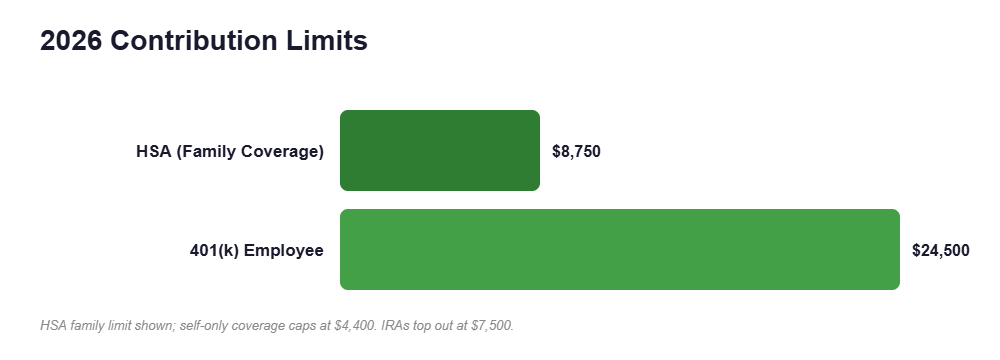
Before getting into strategy, here’s what you’re working with this year. For 2026, the IRS allows HSA contributions up to $4,400 for self-only health coverage or $8,750 for family coverage, with an extra $1,000 catch-up contribution if you’re 55 or older. On the retirement side, the 2026 401(k) employee contribution limit is $24,500, and IRAs (Roth or Traditional) top out at $7,500. One catch: you’re only eligible to contribute to an HSA if you’re enrolled in a qualifying high-deductible health plan, or HDHP. No HDHP, no HSA — you’d be stuck choosing between a 401(k) and an IRA instead, which is its own worthwhile conversation (we cover that tradeoff in our Roth IRA vs Traditional IRA breakdown).
Step one: always grab the match
This part isn’t up for debate. If your employer matches 401(k) contributions — say, 50% up to 6% of your salary — contribute at least enough to get every dollar of that match before you touch anything else. It’s an instant, guaranteed return that no HSA, IRA, or brokerage account can compete with. Skipping the match to prioritize an HSA is like turning down a raise. Get the match, then move to step two.
Why the HSA jumps ahead of everything else
Once the match is secured, the HSA takes over as the best account you can put money into, and the reason comes down to something called the triple tax advantage — a phrase that gets thrown around a lot but is worth actually unpacking. First, your contributions go in pre-tax (or tax-deductible if you contribute outside of payroll), so you lower your taxable income the same way a Traditional 401(k) contribution does. Second, the money grows completely tax-free while it’s invested inside the account — no capital gains tax, no dividend tax, nothing, for as long as it sits there. Third, when you eventually withdraw the money for qualified medical expenses, that withdrawal is also entirely tax-free.
No other account offers all three of those benefits at once. A Traditional 401(k) gets you the tax break going in, but you pay ordinary income tax on withdrawals in retirement. A Roth IRA gets you tax-free withdrawals, but you funded it with after-tax dollars, so there’s no break on the way in. The HSA is the only account in the entire tax code that gets a break on contributions, a break on growth, and a break on withdrawals — assuming those withdrawals are for medical costs. That’s the whole case for why it edges out a Roth IRA on pure math, even though a Roth is a phenomenal account in its own right.
“But I want that money for actual medical bills”
This is the objection that stops most people from treating their HSA like an investment account, and it’s based on a completely reasonable misunderstanding. The instinct is to think of the HSA balance as an emergency fund for health costs, so anything you don’t spend feels like money you’re leaving unprotected. But here’s the workaround that changes everything: there’s no deadline on when you have to reimburse yourself for a medical expense. You can pay a $200 urgent care bill out of pocket today, keep the receipt, leave your HSA balance untouched and invested, and reimburse yourself for that $200 from the HSA ten, twenty, or thirty years from now — completely tax-free, because it was still a qualified medical expense whenever it happened.
That means the smart play, for anyone who can afford to pay small medical costs out of pocket, is to invest your HSA contributions the same way you’d invest a 401(k) — index funds, target-date funds, whatever your provider offers — and let them compound for decades. Save your receipts in a folder (physical or digital) as your proof, and treat the HSA as a stealth retirement account that happens to also be your emergency medical fund if you ever truly need it. Given enough time, this is exactly the kind of account where how compound interest works starts to matter enormously — a few decades of tax-free growth on even modest annual contributions adds up to a genuinely large number.
The lesser-known age-65 rule
Here’s the detail that turns the HSA from “great medical account” into “great retirement account, period.” Once you turn 65, you’re allowed to withdraw money from your HSA for any reason at all, not just medical expenses, without paying the usual 20% early withdrawal penalty. If you use it for non-medical expenses at that point, you’ll owe ordinary income tax on the withdrawal — functionally identical to how a Traditional IRA or 401(k) withdrawal works in retirement. If you still use it for qualified medical expenses (which, statistically, retirees have plenty of), it remains entirely tax-free, penalty and all. In other words, after 65 your HSA behaves like a Traditional retirement account at worst, and like a fully tax-free account at best. There’s no scenario where that money becomes trapped or penalized. That flexibility is a big part of why financial planners increasingly describe a well-funded HSA as one of the most underrated retirement tools available.
The honest tradeoff you shouldn’t skip
None of this works unless you’re actually eligible for an HSA, and eligibility only comes through enrolling in a high-deductible health plan. HDHPs are a real tradeoff, not a hack — you’re agreeing to a higher deductible in exchange for a lower monthly premium, which means if you have a bad health year, you’ll be paying more out of pocket before insurance kicks in. If you have ongoing medical needs, young kids with regular pediatrician visits, or you simply don’t have the cash cushion to absorb a higher deductible, a traditional low-deductible PPO might be the better call regardless of the tax perks you’d be giving up. This whole strategy only applies to people who already have, or are seriously considering, an HDHP for reasons that make sense for their health situation and budget — not people chasing a tax break at the expense of their actual medical care.
Putting the full order together
So here’s what the complete stack looks like for someone with access to both accounts. First, contribute enough to your 401(k) to get the full employer match. Second, max out your HSA — $4,400 for self-only or $8,750 for family coverage in 2026 — and invest it rather than letting it sit in cash. Third, go back to your 401(k) and keep contributing up to the $24,500 limit, or split the rest between your 401(k) and a Roth or Traditional IRA depending on which suits your tax situation. If you don’t have HDHP access at all, skip straight from the match to maxing out an IRA and then your 401(k).
Bottom Line
The HSA vs 401k question isn’t really a competition — it’s a sequence. Take the free match, then let the HSA’s unmatched triple tax advantage do its work, then finish funding retirement accounts with whatever’s left. The biggest mistake isn’t picking the wrong account; it’s treating the HSA like a checking account for copays instead of the tax-advantaged growth engine it’s actually built to be.
Sources: Contribution limits: IRS: 2026 401(k) and IRA limits (checked September 30, 2026).