401(k) vs. Robo-Advisor: Where Should Your Next Dollar Go?
401k vs robo advisor: get the match first, then choose based on taxes and flexibility. Here's the framework that actually settles it.
The 401(k) vs. robo-advisor debate sounds like it should be an either/or decision, but it isn’t. Here’s the whole thing in one sentence: always capture your full employer 401(k) match first, because free money beats any fee or tax consideration, and after that, where your next dollar goes depends on whether you value tax advantages more than flexibility. Everything else in this post is just unpacking that sentence.
The One Rule That Beats Every Other Consideration
If your employer offers any kind of match on your 401(k) contributions, that match comes before literally everything else in your financial life except maybe paying off high-interest debt. A common match structure is 50% up to 6% of your salary, which means if you contribute 6%, your employer kicks in another 3%, for free, no questions asked. There is no robo-advisor fee structure, no tax strategy, and no investment return that beats an instant, guaranteed 50% or 100% return on your money. Skipping the match to put money into a taxable robo-advisor account instead is one of the most avoidable mistakes in personal finance. So step one is not “401(k) or robo-advisor.” Step one is: contribute enough to your 401(k) to get every dollar of the match. Only after that’s locked in does the real question start.
What You’re Actually Choosing Between
Once the match is covered, you’re deciding between two different tools that solve different problems. A 401(k) is a tax-advantaged retirement account: your contributions are typically pre-tax (or after-tax and tax-free at withdrawal, if it’s a Roth 401(k)), your investments grow tax-deferred or tax-free, and in exchange for those tax breaks, the government restricts when you can touch the money without a penalty, generally age 59½. A robo-advisor account, by contrast, is usually a taxable brokerage account managed by an algorithm that builds and rebalances a diversified portfolio for you. If you’re fuzzy on the mechanics, this rundown of what a robo-advisor actually is covers how they build portfolios and what you’re paying for. The trade-off in plain terms: the 401(k) gives you a bigger tax break and a higher contribution ceiling, but locks your money up. The robo-advisor gives you zero withdrawal restrictions, more control over what you’re invested in, and access to your cash anytime, no penalty, no waiting for a qualifying life event.
The 2026 Numbers That Actually Matter Here
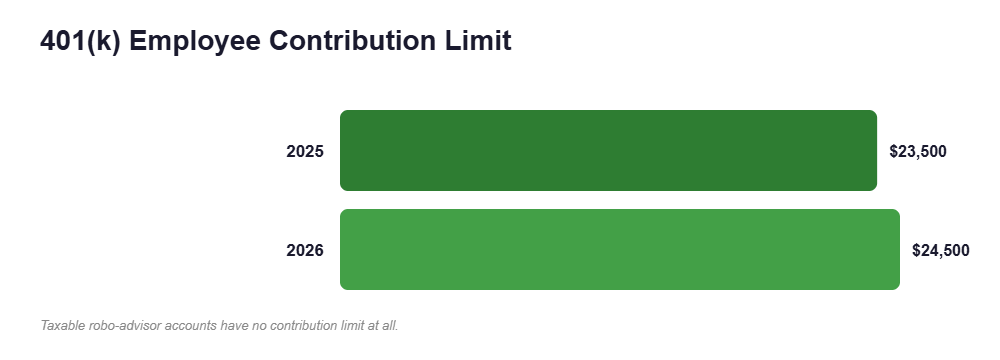
The gap in contribution limits is bigger than most people realize. For 2026, the IRS raised the 401(k) employee contribution limit to $24,500, up from $23,500 in 2025, and if you’re 50 or older, you can add a catch-up contribution of $8,000, bringing your total to $32,500 (workers aged 60-63 get an even higher catch-up of $11,250). A taxable robo-advisor account has no contribution limit at all, but the comparison that matters isn’t the ceiling, it’s the tax treatment. Every dollar you put into a traditional 401(k) reduces your taxable income this year and grows without being taxed annually on dividends or capital gains. A robo-advisor account gets no such break: dividends are taxed as they’re paid out, and you’ll owe capital gains tax when you sell.
On the robo-advisor side, fees have compressed a lot in recent years, but they’re not zero. Typical management fees run in the 0.25% to 0.35% range annually on your assets under management, with some platforms like Vanguard Digital Advisor coming in lower around 0.15%, and Schwab Intelligent Portfolios charging no advisory fee at all (though it requires holding a chunk of cash that isn’t invested, which is its own cost). On top of the management fee, you’re also paying the underlying fund expense ratios, typically another 0.05% to 0.10%. None of these fees are dealbreakers on their own, but they’re a real, ongoing cost that a 401(k)’s tax break has to outweigh for the retirement account to make sense as your next dollar’s destination. If you want to see how the major platforms stack up on fees, minimums, and features, the Best Robo-Advisors 2026 roundup breaks it down platform by platform.
Where Most People Should Send Their Next Dollar
For most people in their 20s and 30s who are building long-term wealth and don’t have an urgent need for the cash, the tax-advantaged accounts win the sequencing race after the match. That usually means maxing out (or getting as close as you can to maxing out) your 401(k), and if you have room after that, adding a Roth or Traditional IRA, before building up a taxable robo-advisor account. The math is straightforward: a $24,500 contribution to a traditional 401(k) doesn’t just grow tax-deferred, it also lowers your taxable income for the year, which for many people is worth more than the flexibility of a taxable account. Over a 30-year investing horizon, the difference between paying taxes annually on gains versus deferring them (or avoiding them entirely with a Roth) compounds into a meaningfully larger balance at retirement, even after accounting for the eventual tax bill on withdrawal. If your only goal is “grow money for retirement as efficiently as possible,” the retirement accounts should absorb your dollars first.
When a Taxable Robo-Advisor Account Should Jump the Line
That said, “retirement accounts first” isn’t a universal rule, and treating it like one can leave you cash-poor when life happens. A few scenarios where prioritizing a taxable robo-advisor account over additional 401(k) contributions makes more sense:
You’re saving for a goal with a real timeline, like a house down payment in the next three to seven years. Money you’ll need before 59½ has no business in a 401(k), where an early withdrawal typically triggers a 10% penalty plus ordinary income tax. A robo-advisor taxable account lets that money grow with some market exposure while staying fully accessible whenever your closing date arrives.
You want liquidity as a general principle, not tied to a specific goal. Some people are simply uncomfortable having the bulk of their net worth locked away for decades, especially early in a career when income and job stability can be unpredictable. A taxable account gives you a pool of money you can tap for a job loss, a medical bill, or an opportunity that comes up, without the bureaucracy of a 401(k) hardship withdrawal or loan.
You’ve already got solid retirement savings on track. If you’re contributing enough to your 401(k) and IRA to be on pace for retirement (a good rule of thumb is having roughly your annual salary saved by age 30, growing from there), pouring every additional dollar into more tax-deferred, illiquid savings might not be the best use of new money. At that point, building a flexible taxable portfolio, or funding other goals like a business, a home, or simply a larger cash cushion, can be the smarter move.
You Don’t Have to Pick Just One
This is the part that gets lost in most of these comparisons: it’s not a permanent, exclusive choice. Most people who stick with investing for the long haul eventually do both. You might spend your 20s maxing your 401(k) match and building a starter taxable robo-advisor account on the side for flexibility, then shift more toward retirement accounts once your income rises and the tax deduction becomes more valuable. Or you might front-load a taxable account while saving for a house, then pivot hard toward retirement contributions once that goal is met. The accounts aren’t competitors, they’re tools with different jobs: one is built to grow your money efficiently over decades with the tax code on your side, and the other is built to keep your money working while staying within reach. Funding both, in whatever proportion fits your actual life, is normal and often optimal.
Bottom Line
Get the full 401(k) match, no exceptions. After that, default to prioritizing tax-advantaged retirement accounts if you’re investing for the long term with no near-term cash needs, since the 2026 contribution limits ($24,500, or $32,500 if you’re 50+) and tax treatment usually outweigh a robo-advisor’s 0.25% to 0.35% fee. But if you’ve got a goal inside the next five to seven years, want a liquid cushion, or you’re already on pace for retirement, a taxable robo-advisor account deserves the next dollar instead. And if you’re not sure which camp you’re in, split the difference. There’s no rule that says you have to choose forever.
Sources: Contribution limits: IRS: 2026 401(k) and IRA limits (checked September 30, 2026).