Wealthfront Review 2026: The Best Robo-Advisor for Hands-Off Investors?
Wealthfront combines tax-loss harvesting, a high-yield cash account, and automated portfolio management into one sleek platform. Here's our full 2026 review.
Wealthfront combines tax-loss harvesting, a high-yield cash account, and automated portfolio management into one sleek platform. Here’s our full 2026 review.
- Annual fee: 0.25%
- Minimum investment: $500
- Tax-loss harvesting: Yes — all taxable accounts
- Human advisors: No
- Cash account APY: Competitive variable rate (check site for current rate)
- Best for: Tax-focused, hands-off investors with $500+
What Is Wealthfront?
Wealthfront launched in 2011 and has grown into one of the largest independent robo-advisors, managing billions in assets. Unlike Acorns (which targets micro-savers) or Betterment (which emphasizes financial planning), Wealthfront’s identity is built around sophisticated automated investing — doing things that used to require a high-net-worth relationship with a wealth management firm, available to anyone with $500 to start.
Wealthfront Pricing in 2026
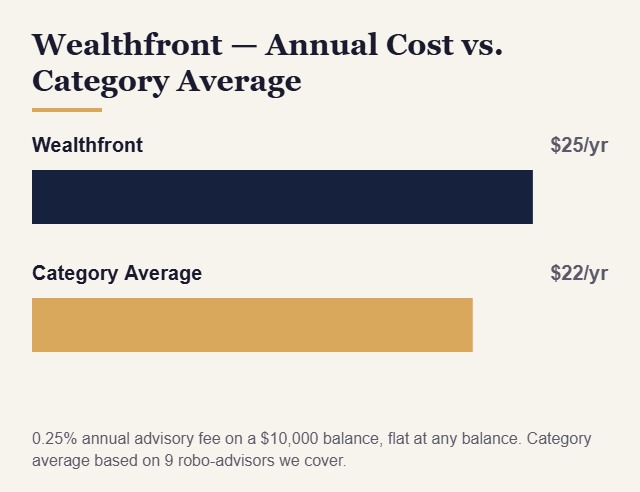
Wealthfront charges a flat 0.25% annual advisory fee on all invested assets — that’s $25/year on a $10,000 account. There are no tiered pricing structures, no subscription fees, and no trading commissions. The high-yield cash account carries zero management fee. Direct indexing (available at $100,000+) is included in the same 0.25%.
The underlying ETFs in Wealthfront portfolios carry their own expense ratios, averaging around 0.07–0.10% annually, bringing your total all-in cost to roughly 0.32–0.35% per year — competitive with Betterment and significantly cheaper than traditional financial advisors who typically charge 1%+.
Wealthfront’s Standout Features
Tax-Loss Harvesting
Wealthfront monitors your portfolio daily and automatically harvests tax losses — selling positions that have declined in value to offset gains elsewhere in your portfolio. Over time, this can meaningfully improve your after-tax returns. Wealthfront offers this on all taxable accounts with no minimum balance, which distinguishes it from competitors like Schwab (no TLH) and Fidelity Go (no TLH).
Direct Indexing (Stock-Level Tax-Loss Harvesting)
At $100,000+, Wealthfront replaces ETFs with individual stocks in your portfolio, enabling harvesting at the individual stock level. This generates significantly more tax alpha than ETF-level harvesting — a feature that wealth management firms typically charge much more for. Wealthfront estimates Direct Indexing adds approximately 1.07% in after-tax returns annually in a typical market environment.
High-Yield Cash Account
Wealthfront’s cash account offers a competitive APY with no fees, no minimums, and FDIC insurance up to $8 million through a network of partner banks. It integrates directly with your investment account, making it easy to move money between saving and investing — and it connects with Wealthfront’s Self-Driving Money automation.
529 College Savings Plan
Wealthfront is one of the only robo-advisors offering a 529 plan, making it a strong choice for parents who want to invest for their children’s education alongside their own retirement — all in one platform.
Self-Driving Money
Wealthfront’s automation goes beyond investing. You can connect your paycheck and set rules to automatically route income — keep a defined amount in checking, move excess to your cash account, then funnel anything beyond your target to investments. Once configured, your financial system runs itself. No manual transfers, no decisions required every pay cycle.
Wealthfront Portfolio: What You’re Actually Investing In
When you open a Wealthfront account, you’ll complete a short risk questionnaire covering your timeline, goals, and comfort with volatility. Based on your answers, Wealthfront assigns you a risk score from 0.5 to 10 and builds a diversified ETF portfolio accordingly.
A typical Wealthfront portfolio for a moderate-risk investor might include ETFs covering US stocks, foreign stocks, emerging markets, dividend stocks, real estate (REITs), natural resources, municipal bonds, and corporate bonds. Wealthfront uses low-cost funds from Vanguard, iShares, and Schwab — keeping underlying expenses minimal.
Portfolios are automatically rebalanced when they drift more than a set threshold from your target allocation — triggered by deposits, withdrawals, or market movements. You don’t need to do anything to keep your allocation on track.
How to Open a Wealthfront Account (Step by Step)
Opening a Wealthfront account takes about 10 minutes. Here’s how the process works:
- Create an account — Enter your email, create a password, and verify your identity (SSN, date of birth, address).
- Complete the risk questionnaire — Answer 7–10 questions about your investing goals, timeline, and risk tolerance. Wealthfront assigns you a risk score.
- Review your proposed portfolio — Wealthfront shows you your recommended asset allocation before you commit any money. You can adjust your risk score if it doesn’t feel right.
- Link your bank account — Connect via Plaid (instant verification for most major banks).
- Fund your account — Transfer a minimum of $500 to activate your investment portfolio. Funds typically invest within 1–3 business days.
- Enable automation (optional) — Set up Self-Driving Money rules to automate future transfers from your paycheck or checking account.
Once funded, Wealthfront runs entirely on autopilot — rebalancing, harvesting tax losses, and reinvesting dividends without any input from you.
Wealthfront vs The Competition (2026)
How does Wealthfront stack up against the other major robo-advisors? Here’s a direct comparison across the features that matter most:
| Feature | Wealthfront | Betterment | Schwab IP | Fidelity Go |
|---|---|---|---|---|
| Annual Fee | 0.25% | 0.25% | 0%* | 0% / 0.35%** |
| Minimum | $500 | $0 | $5,000 | $0 |
| Tax-Loss Harvesting | ✅ All accounts | ✅ All accounts | ❌ | ❌ |
| Human Advisors | ❌ | ✅ ($299+) | ✅ ($30/mo) | ✅ Free |
| Cash Account | ✅ High yield | ✅ Cash reserve | ❌ | ❌ |
| 529 Plan | ✅ | ❌ | ❌ | ❌ |
| Direct Indexing | ✅ $100K+ | ✅ $100K+ | ❌ | ❌ |
| Best For | Tax efficiency | Financial planning | No-fee investing | Beginners |
*Schwab charges no advisory fee but requires ~6–10% cash allocation (opportunity cost). **Fidelity Go is free under $25K, then 0.35%.
Where Wealthfront Falls Short
- $500 minimum — Not accessible to true beginners with nothing saved yet (vs. Acorns’ $0 or Betterment’s $0 minimum)
- No human advisors — Wealthfront is fully automated. If you want to talk to a person about your financial plan, this isn’t your platform
- No fractional shares in direct indexing — A minor limitation that can cause slight tracking error vs. the benchmark
- Cash drag is minimal but present — A small percentage of your portfolio is held in cash for rebalancing purposes
Who Is Wealthfront Best For?
Wealthfront is the best robo-advisor for people who:
- Want maximum automation and tax efficiency with minimal ongoing effort
- Have at least $500 to start (ideally $5,000+ to get meaningful tax-loss harvesting value)
- Want a high-yield cash account integrated with their investments
- Are tech-forward and comfortable managing everything through an app
- Don’t need or want access to a human financial advisor
- Are in a higher tax bracket where tax-loss harvesting provides the most benefit
If you want human advisor access, Betterment or Fidelity Go may be better fits. If you want zero fees and have $5,000+, Schwab Intelligent Portfolios is worth considering (with the caveat of their cash allocation model).
Wealthfront Review Verdict
Wealthfront is our top pick for investors who want their money working as hard as possible with zero ongoing effort. The combination of daily tax-loss harvesting, competitive 0.25% pricing, a best-in-class cash account, and the Self-Driving Money feature make it the most complete automated investing solution available. The $500 minimum keeps it from being the best choice for absolute beginners, but for anyone with a few thousand dollars ready to invest, Wealthfront is hard to beat.
As you build your portfolio with Wealthfront, it’s also worth asking whether your financial plan includes adequate income protection. If you have dependents or debt, a term life insurance policy is one of the most cost-effective ways to protect everything you’re building. See our guide: Do You Need Life Insurance If You’re Already Investing?
The Tax Math: When Wealthfront’s Fee Pays for Itself
At 0.25%, Wealthfront’s advisory fee is identical to Betterment’s. Where Wealthfront earns that fee — and potentially more — is through tax efficiency, and the math is worth understanding before you choose between the two.
Tax-loss harvesting is available at all balance levels. For a $50,000 taxable account in a normal market year, Wealthfront estimates this adds roughly 0.15–0.32% in after-tax returns. That’s potentially enough to cover most or all of the 0.25% advisory fee in good harvest years — though not every year, and the value depends on your tax bracket and contribution pattern.
The bigger opportunity is at $100,000+, where direct indexing activates. Instead of holding a total market ETF, Wealthfront holds individual S&P 500 stocks and harvests losses at the individual stock level — not just the fund level. This unlocks far more harvesting opportunities than ETF-level TLH. Wealthfront estimates stock-level direct indexing adds 0.50–1.10% in after-tax returns annually for eligible accounts. If that estimate holds, you’re not paying 0.25% — the platform is effectively paying you to use it, net of fees.
| Balance | Wealthfront Fee (0.25%) | Estimated TLH Benefit | Net Cost After Tax Benefit |
|---|---|---|---|
| $25,000 | $62/yr | $38–75/yr | ~$0–25/yr |
| $50,000 | $125/yr | $75–160/yr | ~$0–50/yr |
| $100,000 (direct indexing) | $250/yr | $500–1,100/yr | Net positive by $250–850/yr |
| $250,000 (direct indexing) | $625/yr | $1,250–2,750/yr | Net positive by $625–2,125/yr |
Tax-loss harvesting estimates are Wealthfront’s published figures and will vary based on market conditions, tax bracket, and portfolio composition. These are not guarantees.
My Honest Take on Wealthfront
Wealthfront is the platform I’d choose if I expected my taxable brokerage account to eventually hit $100,000. The direct indexing at that tier is genuinely differentiated — most robo-advisors don’t offer it at any price — and the tax savings for high-balance, high-tax-bracket investors are real enough to make the fee decision a non-issue.
Below $100K, the choice between Wealthfront and Betterment is essentially a wash. Both charge 0.25%, both offer tax-loss harvesting, both have solid low-cost ETF portfolios. In that range, I’d give the edge to Betterment simply because its goal-based interface is more intuitive for most people managing multiple financial targets at once.
One thing Wealthfront gets right that doesn’t get enough credit: the Path financial planning tool. Being able to connect your outside accounts — 401(k), savings, home equity — and get a realistic projection of whether you’re on track for retirement without talking to anyone or being sold anything is genuinely useful. It’s not a replacement for a full financial plan, but it’s a free, honest sanity check that most working professionals would benefit from running once a year. Betterment doesn’t offer anything comparable at no cost.
Bottom line: if you’re in a high tax bracket, have or expect to have $100K+ in a taxable account, and care about after-tax returns more than any other single metric — Wealthfront is the right choice. If you want the most intuitive goal-based experience and might someday want to talk to a CFP: Betterment. Both are excellent platforms. The difference is which feature set fits your situation.
Frequently Asked Questions About Wealthfront
Is Wealthfront safe?
Wealthfront is a legitimate, SEC-registered investment adviser that has been operating since 2011. Your investments are held in a brokerage account insured by SIPC up to $500,000. Cash in Wealthfront’s Cash Account is FDIC insured up to $8 million through partner banks. Wealthfront itself does not hold your money — it is custodied at a separate institution.
What is Wealthfront’s annual fee?
Wealthfront charges a flat 0.25% annual advisory fee on all invested assets. There are no additional trading commissions or withdrawal fees. The underlying ETFs in your portfolio also carry their own expense ratios, which average around 0.07–0.10% annually — so your total annual cost is roughly 0.32–0.35%.
Is Wealthfront good for beginners?
Wealthfront is excellent for beginners who want a completely hands-off investing experience. Once you answer a short risk questionnaire and fund your account, Wealthfront handles everything — asset selection, rebalancing, and tax-loss harvesting. The $500 minimum is accessible for most people starting out, and the 0.25% fee is competitive for the level of automation provided. If $500 is too high a bar, consider Betterment (no minimum) or Acorns ($0 minimum) to start.
Does Wealthfront have tax-loss harvesting?
Yes. Wealthfront offers daily automated tax-loss harvesting on all taxable accounts with no minimum balance requirement — one of its strongest differentiators versus competitors like Schwab and Fidelity Go, which do not offer TLH. Tax-loss harvesting sells losing investments to realize a tax deduction, then immediately reinvests in a similar asset to maintain your target allocation.
Can I lose money with Wealthfront?
Yes — like any investment, Wealthfront accounts can lose value during market downturns. Wealthfront invests your money in diversified ETF portfolios, which are subject to normal market risk. Wealthfront’s risk management tools (diversification, rebalancing, tax-loss harvesting) help manage volatility over time, but they cannot eliminate investment risk.
What is Wealthfront’s minimum investment?
Wealthfront requires a $500 minimum to open an investment account. There is no minimum for the Cash Account. The Direct Indexing feature (individual stock portfolios) is available starting at $100,000.
How does Wealthfront compare to Betterment?
Wealthfront and Betterment charge the same fee (0.25%) and both offer tax-loss harvesting on all taxable accounts. The key differences: Betterment has no account minimum ($0 vs. Wealthfront’s $500) and offers access to human financial advisors starting at $299/year. Wealthfront has a stronger cash account, offers a 529 plan, and has the Self-Driving Money automation feature. For pure tax efficiency, Wealthfront has a slight edge. For beginners or those who want occasional human guidance, Betterment is more flexible. See our full Betterment vs Wealthfront comparison.
Does Wealthfront offer a cash account?
Yes. Wealthfront’s Cash Account is a high-yield cash account with no fees, no minimum balance, and FDIC insurance up to $8 million through a network of partner banks. It pays a competitive variable APY and integrates directly with your Wealthfront investment account, making it easy to move money between saving and investing as your goals evolve.
Direct Indexing: Wealthfront’s Most Powerful Feature
For accounts over $100,000, Wealthfront offers US Direct Indexing — instead of buying an S&P 500 ETF, Wealthfront buys the individual stocks that make up the index. This allows far more granular tax-loss harvesting: individual stocks decline while the index stays flat all the time, creating frequent harvesting opportunities that an ETF-based approach can’t capture.
Wealthfront estimates Direct Indexing adds 1.07% in after-tax returns annually in a typical market environment. For a $200,000 portfolio, that’s $2,140/year in additional after-tax value — more than covering the 0.25% management fee and making Wealthfront’s cost structure genuinely self-paying for taxable accounts at that balance.
Self-Driving Money: Automating Your Full Financial Life
Wealthfront’s Self-Driving Money feature connects to your paycheck and automatically moves money between your checking, cash, and investment accounts based on rules you set. Define your checking buffer, your emergency fund target, and where surplus cash should flow — and Wealthfront executes automatically each pay period. No manual transfers, no decisions required.
This cash flow automation is unique among robo-advisors. It’s particularly valuable for high earners with variable income who want their financial system to operate on autopilot. Set it up once; your money routes itself optimally every month.
See also: Betterment vs Wealthfront (2026) — Full Comparison
Wealthfront is a strong pick for hands-off, low-fee investors, but it is not the only option. See how it compares in our Best Robo-Advisors 2026 comparison, or read our Betterment review if you would rather have access to human advisors.
Sources: Fees and terms: Wealthfront pricing (last verified September 2026).