Betterment Review 2026: The Original Robo-Advisor, Still a Top Pick?

Betterment invented the robo-advisor category in 2010 — and it's still one of the best. Here's our full Betterment review for 2026, including pricing, features, and who it's right for.
Betterment is the original robo-advisor — launched in 2010, it pioneered the concept of automated investing for everyday people. A decade and a half later, it remains one of the most polished and feature-complete platforms in the space, with a particular strength in goal-based investing and human advisor access. If you want an automated platform that also lets you talk to a real person when you need to, Betterment is your best option.
KatchingStacks is reader-supported. When you open an account through links on this page, we may earn a commission at no extra cost to you. See our affiliate disclosure and editorial policy.
What Is Betterment?
Betterment manages billions in assets across hundreds of thousands of accounts, offering a full suite of investment accounts: taxable brokerage, Traditional IRA, Roth IRA, SEP IRA, trust accounts, and even 401(k) plans through Betterment for Business. It’s one of the few robo-advisors with an institutional arm, giving it credibility as a long-term platform.
Betterment Pricing in 2026
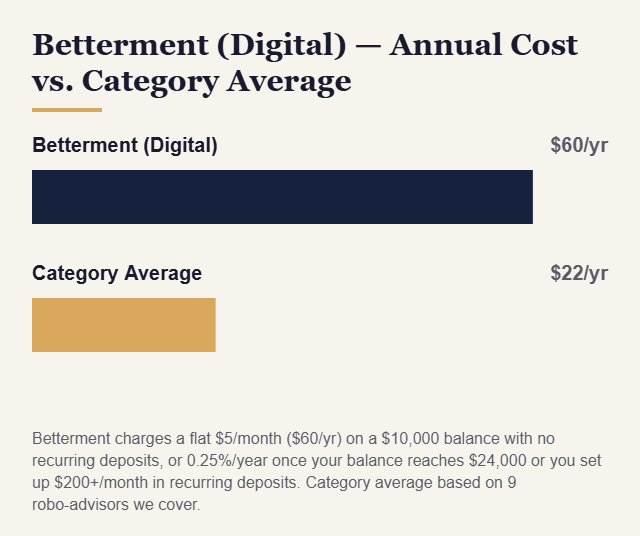
- Betterment Digital — $5/month (or 0.25%/year once your balance hits $24,000 or you set up $200+/month in recurring deposits): Core automated investing with tax-loss harvesting, goal-based tools, and smart rebalancing
- Betterment Premium — 0.40%/year: Everything in Digital plus unlimited calls with CFP professionals. Requires $100,000 minimum balance.
The 0.25% fee is identical to Wealthfront’s — but Betterment’s Premium tier at 0.40% with human advisor access makes it uniquely positioned among automated platforms. Most competitors charge 1%+ for any level of human financial guidance.
Betterment’s Standout Features
Goal-Based Investing
Betterment pioneered the goal-based approach to investing — rather than just managing “a portfolio,” you create separate goals (Retirement, Emergency Fund, Home Purchase) each with their own timeline, target amount, and portfolio allocation. This is one of the clearest mental frameworks for investing available anywhere.
Tax-Loss Harvesting
Like Wealthfront, Betterment offers daily automated tax-loss harvesting on all taxable accounts at no additional cost. It’s one of the key features that makes paying a robo-advisor fee worthwhile — the tax savings can more than offset the cost for taxable investors.
Tax Coordination
If you have both taxable and tax-advantaged accounts with Betterment, Tax Coordination automatically places the right types of investments in the right accounts to minimize your tax drag — a sophisticated strategy that goes beyond basic tax-loss harvesting.
Socially Responsible Investing (SRI)
Betterment offers three different ESG/SRI portfolio options — Broad Impact, Climate Impact, and Social Impact — letting you align your investments with your values without sacrificing Betterment’s core automated management features.
Betterment Cash Reserve
Like Wealthfront, Betterment offers a high-yield cash account with competitive APY and FDIC insurance. It integrates cleanly with your investment accounts for seamless money movement.
Where Betterment Falls Short
- No direct indexing (yet) — Wealthfront offers stock-level tax-loss harvesting at $100K+; Betterment doesn’t currently match this
- Premium requires $100K minimum — Human advisor access is locked behind a high balance threshold
- No 529 plan — Unlike Wealthfront, Betterment doesn’t offer college savings accounts
Who Is Betterment Best For?
Betterment is the best robo-advisor for people who want automated investing with optional access to human advisors, prefer goal-based investing with clear timelines and targets, care about socially responsible investment options, or want an established platform with a track record going back to 2010.
Betterment Review Verdict
Betterment remains one of the best robo-advisors available — polished, feature-rich, and genuinely easy to use. Its goal-based approach makes it the most intuitive platform for people who think about investing in terms of specific life goals rather than abstract portfolio percentages. The 0.25% fee (once you clear $24,000 or set up recurring deposits) is competitive, tax-loss harvesting is automatic, and the Premium tier’s access to CFPs makes it the only platform where you can seamlessly move from automated to human advice as your needs grow. For most investors, Betterment and Wealthfront are essentially tied — the choice comes down to which feature set matters more to you.
As you automate your investing with Betterment, consider whether your broader financial plan accounts for income protection. For investors with dependents, a term life insurance policy is a low-cost safety net that protects your family’s future regardless of what the market does. Read more: Do You Need Life Insurance If You’re Already Investing?
Frequently Asked Questions About Betterment
Is Betterment still a good robo-advisor in 2026?
Betterment remains one of the best robo-advisors in 2026, particularly for goal-based investing. Its core strengths — automated rebalancing, tax-loss harvesting, and goal tracking — hold up against newer competitors. However, its $5/month flat fee for balances under $24,000 (0.25%/year once you clear that threshold or set up qualifying recurring deposits) is no longer uniquely competitive now that free options like Fidelity Go and Schwab Intelligent Portfolios exist. It’s best for people who value Betterment’s goal-planning tools and don’t qualify for the free alternatives.
What is Betterment’s minimum investment?
Betterment has no minimum balance to open an account. The core Betterment Investing account has a $0 minimum, making it accessible to anyone. Betterment Premium, which includes unlimited calls with certified financial planners, requires a $100,000 minimum.
Does Betterment do tax-loss harvesting?
Yes. Betterment offers automated tax-loss harvesting on taxable investment accounts. The feature runs continuously — not just at year-end — and can improve after-tax returns by realizing losses to offset gains. Tax-loss harvesting is most valuable for investors in higher tax brackets and those making regular contributions.
Is Betterment FDIC insured?
Betterment investment accounts are not FDIC insured. They are covered by SIPC insurance up to $500,000, protecting against broker insolvency (not market losses). Betterment Cash Reserve, its high-yield cash account, is FDIC insured up to $2 million through a network of partner banks.
How does Betterment make money?
Betterment charges a flat $5/month for balances under $24,000 without at least $200/month in recurring deposits, or 0.25% of assets under management once your balance reaches $24,000 (or you set up qualifying recurring deposits). Premium members pay 0.40% for access to human financial advisors. Betterment does not earn trading commissions or mark up the ETFs in your portfolio.
Betterment’s Tax Coordination Feature
One of Betterment’s more sophisticated features is Tax Coordination — a strategy that automatically allocates your assets across your taxable and tax-advantaged (IRA) accounts to minimize taxes. Tax-inefficient assets (like bonds, which generate ordinary income) go in your IRA. Tax-efficient assets (like US stock ETFs, which generate qualified dividends) go in your taxable account. This optimization can add meaningful after-tax returns over time with zero manual effort on your part.
Betterment estimates Tax Coordination adds up to 0.48% in after-tax returns annually for investors who use both taxable and IRA accounts on the platform. Combined with tax-loss harvesting, Betterment’s tax tooling is among the most sophisticated in the robo-advisor space — particularly for investors coordinating multiple account types.
Betterment vs. Wealthfront: The Real Difference
The most common comparison in robo-advisor research is Betterment vs. Wealthfront. Both charge 0.25%, both offer tax-loss harvesting, and both are excellent platforms. The key differences: Betterment offers access to human CFPs at the Premium tier ($100K minimum, 0.40%/year); Wealthfront does not offer human advisor access at any tier. Wealthfront offers direct indexing for accounts over $100K and a 529 college savings plan; Betterment does not. For investors who might ever want to talk to a human advisor, Betterment wins. For investors who want maximum tax sophistication and are comfortable with full automation, Wealthfront wins.
Is Betterment Still Worth It in 2026?
Yes — with minor caveats. Betterment remains one of the most consistently excellent robo-advisors available. Its fee transparency, goal-based interface, and tax optimization features have held up against increased competition from brokerage-owned products. The main reason to choose a competitor is a specific feature Betterment lacks: the 529 plan at Wealthfront, the zero-fee model at Fidelity Go (for balances under $25K), or the DIY control at M1 Finance. If none of those specific features matter to you, Betterment is still the safest, most well-rounded choice in the category.
See also: Betterment vs Wealthfront (2026) — Full Comparison
What Betterment’s 0.25% Fee Actually Costs You (The Real Math)
0.25% sounds like almost nothing. But fees compound the same way returns do — in reverse — so it’s worth running the actual numbers before deciding whether it’s worth it.
If you invest $500 a month for 20 years at a 7% average annual return, you end up with roughly $260,000. Betterment’s 0.25% advisory fee, applied to your growing balance year over year, works out to approximately $2,500–$3,000 in total fees over that 20-year period. That’s about $125–$150 a year on average — less than a streaming subscription.
For context: a traditional financial advisor charging 1% over the same period would cost you $11,000–$13,000. A mutual fund with a 0.75% expense ratio adds another layer on top of any advisory fee. Betterment’s fee is genuinely low, and it buys you automated rebalancing, tax-loss harvesting on taxable accounts, and a goal-based interface that most people find easier to stick with than a DIY approach.
| Annual Contribution | After 20 Years (7% return) | Betterment Fees Paid | Fee as % of Portfolio |
|---|---|---|---|
| $3,000/yr ($250/mo) | ~$123,000 | ~$1,200 | ~0.97% |
| $6,000/yr ($500/mo) | ~$245,000 | ~$2,500 | ~1.02% |
| $12,000/yr ($1,000/mo) | ~$490,000 | ~$5,000 | ~1.02% |
The total fee burden over 20 years comes out to roughly 1% of your ending portfolio — a reasonable price for two decades of hands-off management, automatic rebalancing, and tax-loss harvesting on taxable accounts.
My Honest Take on Betterment
If someone I knew asked me what to do with $10,000 they wanted to invest and never think about again, I’d tell them Betterment. Not because it’s the most sophisticated option — it isn’t — but because it’s the easiest to set up correctly, the hardest to mess up, and the one most likely to keep you invested through a down market without touching your allocation.
The goal-based interface is genuinely useful for people with a day job. Seeing a “Retirement” bucket, a “House Down Payment” bucket, and an “Emergency Fund” bucket — each with its own risk level and timeline — is a better mental model than watching a single portfolio number fluctuate. It makes it harder to pull money impulsively because you’d be raiding a specific goal, not just a number.
The main reason to consider an alternative: if you have $100,000+ and care deeply about after-tax returns, Wealthfront’s direct indexing is more sophisticated. If your balance is under $25K and you want zero advisory fee, Fidelity Go is free. But for the majority of working professionals who want a set-it-and-forget-it investing experience with professional portfolio construction? Betterment is the right answer.
Betterment is a strong all-around pick, but it is not the only option. See how it stacks up in our Best Robo-Advisors 2026 comparison, or check our SoFi Automated Investing review if a $0 management fee matters more to you than human advisor access.
Sources: Fees and terms: Betterment pricing (last verified September 2026).