Traditional 401(k) vs Roth 401(k): Which Is Right for You in 2026?
Traditional 401k vs Roth 401k in 2026: how the tax break, contribution limits, and employer match differ — and which one wins for you.
The traditional 401(k) vs Roth 401(k) decision trips people up for the same reason the Roth vs Traditional IRA question does, and honestly, it’s the same question wearing a different outfit. Here’s the whole thing in one sentence: the Traditional 401(k) gives you a tax break today and taxes your withdrawals in retirement, the Roth 401(k) taxes your money today and lets it grow completely tax-free forever, and the right pick depends on whether your tax rate is higher right now or will be higher decades from now. If that setup sounds familiar, it’s because we covered the IRA version of this exact tradeoff in Roth IRA vs Traditional IRA. This is the 401(k) companion piece, and while the core logic carries over, 401(k)s have their own quirks — a much bigger contribution ceiling, an employer match that plays by different rules, and (unlike the Roth IRA) zero income limits standing in your way.
How Each One Actually Works
A Traditional 401(k) takes your contribution out of your paycheck before taxes are calculated. That lowers your taxable income for the year you contribute, which is why your take-home pay doesn’t drop by the full contribution amount. The money grows tax-deferred, and when you eventually pull it out in retirement, every dollar — your original contributions plus decades of growth — gets taxed as ordinary income.
A Roth 401(k) works in reverse. Your contribution comes out of your paycheck after taxes, so you don’t get any deduction today. In exchange, the money grows completely tax-free, and qualified withdrawals in retirement — both your contributions and all the growth — come out with zero additional tax owed. That second part is the whole point of a Roth account, and it’s worth sitting with for a second: if you contribute at 28 and let it ride for 35+ years, every dollar of growth on top of your original contribution is untouched by taxes when you eventually spend it. That’s a big deal once you factor in how compound interest works over a multi-decade career — tax-free compounding on a large balance is a very different outcome than compounding a balance you’ll owe taxes on later.
Contribution Limits: Where 401(k)s Blow Past IRAs
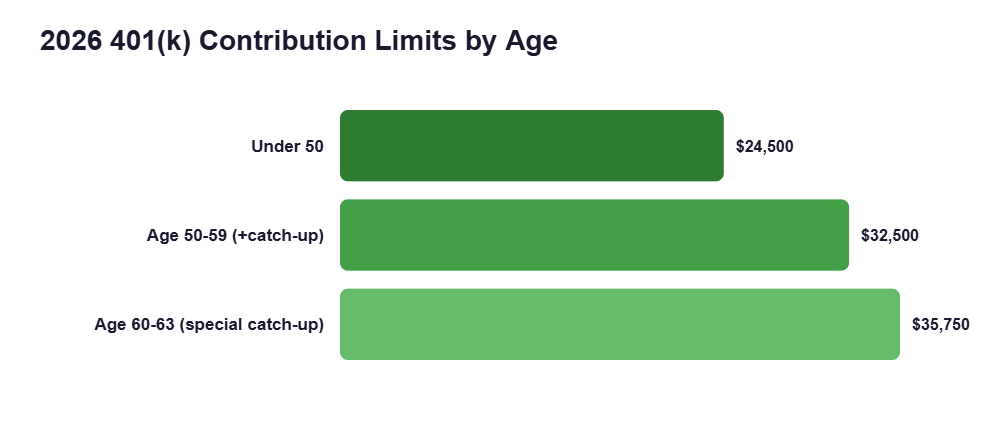
This is the biggest structural difference from the IRA version of this decision. For 2026, the IRS raised the employee contribution limit for 401(k)s to $24,500, up from $23,500 the year before. Compare that to the 2026 IRA limit of $7,500, and you can see why 401(k)s do so much heavier lifting for people trying to seriously fund retirement.
If you’re 50 or older, you get an extra catch-up contribution of $8,000, bringing your total to $32,500 for the year. And thanks to a SECURE 2.0 provision that’s now in effect, workers specifically aged 60 through 63 get an even bigger catch-up: $11,250 instead of $8,000, pushing their total possible contribution to $35,750 in 2026. These limits apply to your combined Traditional and Roth 401(k) contributions — you don’t get to max out both separately. If you split your contributions between the two, the totals still have to add up to the same annual ceiling.
The Core Decision: Your Tax Rate Now vs Later
Same framework as the IRA version, just with bigger numbers attached. If you believe your tax rate today is higher than what you’ll pay in retirement, Traditional wins — you’re deferring taxes from a high-tax year into a lower-tax year. If you believe your tax rate today is lower than what you’ll eventually pay, Roth wins, because you’re locking in today’s cheaper tax rate instead of gambling on what rates look like decades from now.
For most people early in their career, this points toward Roth. You’re likely in a lower tax bracket now than you will be once your income climbs, and you’re also betting on a few decades of tax-free compounding, which is where the Roth’s advantage really compounds (pun intended). But this isn’t automatic — someone in their peak earning years, in a high state and federal bracket, often does better prioritizing the deduction they get right now with Traditional, especially if they expect a lower-spending, lower-bracket retirement.
The Employer Match Wrinkle
Here’s a detail that doesn’t exist in the IRA conversation at all, because IRAs don’t have employer matches: no matter which type of 401(k) you contribute to, your employer’s matching contribution almost always lands in a Traditional, pre-tax bucket. Choose Roth for your own contributions, and your match still shows up as pre-tax money that will be taxed when you withdraw it in retirement. SECURE 2.0 technically opened the door for employers to offer a Roth match instead, but very few plans have actually adopted it, and if yours has, it comes with a catch — the matched amount counts as taxable income to you in the year it’s contributed, since there’s no source of withholding to cover that tax bill from your paycheck.
The practical upshot: most people end up with a blended 401(k) balance regardless of what they pick — a Roth bucket from their own contributions and a Traditional bucket from the match. That’s not a downside; it’s actually a built-in version of tax diversification you don’t have to plan for. But it does mean you shouldn’t assume “I chose Roth” means your whole account is tax-free at withdrawal. Check your plan statement — you’ll likely see both source types listed separately.
When Traditional Clearly Wins
Traditional makes the most sense when you’re in a high tax bracket right now and expect a materially lower one in retirement — a common pattern for high earners in their peak years, or anyone in a high-tax state who plans to relocate somewhere with lower or no state income tax before retiring. It’s also the better call if you need the immediate cash-flow relief: lowering your taxable income today can matter more than a future tax-free withdrawal if money is tight. And if you’re maxing out your 401(k) and trying to squeeze every available dollar into pre-tax space to also qualify for other income-based deductions or credits, Traditional does more of that work for you.
When Roth Clearly Wins
Roth pulls ahead for younger workers and anyone early in their career who expects meaningfully higher income — and a higher tax bracket — down the road. It’s also the stronger pick if you simply think tax rates in general are more likely to rise than fall over the coming decades, which is a reasonable bet given the current fiscal trajectory of federal spending.
There’s another point worth calling out, because it’s a real structural advantage the Roth 401(k) has that the Roth IRA doesn’t: no income limits. Roth IRAs phase out at higher income levels, locking high earners out of contributing directly. Roth 401(k)s have no such restriction — the IRS is explicit that there’s no income test for designated Roth contributions in a 401(k) plan. That makes the Roth 401(k) the only straightforward way for high earners to get money into a Roth-style account through regular payroll contributions, without resorting to backdoor conversion maneuvers.
The other major advantage showed up recently and doesn’t get enough attention: as of 2024, under SECURE 2.0, Roth 401(k)s are no longer subject to required minimum distributions during the original owner’s lifetime. That used to be a real drawback — Roth 401(k)s technically forced you to start withdrawing money at a certain age even though the withdrawals were tax-free, which was mostly just annoying paperwork, but it also meant losing tax-free growth time if you didn’t need the money. Now Roth 401(k)s behave exactly like Roth IRAs on this front: you can leave the money growing tax-free for as long as you want, which matters a lot for anyone planning to pass assets to heirs or simply not needing to touch the account in their 70s and 80s.
Doing Both
You don’t have to pick a lane. Most 401(k) plans today let you split your contributions between Traditional and Roth in whatever proportion you want, as long as your combined total stays under the annual limit. This is a legitimate strategy, not a cop-out — splitting your contributions gives you tax diversification, meaning you’ll have both taxable and tax-free money available in retirement, which lets you control your taxable income year to year by choosing which bucket to pull from. If you’re genuinely unsure which way your future tax rate is headed (and honestly, most people are), a 50/50 or 70/30 split between the two isn’t a bad way to hedge that uncertainty rather than betting everything on one guess.
If your plan doesn’t offer an in-plan Roth option, you’re not entirely out of luck — some plans allow after-tax contributions above the standard limit combined with an in-plan Roth conversion, often called the “mega backdoor Roth.” That’s a more advanced strategy, but it’s worth checking whether your plan supports it if you’re already maxing out the standard $24,500 limit and want more tax-free growth space.
Bottom Line
The traditional 401k vs Roth 401k decision really is the tax-rate-now-vs-later question from the IRA world, just scaled up with a much higher contribution ceiling and a match that almost always lands pre-tax no matter what you pick. If you’re early career and in a lower bracket than you expect to be later, lean Roth — you get tax-free compounding for decades and, unlike the Roth IRA, there’s no income limit to worry about. If you’re in your peak earning years and expect your tax rate to drop in retirement, lean Traditional and take the deduction now. And if you genuinely can’t call it, split your contributions and let your future self sort out which bucket to draw from first. The one mistake worse than picking wrong is not contributing at all — especially with free employer match money sitting on the table either way.
Sources: Contribution limits: IRS: 2026 401(k) and IRA limits (checked September 30, 2026).