How Much Should You Really Keep in a High-Yield Savings Account?
Learn how much to keep in high-yield savings — the simple formula based on essential expenses, not gross income.
Here’s the one-sentence answer: keep roughly three to six months of your essential expenses in a high-yield savings account, adjust that number up or down based on how stable your income actually is, and put everything beyond that into investments instead of letting it sit in cash. That’s it. The rest of this post is about how to find your real number and why going way past it quietly costs you money — but if you remember nothing else, remember that sentence.
Why This Question Trips People Up
High-yield savings accounts (HYSAs) got a lot more attractive over the past few years, and that’s created a new kind of confusion. When your online savings account is paying somewhere around 4% APY instead of the 0.01% your old brick-and-mortar bank offers, it starts to feel like a place you should keep more money, not less. Watching a “safe” account actually earn something feels good. But an HYSA is a tool for one job — money you might need on short notice — not a place to warehouse your long-term wealth because the interest rate finally looks respectable.
Calculate Your Real Number: Essential Expenses, Not Income
The most common mistake in emergency fund math is basing the target on your paycheck instead of your actual bills. You don’t need six months of your gross income sitting in cash — you need enough to cover what it actually costs to keep your life running if that income stopped tomorrow. That means adding up:
Rent or mortgage, utilities, groceries, insurance premiums, minimum debt payments, transportation, and any other non-negotiable monthly cost. Leave out the extras — subscriptions you’d cancel, dining out, travel, discretionary shopping. If we covered the order of operations for building this fund relative to your other financial goals, you already know the emergency fund comes before investing; see Emergency Fund First, Investing Second for that framework. This post is about sizing the fund correctly once you’re building it.
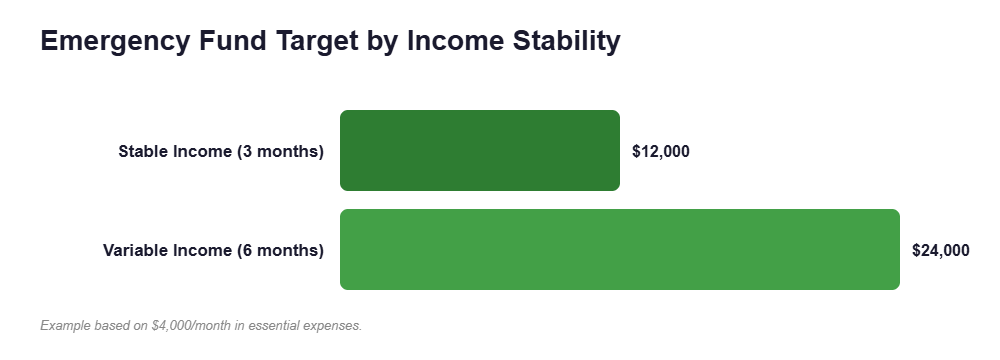
Once you have that bare-bones monthly number, multiply it by three, then by six. That range — not your income, not a round number you saw on a chart — is your target zone.
Who Needs More Than Six Months
Six months is the ceiling for most people, but not everyone. You should lean toward the higher end of the range, or even push past it toward eight to twelve months, if you fall into one of these categories:
Freelancers and self-employed workers, whose income can swing wildly month to month and who don’t have an employer covering unemployment insurance if things dry up. Commission-based earners, whose paychecks depend on sales cycles they don’t fully control. Single-income households, where one job loss means the entire budget is exposed, versus a dual-income household where a layoff still leaves half the money coming in. And anyone supporting dependents, managing a chronic health condition, or working in a volatile or highly cyclical industry, where the odds of needing a longer runway are meaningfully higher.
If several of these apply to you at once — say, you’re a freelancer supporting a family — stacking toward nine to twelve months of essential expenses isn’t overly cautious. It’s just matching your cash cushion to your actual risk.
Who Can Get Away With Less
On the other end, some people are genuinely over-insured by holding a fat cash cushion. If you’re in a stable dual-income household, work in a field with low layoff risk, have no dependents, carry little to no high-interest debt, and have backup options — a working spouse, family who could help in a real pinch, a healthy line of credit you’d never plan to use but could if you had to — three months on the low end of the range is a defensible target. Padding it further isn’t wrong, but it’s also not free, which brings us to the real point of this post.
The Real Cost of Over-Saving in Cash
This is the part most emergency fund advice skips entirely: holding too much cash isn’t just “playing it safe,” it has a cost, and that cost is easy to underestimate because it’s invisible. It’s called opportunity cost — the return you gave up by not putting that money somewhere it could grow.
Right now, top high-yield savings accounts are paying somewhere in the neighborhood of 4% APY, which is genuinely good for a savings account and far better than the near-zero rates most people were used to for a decade. But compare that to the long-run historical average return of the stock market, which has landed around 9-10% annually over long stretches, including dividends and adjusted for the ups and downs along the way. That gap — roughly five to six percentage points a year — compounds. On $20,000 held for ten years, the difference between earning 4% and earning 9% is the difference between ending up with about $29,600 and about $47,300. That’s not a rounding error; that’s real money you never got to keep, simply because it sat in cash longer than it needed to.
And there’s a second, quieter cost: inflation. Even a “good” 4% APY is only barely outpacing typical inflation in most years, meaning cash beyond your emergency fund is often just treading water in real purchasing-power terms rather than actually growing your wealth. An HYSA is excellent at doing its one job — protecting money you need to access without risk of loss — and mediocre at every other job people try to make it do.
The mental trap is that HYSAs feel safe and investing feels risky, so more cash feels like less risk overall. But once you’re past your true emergency fund target, holding excess cash isn’t reducing your risk — it’s just trading one risk (market volatility) for a different, less visible one (your money quietly losing ground to inflation and missing out on growth for years or decades).
A Practical Framework for Building It
You don’t have to choose between “build the whole emergency fund first” and “invest immediately” as an all-or-nothing decision. A staged approach works better for most people:
Stage one: Get a starter cushion of $1,000-$2,000 in your HYSA as fast as possible. This covers the most common small emergencies — a car repair, a vet bill, a broken laptop — without derailing your budget or forcing you onto a credit card.
Stage two: Build toward one full month of essential expenses, then continue up toward your three-to-six-month target (adjusted per the income-stability factors above). If your employer offers a 401(k) match during this stage, keep contributing enough to capture the match — that’s still worth prioritizing alongside cash savings, since it’s an immediate 100% return that a savings account can’t compete with.
Stage three: Once you hit your target number, stop adding to the HYSA beyond routine top-ups for lifestyle inflation, and redirect new savings toward investing — a Roth or Traditional IRA, a taxable brokerage account, or increased retirement contributions, depending on your goals. Let the HYSA balance sit there doing its job quietly, and let your investing account start doing the heavier lifting for long-term growth.
This staged approach means you’re never sitting completely exposed while you save, and you’re never leaving years of growth on the table because your cash cushion crept past where it needed to be.
Bottom Line
Your high-yield savings account should hold three to six months of essential expenses — calculated from your real bare-bones bills, not your income — with adjustments up for unstable or single-source income and dependents, and adjustments down for stable, dual-income households with a strong safety net. Once you hit that number, stop. Every dollar beyond your target sitting in cash is a dollar not compounding at the higher long-run returns investing typically offers, and that gap adds up fast. A great APY makes an HYSA a good place to park money you might need soon. It doesn’t make it a good place to grow money you won’t need for years.