Roth IRA vs Traditional IRA: Which One Is Actually Better for You?
The Roth vs. Traditional IRA decision comes down to one question about your taxes. Here's how to answer it clearly.
The Roth IRA vs. Traditional IRA question has launched a thousand blog posts, most of which make it sound more complicated than it is.
Here’s the whole thing in one sentence: the Traditional IRA gives you a tax break now, the Roth IRA gives you a tax break later, and the right choice depends on whether you think your tax rate is higher today or will be higher in retirement.
That’s the core of it. The rest is details — and the details matter — but if you never remember anything else from this post, remember that sentence.
How Each One Works
A Traditional IRA works like this: you contribute pre-tax money, meaning contributions can reduce your taxable income for the year you make them. The money grows inside the account without being taxed year to year. When you retire and take the money out, you pay ordinary income tax on every dollar you withdraw.
A Roth IRA works in the opposite direction. You contribute money you’ve already paid tax on — your contributions don’t reduce your current-year tax bill. The money grows inside the account tax-free. When you retire and withdraw, you pay zero tax on everything, including all the growth.
Both accounts let you invest in almost anything: index funds, ETFs, individual stocks, bonds, mutual funds. The difference is purely in when and how they’re taxed.
Contribution Limits
For 2026, the combined contribution limit across Traditional and Roth IRAs is $7,500 per year if you’re under 50, and $8,600 if you’re 50 or older. You can split between both types, but the total can’t exceed the limit.
Roth IRAs have income caps. If you earn above a certain threshold, you can’t contribute directly. Traditional IRAs don’t have the same income cap on contributions, but if you’re covered by a workplace retirement plan, the tax deduction for your Traditional contribution starts phasing out at higher incomes.
These limits and thresholds adjust annually. Always check the current IRS numbers before maxing out.
The Core Decision Framework
Here’s the mental model to use. You’re making a bet about two tax rates: the rate you’re paying today vs. the rate you’ll pay on withdrawals in retirement.
If you expect to be in a higher tax bracket in retirement than you are now, Roth wins. You pay the low tax rate now and lock in zero tax later.
If you expect to be in a lower tax bracket in retirement, Traditional wins. You skip the high tax rate now and pay the low rate later.
If you expect to be in roughly the same bracket, it’s close to a wash — and there are secondary reasons (covered below) that often tip the scale toward Roth.
Most young professionals with rising earnings should probably lean Roth. Your income is likely to go up, and you’re locking in today’s lower rate. Most people in peak earning years with expectations of a modest retirement should probably lean Traditional. You’re getting the deduction during your highest-tax years and paying at a lower rate later.
The Roth’s Hidden Advantages
Even when the pure math is a wash, Roth has secondary benefits worth knowing about.
You can withdraw your contributions (not earnings) from a Roth at any time, for any reason, without tax or penalty. Traditional IRAs punish early withdrawals harshly. That flexibility makes the Roth function as a sort of backstop emergency fund, which is useful.
Roth IRAs don’t have required minimum distributions. Traditional IRAs force you to start withdrawing at age 73, whether you need the money or not, which creates taxable income. Roth lets you leave the money untouched for your whole life if you want to.
Roth IRAs are also great estate planning tools. Heirs can inherit a Roth and continue tax-free growth for another decade. A Traditional IRA inheritance comes with tax obligations attached.
These advantages are real and they often tip a close decision toward Roth.
When Traditional Clearly Wins
Traditional is the better answer in a few specific situations.
If you’re in a very high tax bracket now — top federal bracket plus a high-tax state — and you expect to retire in a low-tax state with modest spending, the Traditional deduction is valuable. You’re arbitraging a large current-year rate against a much lower future rate.
If you have a big one-time income event (a windfall, a major bonus), a Traditional contribution during that year can reduce your tax bill meaningfully. The deduction is worth more when your marginal rate is high.
If you’re saving for retirement later in your career and you know exactly what your retirement income will look like, you can do the math more precisely. Sometimes Traditional genuinely wins the calculation.
The Compromise: Do Both
Since the contribution limit is combined across both accounts, and since the future is genuinely uncertain, a lot of investors split contributions — some to Roth, some to Traditional. This gives you tax diversification in retirement, meaning you can pull from whichever account is more tax-efficient depending on the circumstances of that specific year.
This is a perfectly fine strategy, especially if you can’t confidently predict your future tax situation. Hedging across both accounts doesn’t require you to be right.
What About a 401(k)?
A 401(k) from work is a separate thing, with its own contribution limit. You can contribute to both a 401(k) and an IRA in the same year.
Many 401(k) plans now offer both Traditional and Roth options. The same logic applies to the 401(k) decision. The math is the same math.
If your employer offers a matching contribution, contribute at least enough to get the full match regardless of which account type you pick. That match is a guaranteed 50% or 100% return on those dollars. Don’t leave it on the table.
Bottom Line
Pick Roth if you’re younger and earning less than you expect to later. Pick Traditional if you’re in peak earning years and expect a meaningfully lower tax bracket in retirement. Split them if you genuinely can’t decide.
The worst choice is to not open either one because the decision paralyzes you. Start with one — Roth is usually the safer default for most people — and adjust over time as your situation changes.
Quick Links
For more plain-English guides to retirement accounts and the math behind them, subscribe to the KatchingStacks newsletter — one short, practical email per week. If you want to see how an IRA can grow over time, our post on How Compound Interest Works makes the point with real numbers.
Ready to put this into practice? See our Best Robo-Advisors 2026 comparison to find a platform that fits your strategy.
The Actual Dollar Difference, At Three Tax Rates
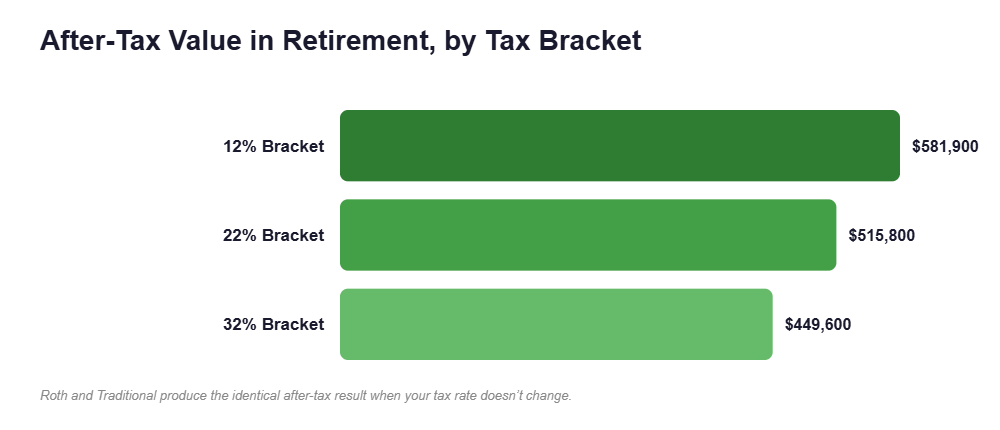
Here’s the math that proves the “it depends on your tax rate” framework isn’t just a hand-wave. Assume you contribute $7,000/year for 30 years at a 7% average return, and compare the after-tax value if your tax rate is the same both now and in retirement:
| Tax bracket (same now and in retirement) | Traditional IRA (after-tax withdrawal) | Roth IRA (tax-free withdrawal) |
|---|---|---|
| 12% | ~$581,900 | ~$581,900 |
| 22% | ~$515,800 | ~$515,800 |
| 32% | ~$449,600 | ~$449,600 |
Identical at every bracket. That’s not a coincidence — it’s a mathematical identity. When your tax rate is the same at contribution and withdrawal, it doesn’t matter which side of the transaction gets taxed. This is exactly why the whole decision comes down to whether you expect your rate to be higher or lower later, as the framework above lays out.
One asymmetry worth knowing: the $7,500 contribution limit is the same dollar figure for both account types, but a Roth $7,500 is “worth more” in pre-tax terms, because you’ve already paid tax on it. Contributing the max to a Roth effectively shields more real, inflation-adjusted future wealth from tax than contributing the same $7,500 to a Traditional IRA — a subtle point that tilts slightly in Roth’s favor for anyone who can comfortably max out either account.
My Honest Take
People treat this decision like it requires predicting the future, and in a narrow sense it does — but the default matters more than the precision. If you genuinely have no idea what your retirement tax bracket will be, Roth is the safer default for most people under 40, for three reasons that aren’t about tax rates at all: no required minimum distributions, penalty-free access to contributions in an emergency, and better estate planning treatment for your heirs. Don’t let “I can’t predict my future tax bracket” become a reason to avoid deciding at all.
Sources: Contribution limits: IRS: 2026 401(k) and IRA limits (checked September 30, 2026).