How to Start Investing With $100 (A Step-by-Step Guide for Beginners)
You don't need thousands to start investing. Here's exactly what to do with your first $100, step by step.
“I’d invest, but I don’t have enough to start.”
This was a reasonable excuse twenty years ago. Brokerages had minimum balances, mutual funds required $3,000 to open, and buying a single share of Amazon meant coming up with hundreds of dollars at a time. For someone with $100, the door was mostly closed.
Today, that excuse doesn’t work. Fractional shares exist. Zero-minimum brokerages exist. Robo-advisors will invest a $5 deposit. The infrastructure for small-dollar investing is real, and it’s available to anyone with a phone.
So here’s exactly how to start with $100. No jargon. Just steps.
Step 1: Make Sure You Actually Should Invest This Money
Before you invest a dollar, check a couple of boxes.
Do you have at least a basic emergency fund — something like $1,000 in a savings account you can reach in a day? If not, that should come first. Money locked in investments isn’t an emergency fund. Stocks can drop 20% in a month, and you don’t want your emergency savings dropping when the emergency actually hits.
Are you carrying high-interest debt — credit cards charging 20%+ APR? Paying that off is a guaranteed return that beats anything the stock market will reliably give you. Pay it first, then invest.
If both boxes are checked, you’re ready.
Step 2: Pick a Type of Account
You have three main options for your first $100.
A taxable brokerage account is the most flexible. You can deposit and withdraw whenever you want without tax penalties on the account itself (you’ll still owe tax on any gains when you sell). Good for general investing when you don’t know yet what the money is for.
A Roth IRA is better if this money is genuinely for retirement. You contribute already-taxed dollars, the money grows tax-free, and you pay no tax on withdrawals in retirement. You can also pull your contributions out penalty-free if you ever really need to. For young investors, Roth is usually the right default.
A Traditional IRA gives you a tax deduction today in exchange for paying tax on withdrawals later. Good if you’re in a high bracket now and expect to be in a lower one later. For most beginners just starting with $100, Roth is simpler.
For this guide, we’re going to assume you’re opening a Roth IRA. If you’d rather go with a taxable brokerage, the rest of the steps work the same way.
Step 3: Pick a Place to Open the Account
There are a lot of options, and most of them are fine. A few we’d feel comfortable pointing anyone to:
Fidelity is free, has zero account minimums, offers fractional shares of basically every stock and ETF, and has some of the cheapest index funds in existence (some with literally 0% expense ratios). Strong default for beginners.
Schwab is a near-identical alternative. Same zero minimums, same fractional shares, slightly different interface. Pick whichever you like more after looking at the apps.
Vanguard is the spiritual home of index investing but has a slightly clunkier interface. Good if you’re committed to Vanguard funds specifically.
A robo-advisor like Betterment, Wealthfront, or Fidelity Go will build your portfolio for you — for a small fee, or free under $25,000 at Fidelity Go. If you’d rather not pick funds yourself, this is the path.
Sign up for one of these. The process takes 10 to 20 minutes. You’ll need your Social Security number, your bank account info, and some basic identity info.
Step 4: Fund the Account
Link your bank account inside the app, then initiate a transfer of $100. This usually takes one to three business days to settle.
If you can, set up a recurring transfer of some amount — even $25 or $50 a month. This is where the real magic happens. A one-time $100 deposit is a start, but consistent monthly contributions are what build actual wealth over time. Automating it now means you never have to decide to invest again. It just happens.
Step 5: Pick What to Buy
For your first $100, keep it simple. Buy a broad-market index fund or ETF. Do not pick individual stocks. Do not try to find the next winner.
A few defensible single-fund choices:
If you’re at Fidelity: FSKAX (total US stock market) or FZROX (total US stock market, zero expense ratio).
If you’re at Schwab: SCHB (total US stock market) or SWTSX (total stock market).
If you’re at Vanguard: VTI (total US stock market ETF) or VTSAX (total US stock market index fund).
If you’re at a robo-advisor: the system will pick a diversified portfolio based on the questionnaire you already answered. You don’t have to pick anything.
Any of the above puts your $100 to work in thousands of US companies simultaneously. That’s it. That’s the “what do I buy” problem solved.
Step 6: Don’t Touch It
This is the hardest step.
Your $100 will go up. It will go down. The market will have bad days, bad weeks, and occasionally very bad years. You are going to be tempted to check the balance every day, to sell when headlines are scary, to chase whatever’s hot. Do not do any of this.
Your job for the next 30 years is exactly two things. One, keep adding to the account on a regular schedule. Two, do not sell. That’s it. That’s the entire remaining strategy.
If this feels anticlimactic, that’s because it is. Building wealth through investing is the most boring thing in personal finance. The drama belongs to the people who lose money. The people who make money do basically nothing for decades.
What Happens Next
Your $100 isn’t going to change your life. Nobody retires on $100. What it will do is make you an investor — someone with an account, a plan, and momentum.
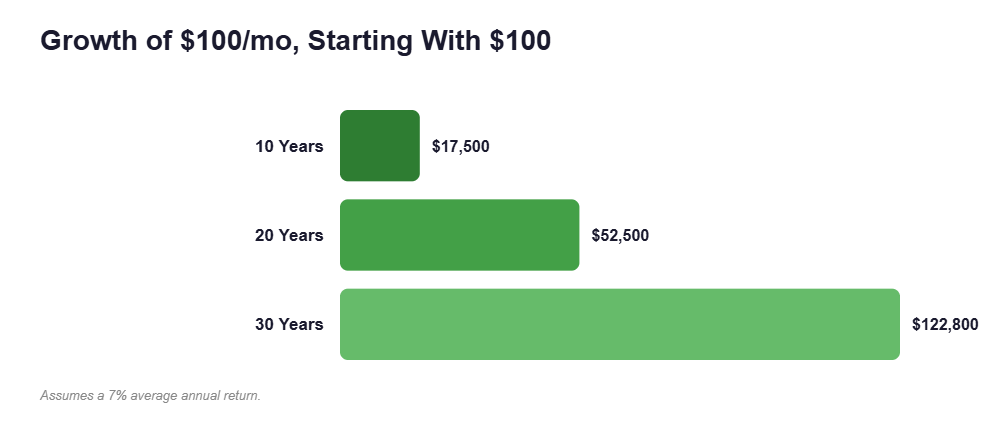
If you add $100 every month for 30 years at an average 7% real return, you’d end up with around $122,000. On $36,000 of contributions. That’s the math, and it only works if you actually start. The difference between someone with $122,000 in 30 years and someone with $0 is that the first person opened the account today.
You now have the steps. The rest is whether you actually do it in the next 30 minutes.
Quick Links
For more concrete, no-jargon guides like this one, subscribe to the KatchingStacks newsletter — one clear email a week on building the finances you actually want. If you’re wondering how your $100 grows over time, our post on How Compound Interest Works explains the math with real numbers.
What Happens If You Add More Later?
The $122,000 example above assumes exactly $100 a month for 30 years. Most people’s income grows over time, and bumping your monthly contribution — even a little — changes the outcome more than most people expect:
| Monthly contribution | 10 years | 20 years | 30 years |
|---|---|---|---|
| $100/mo | ~$17,500 | ~$52,500 | ~$122,800 |
| $200/mo | ~$34,800 | ~$104,600 | ~$244,800 |
| $300/mo | ~$52,100 | ~$156,700 | ~$366,800 |
All figures assume a 7% average annual return, starting with your original $100. Notice the relationship is exactly linear — doubling your contribution exactly doubles the outcome at every time horizon. That’s not a coincidence; it’s how compound growth works when the contribution amount is the only thing changing. Which means a raise that lets you bump from $100 to $200 a month isn’t a modest improvement — it’s literally doubling your eventual outcome.
My Honest Take
The $100 in the headline of this guide matters way less than people think. I’ve talked to people who delayed starting for months trying to save up “enough” to make investing feel worthwhile, not realizing that the starting amount is almost irrelevant compared to the amount and consistency of what you add afterward. Start with $100 today, not because $100 will change your life, but because starting today instead of three months from now is worth more than whatever extra amount you’re waiting to save up. Then focus your actual energy on the thing that matters: automating an amount you’ll actually keep contributing, and increasing it every time your income goes up.