Guides
· 9 min read
Emergency Fund First, Investing Second: The Order of Operations for Getting Your Finances Together
There's a right order for fixing your finances. Here's the step-by-step priority list that actually works, starting with the emergency fund.
Disclaimer: KatchingStacks is an independent review site. We may earn a commission if you open an account through our links, at no extra cost to you. Nothing here is personalized financial advice. All investing involves risk, including the possible loss of principal.
Personal finance is not as complicated as the internet makes it seem. Most people trying to get their financial life together are stuck not because the answers are hard, but because they’re being pulled in five directions at once.
Should you invest or pay off debt? Contribute to a 401(k) or build savings? Buy a house or max out a Roth? Start a side hustle or cut expenses?
There’s an answer. It’s not one-size-fits-all, but it’s close. It’s called the order of operations, and it works for almost everyone in almost every situation. Here it is, top to bottom.
Step 1: Build a Starter Emergency Fund
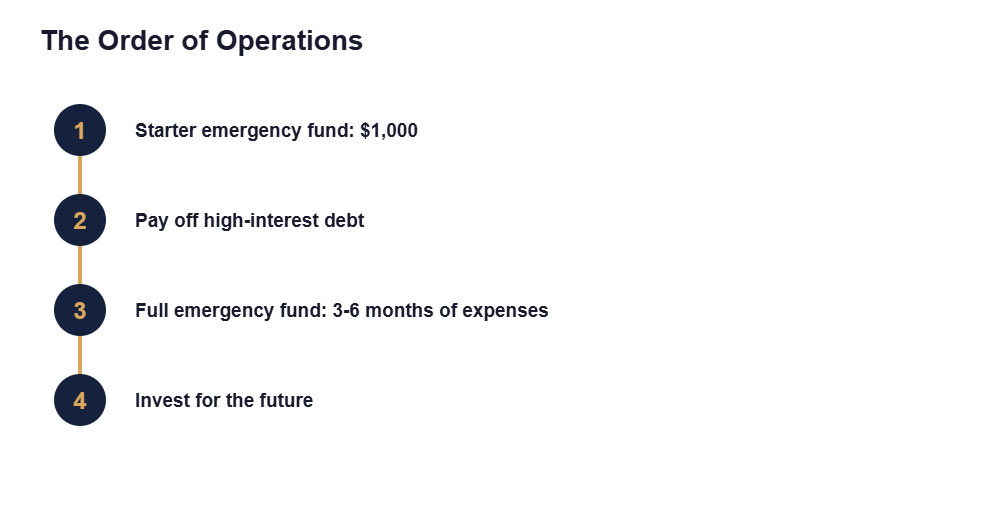
Before anything else — before investing, before paying extra on debt, before even thinking about retirement accounts — get $1,000 into a savings account you can access within 24 hours. Why $1,000? Because that’s about the size of most surprise expenses. Car breaks down. Laptop dies. Urgent care visit. Vet bill. A thousand bucks covers the vast majority of “uh oh” moments that would otherwise force you to borrow. This fund isn’t about feeling rich. It’s about creating a small buffer that keeps a minor emergency from turning into a credit card balance that takes six months and $200 in interest to pay off. That $200 in interest is the cost of not having the $1,000 on hand. Use a regular savings account, a high-yield savings account, or even a separate checking account at a different bank. What matters is that it’s accessible and you don’t accidentally spend it.Step 2: Get the Full 401(k) Match
If your employer offers a 401(k) match, contribute at least enough to capture the full match. This step jumps the queue because the match is free money. A 100% match on your first 3% of salary is a guaranteed 100% return on those dollars the moment you contribute them. Nothing else in personal finance offers a guaranteed 100% return. Even if you have high-interest debt, even if your emergency fund is small, grab the match. Leaving it on the table is essentially saying “no thanks” to a raise. Once you’ve captured the match, move to step 3. Don’t max the 401(k) yet — that comes later. You just want the full match for now.Step 3: Kill High-Interest Debt
Credit card debt at 20%+ APR is the single most destructive force in most people’s finances. No investment reliably beats 20%. Paying off a $5,000 credit card balance is equivalent to earning a guaranteed 20% return, year after year, until it’s gone. Throw every extra dollar you have at debt above roughly 8%. Credit cards obviously. Payday loans, obviously. Personal loans and private student loans if they’re high-rate. Medical debt if interest is accruing. What about lower-rate debt — a 4% mortgage, a 5% federal student loan, a 3% car loan? Don’t prioritize paying those off early. The math works better to invest those dollars instead. You’ll probably earn more in the market long-term than you’d save in interest, and lower-rate debt is usually flexible enough to not ruin your life. Use the avalanche method if you want to optimize math (pay the highest-interest debt first), or the snowball method if you want to optimize psychology (pay the smallest balance first for a quick win). Either works. The best debt payoff method is the one you actually stick with.Step 4: Build a Full Emergency Fund
Once high-interest debt is gone, come back and turn your $1,000 starter fund into a full emergency fund: three to six months of essential expenses. “Essential expenses” means rent or mortgage, utilities, groceries, minimum debt payments, insurance, transportation. Not vacations, not restaurants, not your streaming subscriptions. The number you’re trying to cover is what it actually costs you to survive with zero income for a few months. Three months is enough for most people with stable jobs, low dependents, and solid skills. Six months is better for single-income households, self-employed people, anyone in an industry prone to layoffs, or anyone with medical issues. Keep this money in a high-yield savings account. Online banks often pay several times what traditional banks pay, and your emergency fund should be earning at least something while it sits there.Step 5: Max Your Roth IRA (or Traditional IRA)
With debt handled and a full emergency fund in place, shift your extra dollars into retirement accounts. Start with an IRA — specifically a Roth IRA if you’re eligible, since most people benefit from the tax-free growth and withdrawal flexibility. The 2026 contribution limit is $7,500 per year if you’re under 50. Try to max it if you can. Even if you can’t max it, get as close as possible. Contributions for a given year can be made until the tax filing deadline the following April, so there’s flexibility on timing. If you’ve already maxed the employer match in step 2 but not the full IRA, the IRA takes priority here because IRAs generally have broader investment options and lower fees than most workplace 401(k) plans.Step 6: Max Your 401(k)
After maxing the IRA, return to the 401(k) and keep contributing up to the annual limit ($24,500 in 2026 for under-50s, plus catch-up contributions if you’re over 50). At this stage, you’re saving a serious percentage of your income for retirement — well above what most Americans manage — and you’re doing it in tax-advantaged accounts that will compound for decades. If you have an HSA (Health Savings Account) and you’re eligible, it also belongs in this step. HSAs have a rare triple tax advantage: contributions are pre-tax, growth is tax-free, and withdrawals for medical expenses are tax-free. For long-term investors, it’s arguably the best account in existence.Step 7: Taxable Brokerage (for Everything Else)
Once retirement accounts are maxed, additional savings goes into a taxable brokerage account. Invest it in the same broad index funds or robo-advisor you’d use for retirement. The money in a taxable account is for anything beyond retirement: a house down payment, early retirement, starting a business, generational wealth. Taxable accounts don’t have contribution limits. You can put in as much as you want. You just owe tax on any gains in the years you realize them.Where Most People Get Stuck
The most common mistake isn’t getting the order wrong. It’s skipping steps or doing two at once. If you’re investing in a Roth IRA while carrying $8,000 of credit card debt, you’re losing money on net. Pause the IRA, kill the debt, then come back. If you’re aggressively paying off a 3% mortgage while not capturing your 401(k) match, you’re leaving free money on the table. Capture the match first. If you don’t have any emergency fund at all but you’re throwing every dollar at student loans, the first car repair will put you right back in credit card debt. Build the $1,000 starter fund first. The order matters because it’s sequenced to kill the highest-impact problems first. Follow it, don’t skip ahead, and you’ll end up in a place that surprises you a few years from now.Bottom Line
Starter emergency fund, employer match, high-interest debt, full emergency fund, IRA, 401(k), taxable brokerage. That’s the list. Work through it in order. Revisit it annually because life changes. This isn’t the only valid approach — there are edge cases and nuances — but it works for the vast majority of people, and it beats the paralysis of not knowing where to start.Frequently Asked Questions About Emergency Funds
How much should my emergency fund be?
The standard target is three to six months of essential living expenses — not three to six months of your income. Essential expenses are what it costs you to survive with no income: rent or mortgage, utilities, groceries, minimum debt payments, insurance, and transportation. For most people, that number is meaningfully lower than their take-home pay. A single person with a stable job in a low-cost area might be fine with three months. A single-income household, a freelancer, or anyone in a volatile industry should target six months or more.Where should I keep my emergency fund?
A high-yield savings account (HYSA) is the right answer for most people. You want the money accessible within one to two business days, earning as much interest as possible without any risk of loss. As of 2025–2026, many HYSAs pay between 4% and 5% APY — meaningfully better than the 0.01% you’d get from a traditional savings account at a big bank. Do not invest your emergency fund in stocks or ETFs. The whole point of the fund is that it’s there when you need it, and the stock market can drop 30% right before your car engine fails.What counts as an essential expense?
Essential expenses are the bills you must pay to keep a roof over your head and stay functional: housing (rent or mortgage), utilities (electricity, gas, water, internet), groceries, minimum payments on all debts, health insurance, car insurance if you need a car to work, and basic transportation. Things that don’t count: dining out, subscriptions, gym memberships, vacations, entertainment, clothing beyond the basics. When calculating your emergency fund target, build the budget around survival, not your current lifestyle.Should I invest my emergency fund to earn more?
No. The emergency fund’s job is not to grow — it’s to be there with certainty when something goes wrong. Investing it in stocks introduces the risk that a market downturn hits exactly when you need the money. Investing it in bonds or bond funds introduces interest rate risk and redemption timing. A high-yield savings account gives you 4–5% with zero risk and same-week access. That’s the right trade-off. Once your full emergency fund is built, every dollar beyond it should be invested — but the fund itself stays liquid and safe.What if I can’t afford to build an emergency fund right now?
Start with $500 instead of $1,000. Or $250. The goal of the starter emergency fund is to break the cycle where every surprise expense goes on a credit card, adding high-interest debt to the problem. Even a small buffer changes that. Cut one subscription, pause one savings goal, or redirect a tax refund. Once you hit $500, the next $500 feels easier. The full three-to-six month fund comes later — after debt is handled. But getting something into an untouchable savings account this week is better than waiting until the math works out perfectly.Quick Links
For more step-by-step guides that skip the hype, subscribe to the KatchingStacks newsletter — one honest, useful email a week. Once your emergency fund and debt are handled, our How to Start Investing With $100 guide walks you through the first investing move.Sources: Contribution limits: IRS: 2026 401(k) and IRA limits (checked September 30, 2026).