Debt Avalanche vs. Snowball: Which Payoff Method Actually Works?

Debt avalanche vs snowball: the real math, the real psychology, and a simple framework for picking the method you'll actually finish.
The debt avalanche vs snowball debate gets treated like a moral referendum on your financial character, which is silly, because it’s really just a question about human motivation dressed up in spreadsheet math. Here’s the short version: avalanche saves you more money, snowball gets more people to the finish line. The “right” answer depends on which one you’ll actually stick with, not which one wins on paper.
Before you pick a method, make sure debt payoff is actually the right move for your money right now. If you haven’t sorted out the basics yet, start with Emergency Fund First, Investing Second and Should You Pay Off Debt or Invest First? so you’re not aggressively paying down a 6% student loan while your only backup plan for a car repair is a credit card. Once you’ve confirmed debt payoff is the priority, the avalanche-vs-snowball question is worth taking seriously, because it genuinely changes your odds of finishing.
What Debt Avalanche Actually Means
The debt avalanche method is the mathematically optimal way to pay off multiple debts. You pay the minimum on every debt you owe, then throw every extra dollar at whichever debt has the highest interest rate, regardless of the balance. Once that debt is gone, you roll its entire payment — minimum plus whatever extra you were paying — into the next-highest-rate debt. Repeat until you’re debt-free.
The logic is simple: interest is the cost of carrying debt, and the debt charging you the most per dollar owed is doing the most damage to your finances every single month it sticks around. Kill that one first and you stop the bleeding fastest.
What Debt Snowball Actually Means
The debt snowball method uses the same basic mechanics — pay minimums on everything, throw extra money at one target, then roll payments forward once that target is eliminated — but it picks the target differently. Instead of ranking debts by interest rate, snowball ranks them by balance size, smallest to largest, and ignores the interest rate entirely. You attack your smallest debt first no matter what it’s costing you, because the point isn’t optimizing interest. It’s generating a win you can see fast.
Popularized by Dave Ramsey, snowball’s whole pitch is behavioral, not mathematical. It openly trades some interest savings for motivation.
The Math Case for Avalanche
Here’s a simplified example to make the gap concrete. Say you’re carrying two debts: a $2,000 car loan at 5% APR, and a $9,000 credit card at 23% APR. You’ve got $500 a month total to put toward both, and your minimum payments are $100 on the car loan and $200 on the card.
Under avalanche, your extra $200 a month goes straight to the credit card — the debt actually costing you money — while the car loan gets its minimum. Under snowball, that extra $200 goes to the car loan instead, because it’s the smaller balance, even though it’s already your cheapest debt. You’d clear the car loan in a matter of months, which feels great, but in the meantime your 23% credit card balance keeps accruing interest at full speed with only the minimum chipping away at it.
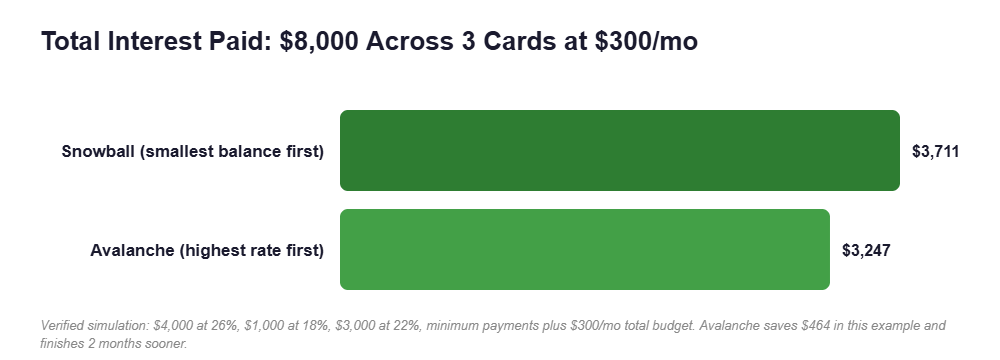
That’s the core inefficiency of snowball: it can leave your most expensive debt untouched the longest. The wider the interest-rate gap between your debts, the more that costs you — real-world comparisons from lenders analyzing typical household debt loads have found avalanche saving anywhere from a few dollars up to well over a thousand dollars in interest and shaving a month or more off the payoff timeline, depending on how spread out the rates are. When your debts are all clustered around similar rates, the two methods barely differ. When one card is sitting at 24% while another debt is sitting at 6%, the gap gets real.
The Behavioral Case for Snowball
Here’s the part avalanche purists tend to gloss over: a payoff plan you abandon in month four saves you zero dollars, no matter how optimal it looked on a spreadsheet.
This is where the actual research comes in, and it’s worth citing accurately because it gets exaggerated a lot online. In 2012, researchers David Gal and Blakeley McShane, then at Northwestern’s Kellogg School of Management, published a study in the Journal of Marketing Research analyzing real account-level data from about 6,000 people working with a debt settlement company. They found that people who closed out smaller debt accounts first — independent of the interest rate or dollar amount involved — were more likely to eventually eliminate all of their debt. The act of closing an account, of getting a visible win, predicted follow-through better than the size of the balance did.
That’s a real, published finding, and it’s the legitimate basis for the “snowball works better in practice” claim you’ll see repeated across personal finance content. It’s not, however, proof that snowball beats avalanche for everyone in every situation — it’s evidence that quick wins correlate with sticking to a payoff plan, in one dataset of people who were already working with a debt settlement service. Treat it as a genuinely useful data point about motivation, not a universal law. Other analyses that model out full amortization schedules for typical households find the dollar difference between the two methods is often smaller than people assume, especially when your debts don’t have wildly different rates. The behavioral effect is the real story here, not the interest math.
So Which One Should You Actually Use?
Skip the personality-test framing and ask yourself two practical questions instead.
First: have you tried to pay off debt before and quietly given up? If you’ve started a payoff plan in the past and lost steam a few months in, that’s information. It means the thing standing between you and debt-free isn’t knowledge of the optimal math — it’s follow-through. Snowball is built for exactly that problem. The dopamine hit of crossing a debt off your list, even a small one, is what keeps people going long after the initial motivation from January 1st has worn off. If that’s you, the extra interest you pay for going smallest-balance-first is a reasonable price for a plan you’ll actually finish.
Second: how big is the interest-rate spread across your debts, and how confident are you in your own consistency? If you’ve got one card at 26% next to a 4% car loan, and you know you’re the type of person who sticks to a plan once you’ve committed to it on paper — a budget you’ve actually followed, a savings goal you’ve actually hit — then avalanche is going to put real money back in your pocket, and you don’t need the psychological training wheels to get there. The bigger the rate gap, the more avalanche’s math advantage matters, and the less you should let a “feel-good” argument talk you out of the cheaper option.
If your debts are all sitting in a similar interest-rate range — a handful of cards all charging somewhere between 18% and 24%, say — the math difference between the two methods shrinks to almost nothing. In that case, just pick whichever order motivates you more and stop agonizing over it, because you’re not leaving meaningful money on the table either way.
Hybrid Approaches Are Fine, Too
Nothing says you have to pick a pure version of either method. A common middle ground: knock out one or two genuinely tiny debts first for an early win — a $300 medical bill, a $500 old store card — then switch to avalanche order for everything that’s left. You get a taste of the snowball’s momentum without sacrificing much interest, since the accounts you’re clearing first are too small to matter much on the math side anyway. Some people also carve out an exception for any debt at an unusually punishing rate — a payday loan or a card north of 28% — and attack that one first regardless of balance, then snowball or avalanche the rest. There’s no rulebook that says your payoff order has to be pure. The only real requirement is that you keep going until the balances hit zero.
Bottom Line
Avalanche is the mathematically correct answer if you’re only optimizing for total interest paid — order your debts by interest rate, highest first, and you’ll pay the least amount of money to be debt-free. Snowball trades some of that interest savings for a structure that’s easier to stick with, backed by real research showing that early, visible wins are linked to higher completion rates. Neither method works if you abandon it, so be honest about your own track record before you pick one. If you’ve quit a debt plan before, snowball’s quick wins are worth the extra interest. If you’re already disciplined and the rate gap between your debts is wide, avalanche puts real money back in your pocket. Either way, the best debt payoff method is simply the one you’re still following six months from now.