Vanguard Digital Advisor Review: The Index Fund King Goes Robo
Vanguard invented the low-cost index fund. Here's how its robo-advisor stacks up and whether the legend still holds.
KatchingStacks is reader-supported. When you open an account through links on this page, we may earn a commission at no extra cost to you. See our affiliate disclosure and editorial policy.
Vanguard is the reason “low-cost index investing” exists as a concept. Jack Bogle launched the first index fund for retail investors in 1976 and spent forty years convincing Americans that most actively managed funds weren’t worth their fees. He mostly won the argument.
So when Vanguard builds a robo-advisor, expectations are high. Does Digital Advisor live up to the legacy? Mostly. With a couple of meaningful caveats.
(Heads up: we may earn a commission if you use our links. We’re covering the good and the annoying parts of Vanguard below, because both are real.)
What Vanguard Digital Advisor Is
Vanguard Digital Advisor is the company’s all-digital robo product. You answer a questionnaire, Vanguard builds a portfolio of four Vanguard ETFs covering US stocks, US bonds, international stocks, and international bonds, and it rebalances automatically.
The portfolio is exactly what you’d expect from Vanguard: broad, boring, diversified, dirt cheap. The ETFs used have expense ratios measured in hundredths of a percent.
For investors with more complex needs, Vanguard also offers Personal Advisor Services, a hybrid product that combines the digital platform with access to human advisors. Personal Advisor has a higher minimum and higher fee. Digital Advisor is the pure-digital option, and it’s what we’re reviewing here.
Fees and Minimums
The account minimum is $100, which is approachable for most investors. Once you’re in, the fee structure is interesting.
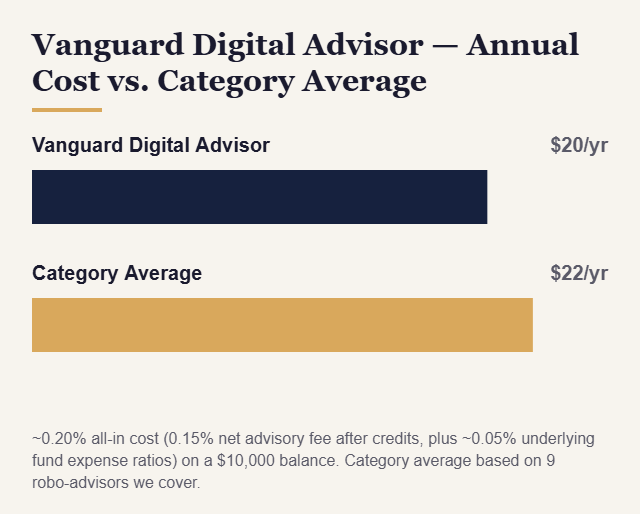
The all-in fee is around 0.20% per year, combining Vanguard’s advisory fee with the expense ratios of the underlying ETFs. That’s a touch cheaper than the 0.25% management fee at Betterment or Wealthfront (though those competitors also charge the underlying ETF expense ratios, so the total gap is smaller than it appears).
Vanguard caps the advisory fee so it’s never wildly expensive. And there are no trading commissions, no account transfer fees in most cases, and no performance fees.
What You Get
The portfolio construction is Vanguard being Vanguard. Four ETFs, broad diversification, low expense ratios, rebalanced automatically. Risk tolerance drives the stock-to-bond ratio. It’s the textbook approach executed well.
Tax-loss harvesting was added a couple of years ago and now runs on taxable accounts. It’s competent, though historically not as aggressive as Wealthfront’s.
Goal-based planning is integrated. You can set retirement and other long-term goals, and the system will project whether you’re on track and adjust recommended contributions.
The Vanguard ecosystem benefit is meaningful if you already hold a 401(k), IRA, or brokerage account at Vanguard. Everything lives in one place.
Where Vanguard Shines
Total cost is the headline win. A broad-market portfolio at a total expense of around 0.20% per year, including the management layer, is extremely competitive. Over decades, that cost difference compounds into real money.
The fund quality is ironclad. Vanguard’s core index ETFs are benchmarks against which the entire industry is measured. If you’re going to own a single total-market ETF, VTI is a defensible choice. Digital Advisor holds it.
The company’s structure is also worth noting. Vanguard is owned by the funds it manages, which are in turn owned by the shareholders. That structure genuinely aligns incentives in a way that public for-profit brokerages can’t match.
Where Vanguard Falls Short
The user experience is the main complaint. Vanguard’s app and website are functional but not polished. The onboarding flow feels dated compared to Betterment or Wealthfront. Customer service has also had well-publicized challenges over the past few years as Vanguard has grown.
Tax-loss harvesting, while present, is less aggressive than the top competitors. This matters more as taxable balances grow.
Customization is limited. You get the four-ETF portfolio the algorithm assigns. No ESG tilts, no crypto, no thematic options. For a lot of investors that’s fine. For some, it’s constraining.
Finally, Vanguard’s culture is genuinely unenthusiastic about tactical features. You won’t find the “one-tap” experience that Acorns offers, and you won’t find human advisor access on Digital Advisor (that’s Personal Advisor). Vanguard is a serious, long-term, keep-your-costs-low institution, and the interface reflects that.
Who Should Sign Up
Vanguard Digital Advisor is a strong pick for the investor who values total cost and fund quality above all else, who already has other accounts at Vanguard, and who doesn’t need a slick interface or exotic features. If your goal is to own the US stock market through a broad ETF at the lowest reasonable management cost, this is on the shortlist.
It’s a weaker pick if you want a polished app, human advisor access at the digital tier, or the most aggressive tax-loss harvesting available. Wealthfront or Betterment will serve those needs better.
Bottom Line
Vanguard Digital Advisor is what you’d expect from Vanguard: a cheap, boring, effective robo-advisor built on some of the best index funds in the world. It’s not the flashiest or the most feature-rich. What it is, is trustworthy, low-cost, and aligned with the long-term investor in a way few other products manage.
For buy-and-hold index investors, it’s one of the cleanest options available.
Quick Links
You can open a Vanguard Digital Advisor account with $100 through Vanguard’s site.
For more reviews that cut through the marketing, subscribe to the KatchingStacks newsletter — one plain-English email a week. If you want to understand why index funds became the dominant force in modern investing, read our What Is an Index Fund? guide.
How Vanguard Digital Advisor Compares to Competitors
Against Betterment, Vanguard Digital Advisor has a lower all-in cost (approximately 0.20% total vs. Betterment’s 0.33–0.40%) and includes human advisor access. Betterment counters with tax-loss harvesting, goal-based buckets, and no $3,000 minimum. For taxable brokerage accounts, Betterment’s tax tools win. For IRA-focused retirement investors already in the Vanguard ecosystem, Digital Advisor wins on cost and coordination.
Against Wealthfront, Vanguard Digital Advisor is cheaper all-in and includes human advisor access — but Wealthfront offers daily tax-loss harvesting, direct indexing at $100,000+, and a broader asset class mix. For retirement savers who don’t need taxable investing optimization, Vanguard Digital Advisor is the more cost-efficient choice.
Against Fidelity Go, the comparison is close for IRAs. Fidelity Go is free under $25,000 vs. Vanguard’s ~0.20% all-in. Fidelity Go’s Flex funds carry 0.00% expense ratios vs. Vanguard’s ~0.05%. Both offer human coaching. Fidelity Go wins on cost for smaller balances; Vanguard’s portfolio coordination advantage grows as you accumulate more across Vanguard accounts.
Is Vanguard Digital Advisor Right for You?
Vanguard Digital Advisor is the strongest choice for three types of investors: those who already hold Vanguard funds in a 401(k) or other accounts and want coordinated portfolio management across all of them; long-term retirement savers who want the lowest total cost structure available; and investors who value access to human financial advisors but don’t want to pay separately for it.
It’s the wrong choice for investors building taxable brokerage accounts who need tax-loss harvesting, for those with less than $3,000 to invest (Betterment and Fidelity Go both have no minimum), and for investors who want a broader range of goal types beyond retirement.
Frequently Asked Questions
What is the minimum for Vanguard Digital Advisor?
Vanguard Digital Advisor requires a $3,000 minimum to open an account.
Does Vanguard Digital Advisor offer tax-loss harvesting?
No. Vanguard Digital Advisor does not offer tax-loss harvesting. For taxable accounts where tax optimization is a priority, Betterment or Wealthfront are stronger alternatives.
Can I talk to a human financial advisor through Vanguard Digital Advisor?
Yes — human advisor access is included as part of the Vanguard Digital Advisor service at no additional cost beyond the advisory fee.
What funds does Vanguard Digital Advisor use?
Vanguard Digital Advisor builds portfolios from four core Vanguard index funds: US stocks, international stocks, US bonds, and international bonds. These funds carry expense ratios as low as 0.03–0.07%.
How does Vanguard Digital Advisor’s fee compare to other robo-advisors?
Vanguard Digital Advisor targets a net advisory fee of approximately 0.15% per year, plus underlying fund expense ratios of about 0.05%, for an all-in cost near 0.20%. This is among the lowest total costs in the robo-advisor category.
Vanguard Digital Advisor is a solid low-cost pick if you can meet the $3,000 minimum. See how it compares in our Best Robo-Advisors 2026 comparison.
The All-In Cost Math: Vanguard vs. Betterment and Wealthfront at Scale
Vanguard’s ~0.20% all-in fee already bundles the advisory charge and the underlying ETF expense ratios into one number. Betterment and Wealthfront quote 0.25% for the advisory fee alone, then add roughly 0.05%–0.15% more in ETF expense ratios on top, depending on your allocation — putting their real all-in cost closer to 0.30%–0.40%. Once both platforms are compared on that same true-cost basis, the gap is real, if smaller than the headline 0.20% vs. 0.25% numbers suggest.
| Balance | Vanguard (~0.20% all-in) | Betterment/Wealthfront (~0.30%–0.40% all-in) | Vanguard’s annual edge |
|---|---|---|---|
| $25,000 | $50 | $75–$100 | $25–$50 |
| $50,000 | $100 | $150–$200 | $50–$100 |
| $100,000 | $200 | $300–$400 | $100–$200 |
| $250,000 | $500 | $750–$1,000 | $250–$500 |
That edge compounds over decades the same way any fee difference does — a few hundred dollars a year doesn’t sound like much until you’re comparing 20-year totals. But it’s worth being honest about what you’re trading for it: Betterment’s goal-based interface, CFP access on the Premium plan, and Wealthfront’s direct indexing above $100K are real features Vanguard’s bare-bones Digital Advisor doesn’t try to compete on.
My Honest Take on Vanguard Digital Advisor
Vanguard Digital Advisor makes the most sense for someone who already thinks like a Vanguard investor — you want the lowest defensible cost, you don’t need a polished app to stay motivated, and you’d rather own VTI through an automated wrapper than manage the rebalancing yourself. If you already have a Vanguard 401(k) or IRA, the consolidation is genuinely convenient.
I’d steer someone toward Betterment instead if the interface and goal-tracking matter to you as much as the fee, or if you want the option of talking to a human CFP without switching platforms later. Vanguard isn’t trying to be that product, and it shows in the onboarding flow.
For most people building long-term wealth in low-cost index funds and not much else, Vanguard Digital Advisor is one of the cheapest ways to do it hands-off. See how it stacks up against the full field in our Best Robo-Advisors 2026 comparison.
Sources: Fees and terms: Vanguard Digital Advisor (last verified September 2026).