Wealthfront vs Vanguard Digital Advisor (2026): Which Robo-Advisor Wins?
Wealthfront vs Vanguard Digital Advisor: comparing fees, tax-loss harvesting, minimums, and retirement tools so you can choose the right robo-advisor for your balance and goals.
Wealthfront vs Vanguard Digital Advisor is a comparison worth making carefully — both are tech-first robo-advisors with low fees, strong reputations, and tax-efficiency features. But they cater to genuinely different investors. Wealthfront is built for growth-oriented investors who want automated sophistication and a direct indexing upgrade path. Vanguard Digital Advisor is built for long-term, set-it-and-forget-it retirement savers who trust Vanguard’s low-cost philosophy.
This guide breaks down the real differences across fees, portfolios, tax tools, and who each platform actually serves best.
Quick Verdict
Wealthfront edges ahead on features and flexibility — tax-loss harvesting on all taxable accounts, direct indexing at $100,000+, and a broader account type selection. Vanguard Digital Advisor wins on simplicity and ecosystem — if you already have a Vanguard 401(k) or IRA, the platform’s ability to coordinate across all your accounts is uniquely valuable. For most new investors without existing Vanguard accounts, Wealthfront is the stronger standalone robo-advisor.
| Feature | Wealthfront | Vanguard Digital Advisor |
|---|---|---|
| Management Fee | 0.25%/yr | ~0.20%/yr net (varies) |
| Minimum Balance | $500 | $3,000 |
| Tax-Loss Harvesting | ✅ All taxable accounts | ❌ Not available |
| Direct Indexing | ✅ At $100k+ | ❌ Not available |
| Fund Expense Ratios | ~0.08% | ~0.05% (Vanguard funds) |
| Retirement Focus | Partial | ✅ Core focus |
| Human Advisor | ❌ | ✅ Included |
How Fees Actually Compare
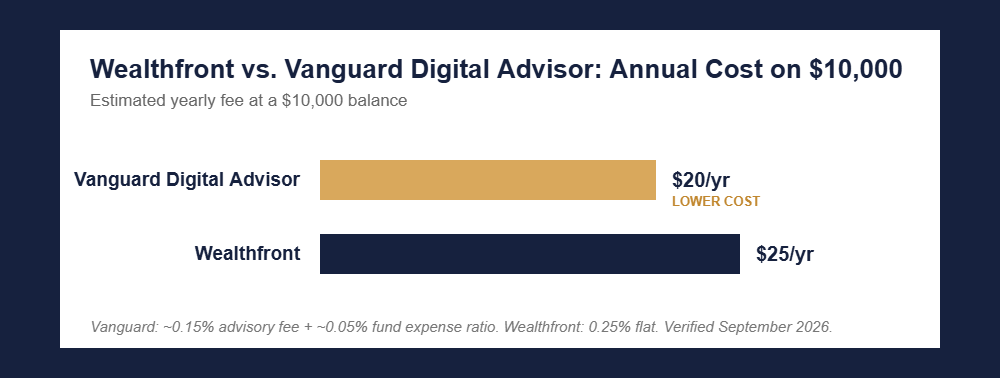
The fee comparison here requires some nuance. Wealthfront charges a straightforward 0.25% annual advisory fee plus underlying ETF expense ratios of approximately 0.08%, bringing the total all-in cost to roughly 0.33% per year.
Vanguard Digital Advisor targets a net advisory fee of approximately 0.15%, on top of which you pay the expense ratios of the underlying Vanguard funds (typically around 0.05%). Total all-in cost lands near 0.20% annually — meaningfully cheaper than Wealthfront for comparable balances. Vanguard’s all-in cost advantage is real, though the gap narrows when you factor in what you’re getting for each dollar.
Minimum Balance and Getting Started
Wealthfront requires a $500 minimum, which is accessible for most new investors. Vanguard Digital Advisor requires $3,000, which rules out some early savers but isn’t prohibitive for anyone with modest savings. If you’re starting with less than $3,000, Wealthfront is the only option between the two.
Portfolio Construction
Wealthfront builds globally diversified portfolios from low-cost ETFs across US stocks, international stocks, emerging markets, bonds, real estate, and natural resources. The platform selects your allocation based on your risk score and time horizon, and rebalances automatically. Wealthfront also offers a socially responsible investing portfolio and a US Direct Indexing upgrade at $100,000+ where it holds individual stocks instead of an ETF, enabling more precise tax-loss harvesting.
Vanguard Digital Advisor takes a more focused approach: four core Vanguard index funds covering US stocks, international stocks, US bonds, and international bonds. The simplicity is intentional — this reflects Vanguard’s philosophy that broad, low-cost diversification beats complexity. The platform also looks at your total portfolio across all your Vanguard accounts, which is a genuine advantage if you hold a Vanguard 401(k) alongside your robo-advisor account. It avoids over-weighting asset classes you already own elsewhere.
Tax-Loss Harvesting: A Critical Difference
Wealthfront offers daily automated tax-loss harvesting on all taxable brokerage accounts. This is one of the platform’s most-touted features, and for investors in high tax brackets with substantial taxable portfolios, the after-tax return improvement can meaningfully offset the management fee.
Vanguard Digital Advisor does not offer tax-loss harvesting. For investors holding primarily tax-advantaged accounts (Roth IRA, traditional IRA), this distinction doesn’t matter — those accounts don’t generate taxable capital gains. But for taxable brokerage investors, Wealthfront’s tax efficiency is a significant functional advantage.
Access to Human Advisors
This is an area where Vanguard holds an advantage many investors undervalue. Vanguard Digital Advisor includes access to human financial advisors who can provide guidance on retirement planning, Social Security timing, and holistic financial planning. Wealthfront is fully automated with no human advisor access at any balance level (it partnered with UBS in 2022 but does not offer embedded human advice in the standard product).
If you value the ability to speak with a fiduciary professional at no additional cost, Vanguard Digital Advisor’s included advisor access is a genuine differentiator.
Retirement Planning Features
Vanguard Digital Advisor is explicitly retirement-oriented. It sets a retirement income goal, shows you whether you’re on track, and provides specific guidance on contribution rates and asset allocation to meet your target. The platform’s whole-portfolio view — coordinating across all your Vanguard accounts — makes this retirement planning more accurate than most robo-advisors can offer.
Wealthfront offers retirement planning tools and projections, but it’s designed for a broader range of goals including taxable investing, college savings (529), and short-term goals. Neither approach is wrong, but Vanguard Digital Advisor is more singularly focused on the retirement use case.
Who Should Choose Wealthfront
Wealthfront makes more sense for investors building a taxable brokerage account where tax-loss harvesting generates real savings, for investors who want the direct indexing upgrade at $100,000+, for investors who want a wider range of goal types beyond retirement, and for anyone starting with less than $3,000 (since Vanguard’s minimum excludes them).
Who Should Choose Vanguard Digital Advisor
Vanguard Digital Advisor is the better fit for investors primarily building retirement accounts (Roth IRA, traditional IRA, rollover IRA), especially those who already hold Vanguard funds in a 401(k) and want a unified view of their retirement picture. The lower all-in fee and included human advisor access are genuine advantages for long-term retirement savers who don’t need taxable investing optimization.
The Bottom Line
Both are strong platforms. The choice comes down to what you’re optimizing for: Wealthfront for taxable investing and tax efficiency features; Vanguard Digital Advisor for retirement focus, lower total cost, and human advisor access. For most standalone investors, Wealthfront is the more feature-complete product. For investors already inside the Vanguard ecosystem, Digital Advisor’s coordination capabilities make it uniquely valuable.
Read our individual reviews for a deeper look: Vanguard Digital Advisor review and Wealthfront review.
Frequently Asked Questions
Is Wealthfront or Vanguard Digital Advisor cheaper?
All-in, Vanguard Digital Advisor is slightly cheaper — approximately 0.20% annually vs. Wealthfront’s ~0.33% when including ETF expense ratios. However, Wealthfront’s tax-loss harvesting can more than recover this cost difference for investors in higher tax brackets with taxable accounts.
Does Vanguard Digital Advisor offer tax-loss harvesting?
No. Vanguard Digital Advisor does not offer tax-loss harvesting. Wealthfront provides it automatically on all taxable brokerage accounts.
What is the minimum for each platform?
Wealthfront requires $500 to open an account. Vanguard Digital Advisor requires $3,000.
Can I access a human financial advisor through either platform?
Vanguard Digital Advisor includes access to human financial advisors as part of the service. Wealthfront is fully automated with no human advisor access.
Which is better for a Roth IRA?
For a Roth IRA, Vanguard Digital Advisor’s lower total cost and retirement planning focus make it a strong choice — especially if you already have Vanguard accounts. Tax-loss harvesting isn’t relevant inside a Roth IRA, removing Wealthfront’s main edge. The $3,000 minimum applies.