What Is a 401(k) Match, and How Do You Get the Most From Yours?
A 401k match is free money from your employer — but only if you contribute enough to earn it. Here's how to calculate and claim all of yours.
Here’s the one-sentence version: a 401(k) match is your employer adding money to your retirement account based on how much you personally contribute, and if you’re not contributing enough to get the full match, you are turning down part of your salary. Not “leaving money on the table” in some abstract, someday-I’ll-deal-with-it way — you are, right now, this pay period, declining compensation your employer already budgeted to give you. That’s the whole concept. The mechanics of how much, how it vests, and what to do once you’ve captured it are what the rest of this post is for.
What a 401(k) match actually is
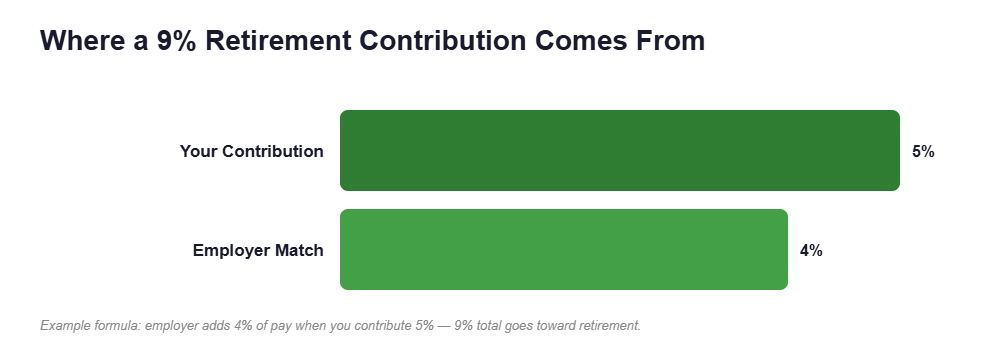
When you contribute a percentage of your paycheck to your 401(k), many employers agree to kick in additional money on top of it, up to a certain limit. The formula varies by company, but the most common structure — according to Fidelity’s data on the plans it administers — is a dollar-for-dollar match on the first 3% of your salary you contribute, plus 50 cents on the dollar for the next 2%. So if you contribute 5% of your salary, your employer adds another 4%, and your total retirement contribution for the year is 9% of your pay even though only 5% came out of your check. Other common formulas exist too, like 50% of your contribution up to 6% of salary (which caps the employer’s contribution at 3% of your pay), or a flat percentage match with no tiering at all. The specific formula matters less than understanding the mechanism: your employer is offering to multiply your own savings, but only up to whatever ceiling their plan sets.
Across U.S. employers, Fidelity’s plan data shows the actual average employer contribution lands around 4.8% of salary, though the typical formula offered on paper works out closer to 4.1% — the gap exists because employees at more generous companies pull the average up. Either way, the takeaway is the same: a meaningful chunk of your potential retirement savings is sitting with your employer, waiting for you to claim it, and most people never bother to check whether they’re getting all of it.
Why unmatched contributions are free money, full stop
It’s become a cliché to call the 401(k) match “free money,” and clichés earn that status by being true often enough that people stop listening. But think about what you’re actually declining if you contribute less than the match threshold: a guaranteed, instant return on your own contribution before the market does anything at all. If your employer matches 100% on the first 3% you contribute, moving your contribution rate from 1% to 3% is an immediate 100% return on that extra 2% of salary — a return no index fund, no stock pick, and no financial advisor can promise you. There’s no investment risk in capturing the match itself; the risk only shows up afterward, in how the combined money gets invested. Skipping it isn’t a conservative financial choice. It’s the single most expensive mistake available in a typical benefits package, because it’s invisible — nothing gets deducted from your check to remind you it’s happening, it’s just money that was never offered to you in the first place because you didn’t ask for it by contributing enough.
How to calculate the minimum contribution to get your full match
This is simpler than it looks once you find your plan’s specific formula, which is usually in your benefits portal or summary plan description. Say your employer matches dollar-for-dollar on the first 3% of salary and 50 cents on the dollar for the next 2% — the common formula mentioned above. To capture the entire match, you need to contribute at least 5% of your salary; contributing less means you’re forfeiting part of the match, and contributing more doesn’t get you additional matched dollars, it’s just extra money you’re saving on your own (which is still good, just not “free” in the same way).
The general approach: find the percentage at which your employer’s match formula tops out, and set your own contribution rate to at least that number. If your plan matches 50% up to 6% of salary, you need to contribute the full 6% to get the maximum 3% employer contribution — contributing 4% only nets you a 2% match, quietly costing you 1% of your salary in free money every single pay period. Most payroll and 401(k) platforms let you check this against your specific paycheck, and it’s worth doing the math with real numbers once a year, especially after a raise, since your contribution is usually set as a percentage but people mentally anchor to a dollar amount and forget to adjust it upward.
Vesting: why “your” employer match might not be yours yet
Here’s the part that trips people up: the money you personally contribute to your 401(k) is always 100% yours, immediately, no matter what. Employer match money is a different story — it’s often subject to a vesting schedule, meaning you only fully own it after working at the company for a certain amount of time. Leave too early, and you forfeit whatever portion hasn’t vested yet, even though it’s been sitting in your account statement the whole time looking like your money.
There are two main types. Cliff vesting is all-or-nothing: you own 0% of the match until you hit a specific milestone — the IRS caps this at three years for most plans — at which point you’re instantly 100% vested. Leave after two years and eleven months under a three-year cliff, and every dollar of employer match walks out the door without you. Graded vesting spreads ownership out incrementally, typically in 20% increments each year, capped by the IRS at six years to reach full vesting. Under a common six-year graded schedule, you might be 20% vested after two years, 40% after three, and so on until you’re fully vested at year six — so leaving after four years might mean you keep 60% of the match and lose the rest.
The practical implication is that “getting the full match” and “keeping the full match” are two different achievements. Always check your plan’s vesting schedule before you assume that employer-contributed balance is entirely yours, and factor it into decisions about when to leave a job if you’re close to a vesting cliff — sometimes staying an extra few months is worth thousands of dollars.
2026 contribution limits you should know
For 2026, the IRS raised the employee elective deferral limit for 401(k) plans to $24,500, up from $23,500 in 2025. If you’re age 50 or older, you can add a catch-up contribution of $8,000 on top of that, bringing your total potential contribution to $32,500. And thanks to SECURE 2.0, workers specifically aged 60 to 63 get an even higher catch-up limit of $11,250 instead of the standard $8,000, allowing a total contribution of up to $35,750. These limits apply to what you personally contribute — employer match money doesn’t count against your individual deferral limit, though it does count toward a separate, much higher combined limit that most people never come close to hitting.
For the vast majority of readers, these ceilings aren’t the immediate concern. The immediate concern is simply making sure your contribution rate clears whatever threshold your employer’s match formula requires. Maxing out the 401(k) entirely is a great long-term goal, but it’s a later-stage goal — the match comes first, always, before anything else in your investing plan.
What to do after you’ve captured the full match
Once your contribution rate is high enough to get every dollar of employer match, you’ve completed step one. Step two, for most people, is opening an IRA — either Roth or Traditional — because IRAs often have lower fees and a wider investment selection than workplace plans, and the tax treatment might work better for your situation depending on where you are in your career. If you’re not sure which type makes sense, the logic is the same one that applies to picking between a Roth and Traditional 401(k): a Roth IRA vs Traditional IRA comes down to whether you’d rather pay taxes now or later, and it’s worth understanding before you open either account.
If picking your own investments inside that account feels overwhelming, that’s exactly the gap robo-advisors were built to fill — it’s worth understanding what a robo-advisor actually is before deciding whether to manage the account yourself or let software do the allocating. From there, the order of operations most financial planners recommend is: capture the full match, max out an IRA if it makes sense for your tax situation, then go back and increase your 401(k) contributions further, up toward that $24,500 limit, if you have the cash flow to do it.
Bottom Line
Contribute at least enough to your 401(k) to get every dollar of your employer’s match — that’s the non-negotiable first move in any beginner investing plan, full stop, before you think about IRAs, robo-advisors, or anything else. Find your plan’s exact match formula, calculate the contribution percentage it requires, and set your payroll deduction to at least that number, then revisit it every time you get a raise so the dollar amount keeps pace. Check your vesting schedule so you know how much of that match is actually yours if you leave your job early. And once the match is fully captured, move on to an IRA and, eventually, maxing out the 401(k) itself. None of this requires picking winning stocks or timing the market — it just requires contributing enough to stop turning down money your employer already offered you.
Sources: Contribution limits: IRS: 2026 401(k) and IRA limits (checked September 30, 2026).