What Is Dollar-Cost Averaging? The Boring Strategy That Actually Works
Dollar-cost averaging is the most-recommended investing strategy for a reason. Here's what it is, why it works, and when it doesn't.
If you’ve ever heard someone say “just keep contributing to your 401(k) every month and don’t look at it,” they were describing dollar-cost averaging. They probably didn’t use the term because it’s a finance-textbook phrase that sounds more complicated than it is.
Dollar-cost averaging — DCA, if you want to sound like a pro — is one of the most universally recommended investing strategies for one reason: it works for most people in most situations, especially for people who would otherwise not invest at all.
Let’s get into what it actually is and why the case for it is strong, while still being honest about where the argument gets complicated.
The Definition
Dollar-cost averaging is the practice of investing a fixed dollar amount at regular intervals regardless of what the market is doing.
$200 into an index fund on the first of every month. $50 into your 401(k) every paycheck. $500 into a brokerage account every quarter. The specifics don’t matter — what matters is that the amount and the schedule are fixed, and you stick to them no matter what headlines you read that week.
When prices are high, your fixed dollar amount buys fewer shares. When prices are low, it buys more. Over time, your average cost per share tends to smooth out, and you avoid the single worst mistake a human investor can make: trying to time the market.
Why It Works (The Behavioral Argument)
The strongest case for DCA isn’t mathematical. It’s psychological.
If you had a lump sum of $12,000 today and decided to invest $1,000 a month for the next year, you’d probably sleep fine either way the market moved. If it dropped, your next $1,000 would buy more shares at lower prices — a win, in a sense. If it rose, your already-invested money would be up — also a win.
Compare that to dumping all $12,000 in today. If the market drops 20% next week, you’re down $2,400 and staring at the sickening feeling of a mistake. A lot of investors in that situation panic-sell, which turns a temporary drop into a permanent loss.
DCA eliminates that specific failure mode. It takes the decision of “when to invest” out of your hands and hands it to a schedule. You invest when the calendar says to, not when you feel like it. Since you’re not deciding, you can’t second-guess.
Why the Math Is Less Clean
Here’s the uncomfortable counterpoint: if you have a lump sum to invest and markets generally go up over time, investing it all at once usually beats dollar-cost averaging over long periods. Studies from Vanguard and others have shown this repeatedly. About two-thirds of the time, lump-sum investing a large amount wins vs. spreading it over 6 or 12 months.
This makes sense. If the market is up in most years, every month your cash is sitting on the sidelines waiting to be DCA’d in is a month it’s not earning returns.
So why do people still recommend DCA? Because the studies assume you actually deploy the full amount eventually. In real life, people with a lump sum who try to DCA often get scared halfway through, pause the strategy, and end up with a pile of cash they never fully invest. That outcome is much worse than either lump-sum or pure DCA.
The behavioral argument beats the math argument because most of us are more like “the person who gets scared and stops” than we are like “the rational actor who executes the optimal strategy without emotion.”
DCA as a Default, Not a Strategy
Here’s the cleanest way to think about DCA. For money you earn over time — your paycheck, your freelance income, your business profits — DCA isn’t really a strategy you’re choosing. It’s just how reality works. You can’t lump-sum invest money you haven’t earned yet. So you invest each paycheck as it comes in, which is DCA by definition.
For money that arrives as a lump sum — an inheritance, a bonus, the proceeds of a house sale — you genuinely do have a choice between DCA’ing it in over 6 or 12 months or deploying it immediately. In that case, the historical math says lump sum usually wins, but the behavioral case for DCA is stronger than most people give it credit for.
A good default for most people: DCA your paychecks (easy — just automate it) and lump-sum any windfalls (if you can genuinely tolerate the short-term volatility without panicking).
How to Actually Set Up DCA
The whole point of DCA is automation. If you’re making the decision manually each month, you’ll start fidgeting with it and the strategy will collapse.
For retirement accounts, automation is usually built in. Your 401(k) contribution is automatically DCA’d every paycheck. For an IRA, most brokerages let you set up automatic monthly transfers from your bank.
For a taxable brokerage, most platforms — Fidelity, Schwab, Vanguard, M1, Betterment, Wealthfront — offer recurring deposits. Set the amount, set the frequency, and walk away.
For robo-advisors, it’s even more automatic. You pick the monthly contribution and the system handles everything else, including picking which funds to buy and rebalancing over time.
What DCA Won’t Do
Dollar-cost averaging is not a protection against losses. If the market drops 30% over a year, your DCA contributions during that year will also lose value. DCA doesn’t create a floor.
It also doesn’t guarantee higher returns than lump-sum investing. As covered, lump sum usually wins mathematically over long periods.
What DCA does is make long-term investing psychologically sustainable. It removes the need to time the market, removes the temptation to pause during downturns, and removes the decision fatigue of “is now a good time?” Those benefits are quietly enormous, even though they don’t show up in a spreadsheet.
Bottom Line
Dollar-cost averaging is boring, consistent, and extremely hard to beat in the real world. Not because it’s mathematically optimal, but because it keeps you invested through the emotional turbulence that knocks most investors off their long-term plan.
Automate your contributions, ignore the headlines, and let the strategy do its boring work.
Quick Links
For more plain-English coverage of the strategies that actually work for regular investors, subscribe to the KatchingStacks newsletter — one short, readable email a week. If you want to put DCA into practice starting today, our How to Start Investing With $100 guide walks through the exact steps.
Ready to put this into practice? See our Best Robo-Advisors 2026 comparison to find a platform that fits your strategy.
A Hypothetical Example: DCA vs. Lump Sum in a Rocky Year
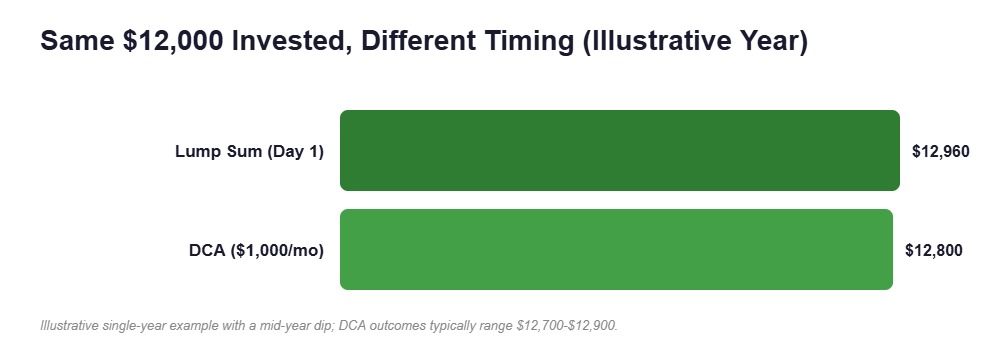
Here’s a simplified, illustrative scenario (not real market data) that shows why both the math argument and the behavioral argument are true at the same time. Say you have $12,000 to invest and the market drops 15% in month 3, then recovers and ends the year up 8% overall.
| Approach | What happens | Illustrative year-end result |
|---|---|---|
| Lump sum ($12,000 on day 1) | Full amount rides the entire recovery from the low point | ~$12,960 (+8%) |
| DCA ($1,000/month for 12 months) | Later contributions buy in after the dip at lower prices, missing some of the early-year growth but catching a better average price | ~$12,700-$12,900 (typically slightly behind lump sum in a year that ends up) |
In this illustration, lump sum wins slightly — consistent with the historical pattern where markets rise most years. But notice what DCA did for the investor psychologically: nobody staring at a 15% drop in month 3 with only $1,000 invested so far panics the way someone with the full $12,000 already in does. The DCA investor’s worst-case emotional moment was much smaller, even though their eventual return was a bit lower.
My Honest Take
I default to recommending DCA for windfalls to almost everyone, even knowing the math slightly favors lump sum most years — because the math only wins if you actually follow through, and lump sum’s failure mode is catastrophic (panic-selling at the bottom) while DCA’s failure mode is just “slightly lower average return.” Those aren’t symmetric risks. Unless you’ve genuinely sat through a real 20%+ drop with real money invested and know for certain you won’t touch it, I’d rather you take the statistically smaller return with the much smaller chance of blowing up the whole plan.