Betterment vs Wealthfront (2026): Which Robo-Advisor Is Actually Better for You?
Betterment and Wealthfront both charge 0.25% and invest in low-cost ETFs — but the differences are real. Here's how to pick the right robo-advisor for your situation.
KatchingStacks is reader-supported. When you open an account through links on this page, we may earn a commission at no extra cost to you. See our affiliate disclosure and editorial policy.
If you’ve been shopping for a robo-advisor, you’ve almost certainly landed on these two. Betterment and Wealthfront are the two biggest independent robo-advisors in the US — and for good reason. Both charge the same low fee, both invest in diversified ETF portfolios, and both make it dead simple to start investing without picking stocks yourself.
But they’re not the same. The differences are real, and depending on your situation, they could matter a lot. Here’s everything you need to know to pick the right one.
Quick Comparison: Betterment vs Wealthfront
| Feature | Betterment | Wealthfront |
|---|---|---|
| Management fee | $5/mo (<$24K) or 0.25%/yr | 0.25%/yr |
| Minimum to invest | $0 ($10 to start) | $500 |
| Tax-loss harvesting | All accounts | All accounts |
| Direct indexing | No | $100K+ |
| Human advisors | Premium plan | No |
| Cash account APY | 4.75% (5.10% Premium) | 4.50% |
| Crypto portfolios | Yes | No |
| Goal-based planning | Yes | Yes |
| Smart Beta | No | $500K+ |
Quick take: who each one fits
- you would rather not commit $500 to open an account (Wealthfront’s minimum)
- you have under $24,000 and will set up $200+/month in deposits, so the 0.25% fee applies instead of a flat $5/month
- Read the Betterment review
- you can open with $500 and want a straightforward 0.25% fee
- you are heading toward $100,000 in a taxable account, where its US Direct Indexing becomes available
- Read the Wealthfront review
Fees and minimums checked against each provider’s own pages on Oct. 6, 2026.
Fees: A Dead Heat (Mostly)
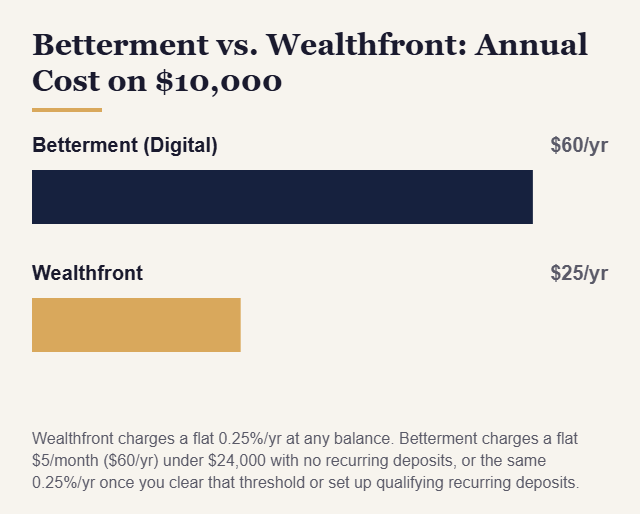
Both platforms are built around a 0.25% per year advisory fee — that’s $25 per year on a $10,000 portfolio — but Betterment only charges it once your balance clears $24,000 or you set up qualifying recurring deposits. No trading fees, no rebalancing fees, no hidden costs.
Betterment adds a twist: below $24,000 without qualifying recurring deposits, you pay a flat $5/month ($60/year) instead of the percentage fee — which is more than 0.25% would cost at any balance under $24,000, not less. Once you clear that threshold (or set up $200+/month in recurring deposits), you’re on the same 0.25% as Wealthfront. Betterment’s Premium plan costs 0.65%/yr total (0.25% base plus a 0.40% surcharge) and gives you unlimited access to Certified Financial Planners. Wealthfront has no human advisor option at any price.
Winner: Tie above $24,000 — 0.25% is the same either way. Below that, Wealthfront is cheaper unless you qualify for Betterment’s recurring-deposit waiver; Betterment still wins for anyone who wants CFP access.
Minimum Balance: Betterment Wins for Beginners
Betterment has no minimum — you need just $10 to start investing. Wealthfront requires a $500 minimum. If you’re just starting out with a few hundred dollars, Wealthfront won’t take you at all. Betterment will.
Winner: Betterment — and it’s not close.
Tax-Loss Harvesting: Wealthfront’s Secret Weapon
Both offer standard tax-loss harvesting — selling losing positions to offset gains and reduce your tax bill. It’s included at no extra cost on both platforms.
But Wealthfront goes further with direct indexing on accounts over $100,000. Instead of holding a single ETF that tracks the S&P 500, Wealthfront buys the individual stocks directly. That creates far more tax-loss harvesting opportunities — potentially adding 1.8% in after-tax annual returns compared to 0.77% from ETF-level harvesting. For high earners with large taxable accounts, that difference compounds into serious money.
Betterment’s tax-loss harvesting is solid at the ETF level. The company claims nearly 70% of customers using it cover their advisory fees through estimated tax savings.
Winner: Wealthfront — especially if you have $100K+ in a taxable account.
Portfolio Options: Betterment Has More to Choose From
Wealthfront keeps it focused: classic automated index investing with a risk score setting your allocation. Betterment gives you more levers: Core portfolio (standard diversified ETFs), Goldman Sachs Smart Beta, Flexible portfolios (adjust individual ETF weights), Crypto portfolios (Bitcoin, Ethereum, diversified crypto), and multiple SRI/ESG options. If you want to customize or add crypto exposure, Betterment is the only one of the two that lets you do it.
Winner: Betterment — more flexibility and more portfolio types.
Cash Accounts: Betterment Pays More
Both offer high-yield cash accounts that crush traditional savings rates. Betterment Cash Reserve pays 4.75% APY (5.10% for Premium), FDIC insured up to $2M. Wealthfront Cash Account pays 4.50% APY, FDIC insured up to $8M through 34 partner banks.
Winner: Betterment for most people. Wealthfront for those parking very large cash positions.
Human Advisors: Betterment Only
Wealthfront is fully automated — no CFPs, no phone calls. Betterment’s Premium plan (0.65%/yr, $100K minimum) includes unlimited messaging and calls with Certified Financial Planners who can review your full financial picture, not just your Betterment account.
Winner: Betterment
Performance
Both invest in similar low-cost diversified ETFs, so long-term returns should be comparable before taxes. After taxes, Wealthfront’s direct indexing may pull ahead for large taxable accounts.
Who Should Choose Betterment?
- You’re just starting and don’t have $500 yet
- You want access to a human financial planner
- You want crypto in your portfolio
- You want to customize your ETF mix
- You have multiple financial goals to track
Who Should Choose Wealthfront?
- You have $500+ to start
- You have a $100K+ taxable account (direct indexing is a real advantage)
- You want the most automated, hands-off experience
- You prioritize tax efficiency over human contact
- You want higher FDIC cash insurance ($8M vs $2M)
The Bottom Line
For most beginners: Betterment. No minimum, easier to start, more portfolio options, and you can get a human on the phone.
For serious investors with $100K+ in a taxable account: Wealthfront. Direct indexing is a legitimate edge that Betterment simply doesn’t offer.
Both are excellent. You won’t go wrong with either — but the right choice depends on where you are financially.
Ready to dive deeper? Read our full Betterment review or Wealthfront review for a closer look at each platform.
What Direct Indexing Is Actually Worth in Dollars
Wealthfront advertises direct indexing’s tax-loss harvesting edge as 1.8% in additional after-tax annual return, versus roughly 0.77% from standard ETF-level harvesting. That gap sounds abstract until you put a balance behind it. Here’s the approximate cumulative value of that edge over 10 years, assuming a 7% annual growth rate on the underlying balance:
| Taxable account balance | ~Extra value over 10 years |
|---|---|
| $100,000 | ~$14,000 |
| $250,000 | ~$36,000 |
| $500,000 | ~$71,000 |
These are estimates, not guarantees — actual harvesting value depends on market volatility (more volatility means more harvesting opportunities), your tax bracket, and how the underlying stocks perform individually rather than as a basket. But the order of magnitude is real: at $250,000 and up, direct indexing isn’t a nice-to-have footnote, it’s a meaningful chunk of return that Betterment structurally cannot offer, no matter how good its ETF-level harvesting is.
My Honest Take
Don’t let the direct indexing pitch talk you out of Betterment if you’re nowhere near $100,000 in a taxable account yet. I see people get anchored on Wealthfront’s “advantage” when they’re investing $15,000 — at that balance, the feature literally doesn’t apply to them (it kicks in at $100K), and they’re paying identical fees for identical underlying diversification. Pick based on minimum balance and portfolio flexibility today, and know that if your taxable account eventually crosses six figures, direct indexing becomes a real reason to reconsider — not before.
It’s also worth remembering the 1.8% figure is Wealthfront’s own marketing number, drawn from favorable market conditions with plenty of volatility to harvest against. In a quiet, steadily-rising market, harvesting opportunities dry up and the realized edge shrinks toward the same 0.77% you’d get from ETF-level harvesting anyway. Treat the table above as a ceiling, not a promise — the honest expectation for most years is somewhere below it.