Acorns vs Betterment (2026): Which Robo-Advisor Is Right for You?
Acorns rounds up your spare change and invests it. Betterment is a full-featured robo-advisor. Here's how to pick the right one for where you are financially.
KatchingStacks is reader-supported. When you open an account through links on this page, we may earn a commission at no extra cost to you. See our affiliate disclosure and editorial policy.
Acorns and Betterment are both robo-advisors, but they’re built for very different investors. Acorns is designed to make investing effortless for people who struggle to save — it rounds up your spare change and invests it automatically. Betterment is a full-featured robo-advisor built for people who are ready to invest intentionally and maximize returns.
Which one is right for you depends almost entirely on where you are financially. Here’s the honest breakdown.
Quick Comparison: Acorns vs Betterment
| Feature | Acorns | Betterment |
|---|---|---|
| Monthly fee | $4–$12/mo (flat) | $5/mo (<$24K) or 0.25%/yr |
| Minimum to invest | $0 | $0 ($10 to start) |
| Round-Up investing | Yes — core feature | No |
| Tax-loss harvesting | No | Yes |
| IRA match | Yes (up to 3%) | No |
| Human advisors | No | Yes (Premium) |
| Custodial (kids) accounts | Yes | No |
| Joint/Trust accounts | No | Yes |
| Crypto | No | Yes |
| Best for | Beginners, passive savers | Intentional investors |
Fees: It Depends on Your Balance
This is the most important factor and it’s not obvious at first glance.
Acorns charges a flat monthly subscription: $4/mo (Bronze), $8/mo (Silver), or $12/mo (Gold). Simple. Predictable.
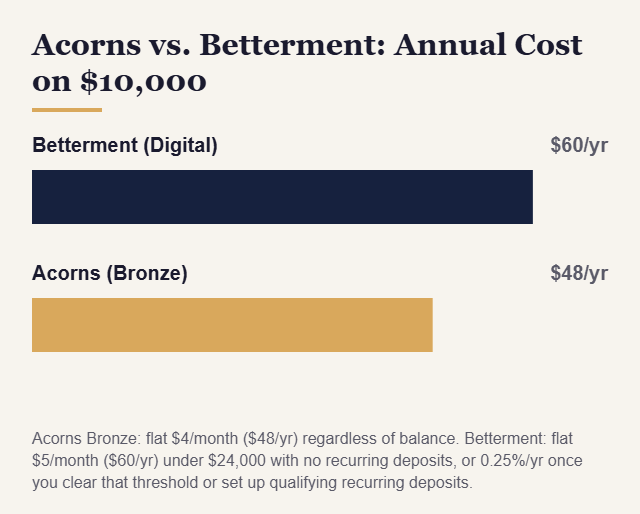
Betterment charges a flat $5/month under $24,000 (unless you set up $200+/month in recurring deposits), or 0.25% per year once your balance reaches $24,000 — a percentage of your balance, so the cost scales up as your portfolio grows.
Without recurring deposits, Betterment’s flat $5/month ($60/yr) is more than Acorns Bronze’s flat $4/month ($48/yr) at every balance below $24,000 — and once Betterment switches to 0.25% at $24,000, that’s $60/yr too, so Acorns Bronze stays cheaper in raw dollars unless your balance climbs well past $24,000. The one exception: if you qualify for Betterment’s recurring-deposit waiver, its 0.25% rate applies immediately, and it beats Acorns Bronze’s flat $48/yr on any balance under $19,200.
- $1,000 balance, no recurring deposits: Acorns = $48/yr (4.8%), Betterment = $60/yr (6.0% flat fee)
- $10,000 balance, no recurring deposits: Acorns = $48/yr (0.48%), Betterment = $60/yr (0.60% flat fee)
- $10,000 balance, with $200+/mo recurring deposits: Acorns = $48/yr, Betterment = $25/yr (0.25%)
- $50,000 balance: Acorns = $48/yr, Betterment = $125/yr (0.25%)
If you have a small balance and plan to keep it there, Acorns wins on fees. As your portfolio grows, Betterment becomes significantly cheaper.
Winner: Acorns for small balances, Betterment for large ones.
Round-Ups: Acorns’ Killer Feature
Acorns’ signature feature is Round-Ups. Link your debit or credit cards and Acorns rounds every purchase up to the nearest dollar, sweeping the change into your investment account. Buy a $4.30 coffee and $0.70 goes to your portfolio.
It’s a clever way to invest without thinking about it. For people who know they should save but keep forgetting or spending, Round-Ups create a passive savings habit.
Betterment has no equivalent. It’s built for people who are ready to make deliberate contributions — set up auto-deposits, fund goals, build toward a target.
Winner: Acorns — if this is the feature that gets you investing, it’s worth a lot.
Tax-Loss Harvesting: Betterment Only
Tax-loss harvesting automatically sells positions at a loss to offset capital gains, reducing your tax bill. On a $100K portfolio in a high tax bracket, this can save hundreds or thousands per year.
Betterment does this automatically on all taxable accounts. Acorns doesn’t offer it at all.
If you have a meaningful taxable investment account ($20K+), this difference alone can outweigh everything else.
Winner: Betterment
IRA Match: Acorns’ Hidden Gem
Acorns Gold ($12/mo) includes an IRA match of up to 3% on IRA contributions. That’s free money — a $7,000 IRA contribution gets you $210 back. No other major robo-advisor offers anything like this.
If you’re maxing your Roth IRA annually, this feature alone could justify Acorns’ cost for some users.
Betterment offers no IRA match.
Winner: Acorns — unique in the robo-advisor space.
Portfolio Options
Both invest in diversified ETF portfolios, but Betterment gives you far more control.
Acorns offers five preset risk portfolios (Conservative, Moderately Conservative, Moderate, Moderately Aggressive, Aggressive). Acorns Gold adds Custom Portfolios where you can adjust allocations. Simple and hands-off.
Betterment offers a core diversified portfolio, Goldman Sachs Smart Beta, flexible portfolios (adjust individual ETF weights), crypto portfolios, and multiple SRI/ESG options. It’s a full-featured investment platform.
Winner: Betterment
Account Types
Acorns offers individual taxable accounts and IRAs (plus custodial accounts for kids on the Gold plan). No joint accounts, no trust accounts.
Betterment offers individual taxable, IRAs, joint accounts, and trust accounts. More flexibility for complex financial situations.
Winner: Betterment for most adults. Acorns wins if you want a kids/custodial account.
Who Should Choose Acorns?
- You struggle to save consistently and want investing on autopilot
- You’re just starting and have under $14,400 to invest
- You want to earn an IRA match on your contributions
- You want to open a custodial investing account for a child
- You want the simplest possible experience with minimal decisions
Who Should Choose Betterment?
- You have $14,400+ invested (Betterment becomes cheaper)
- You want tax-loss harvesting on taxable accounts
- You want more portfolio options (crypto, ESG, Smart Beta)
- You want access to a human financial planner
- You have a joint account or trust you need to invest
- You’re a deliberate investor who makes regular contributions
The Bottom Line
Starting out with under $5,000 and trouble saving consistently? Acorns. The Round-Ups and flat fee make it the right tool to build the habit. The IRA match sweetens the deal.
Have a growing portfolio and want to optimize returns? Betterment. Tax-loss harvesting, more portfolio options, and a lower percentage fee at scale make it the stronger long-term platform.
Both are solid. Neither will make a bad investment. The question is which one will actually keep you invested.
Want a deeper look? Read our full Acorns review or Betterment review. Also see: Betterment vs Wealthfront and Acorns vs Wealthfront vs Betterment.
How Fast Does Round-Ups Money Actually Add Up?
Round-Ups feel too small to matter — that’s kind of the point. But invested consistently, spare change compounds like any other contribution. Here’s the projected value of Acorns’ typical ~$43/month in Round-Ups compared to a deliberate $50/month contribution into Betterment, both growing at 7% annually:
| Time horizon | Round-Ups (~$43/mo) | Deliberate $50/mo |
|---|---|---|
| 5 years | ~$3,100 | ~$3,600 |
| 10 years | ~$7,400 | ~$8,700 |
| 20 years | ~$22,400 | ~$26,000 |
The gap between the two isn’t the story — it’s how close they are. Round-Ups, which require zero decisions and zero willpower, get you within striking distance of a deliberate monthly contribution that most people never actually stick to. That’s the entire value proposition in one table.
My Honest Take
I don’t think of Round-Ups as an investing strategy — I think of it as a gateway habit. Nobody builds real wealth on spare change alone; $22,400 after 20 years is meaningful, but it’s not retirement. What Round-Ups actually does well is get someone who “isn’t a saver” into the habit of having money automatically invested every single week, without ever making a decision about it. Once that habit exists, layering a deliberate $100 or $200/month contribution on top feels a lot less intimidating than starting from zero. Use Acorns to get moving, then graduate the strategy once the habit sticks.
One more nuance: the Round-Ups total depends entirely on your spending habits, not your income. Someone who swipes a card 30 times a week generates meaningfully more Round-Ups than someone who pays cash or uses one card for big purchases. If your spending is mostly digital and frequent, the numbers above may undersell what you’d actually see. If you rarely use cards, Round-Ups alone won’t move the needle much — and Acorns’ Recurring Investments feature (a scheduled deliberate deposit on top of Round-Ups) becomes the more important lever.