Acorns vs Wealthfront vs Betterment: Which Robo-Advisor Is Right for You?
Informational purposes only: The content on this page is for educational purposes and does not constitute personalized investment advice. Consult a licensed financial advisor before making investment decisions. Past performance does not guarantee future results. See our editorial policy. KatchingStacks is reader-supported. When you open an account through links on this page, we may earn...
KatchingStacks is reader-supported. When you open an account through links on this page, we may earn a commission at no extra cost to you. See our affiliate disclosure and editorial policy.
Acorns, Wealthfront, and Betterment all promise to grow your money on autopilot — but they work very differently, serve different investor types, and have meaningfully different fee structures. This head-to-head comparison breaks down exactly what you get with each, so you can choose the right platform for where you are right now.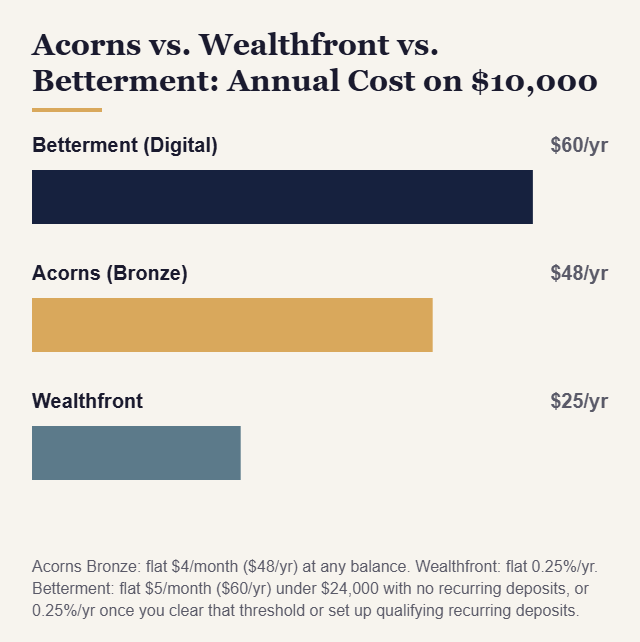
What Is a Robo-Advisor?
A robo-advisor is an automated investment platform that builds and manages a diversified portfolio for you. Instead of picking stocks yourself, you answer a few questions about your goals and risk tolerance, and the platform does the rest. They’re low-cost, hands-off, and used by millions of investors from complete beginners to high-net-worth individuals who simply want their money managed efficiently.Acorns: Best for Micro-Investors and Beginners
Acorns is designed for people who want to start investing with almost nothing. Its signature feature is “Round-Ups” — it rounds up your everyday purchases to the nearest dollar and invests the spare change automatically. Spend $3.75 on coffee? Acorns rounds to $4.00 and invests $0.25. Small amounts, but they accumulate into real money over time — especially when combined with market compounding. Key Features:- Start with as little as $5
- Diversified ETF portfolios (5 risk levels from conservative to aggressive)
- Acorns Checking — a full debit card account with automatic round-ups
- Acorns Later — IRA accounts (Traditional, Roth, SEP)
- Acorns Early — UTMA/UGMA custodial accounts for kids
- Found Money — cashback into your investment account from partner brands
Wealthfront: Best for Sophisticated, Hands-Off Investors
Wealthfront is the most feature-rich of the three. It offers tax-loss harvesting, direct indexing (for accounts over $100K), and a high-yield cash account — features that become increasingly valuable as your balance grows. The interface is clean, the automation is thorough, and the Self-Driving Money feature can automatically move money between checking, savings, and investing based on rules you set. Key Features:- $500 minimum investment
- Automatic tax-loss harvesting on all taxable accounts
- Direct indexing for accounts over $100,000 (enhanced tax optimization)
- 529 college savings plan
- Financial planning tools (built-in, no extra cost)
- High-yield cash account (competitive APY)
- Self-Driving Money automation
- Crypto investing available (Bitcoin and Ethereum ETFs)
Betterment: Best All-Around Robo-Advisor
Betterment is widely considered the gold standard of robo-advisors. It has no minimum balance, a goal-based interface that actually teaches you about investing as you use it, and flexible account types that scale from your first $100 to your first $1 million. The Premium tier adds access to human CFPs for investors with $100,000+ who want professional guidance alongside automation. Key Features:- No minimum balance
- Tax-loss harvesting on all taxable accounts
- Socially responsible investing (SRI) portfolios
- Crypto investing portfolios
- Premium plan with human financial advisor access
- Goal-based investing tools (retirement, emergency fund, major purchase)
- Cash Reserve high-yield savings account
Head-to-Head Comparison
| Feature | Acorns | Wealthfront | Betterment |
|---|---|---|---|
| Minimum | $5 | $500 | $0 |
| Fee | $4–$12/mo | 0.25%/yr | $5/mo (<$24K) or 0.25–0.65%/yr |
| Tax-loss harvesting | No | Yes | Yes |
| Human advisors | No | No | Yes (Premium) |
| Round-Ups | Yes | No | No |
| Direct indexing | No | Yes ($100K+) | No |
| Crypto | No | Yes | Yes |
| 529 plan | No | Yes | No |
| IRA accounts | Yes | Yes | Yes |
The Fee Math Over Time
Fees compound negatively just as returns compound positively. Here’s a concrete look at how the fee structures differ on a $10,000 initial investment with $200/month contributions at a 7% annual return over 20 years:- Acorns Bronze ($4/month = $48/year): The flat fee hurts small balances but becomes more manageable as the portfolio grows. At a $10,000 balance, you’re paying 0.48% — already higher than the percentage-fee alternatives once they kick in.
- Wealthfront (0.25%/year): Starts at $25/year on $10,000 and scales proportionally. At $100,000, you pay $250/year. At $500,000, you pay $1,250/year. Always fair relative to portfolio size.
- Betterment ($5/month under $24,000, then 0.25%/year): Identical to Wealthfront at the Digital tier once you clear $24,000 (or set up qualifying recurring deposits) — below that, the flat $5/month fee is pricier. The 0.65% total Premium tier becomes cost-competitive with traditional advisors when you factor in unlimited CFP access.
Which One Should You Choose?
Choose Acorns if: You’re just starting out and want to invest spare change effortlessly. You have under $1,000 to start and struggle to save. You want a simple habit-builder, not a full financial platform. Choose Wealthfront if: You have $500+ ready to invest. You want the best tax optimization (especially tax-loss harvesting and, eventually, direct indexing). You’re comfortable with no human advisor access. You want the most automation — including Self-Driving Money for managing cash flow. Choose Betterment if: You want zero minimum and a goal-based interface. You might want human advisor access as your balance grows (Premium). You want the most flexible all-around platform that works equally well at $500 and $500,000.The Bottom Line
All three are legitimate, regulated robo-advisors that will serve most investors well. The decision comes down to where you are financially right now. If you’re just starting: Acorns or Betterment. If you have a real balance and want maximum optimization: Wealthfront or Betterment Premium. When in doubt, Betterment is the safest all-around pick — it’s the platform that works at every stage of your investing journey. Ready to dig deeper? Read our full reviews: Acorns Review | Wealthfront Review | Betterment Review.How Each Platform Handles Market Downturns
Behavioral coaching — helping investors not panic-sell during market crashes — is one of the less-discussed but genuinely valuable features of premium robo-advisors. Here’s how each handles it: Acorns takes a minimal approach. The app is designed to be ignored, which is actually a feature. Sparse notifications and a simple interface mean you’re less likely to log in during a crash and make an impulsive decision. The downside: there’s no active communication during volatile periods. Wealthfront sends informational emails during major market events explaining what’s happening and why staying the course is statistically optimal. The Self-Driving Money feature also keeps idle cash deployed automatically, which smooths out decision fatigue during uncertain times. Betterment has the most robust behavioral coaching features. During market downturns, Betterment actively contacts users with contextual guidance, shows historical recovery data, and in some cases temporarily prevents the easiest path to panic-selling by adding a confirmation step. Their Premium users also get direct CFP access — which is invaluable during a 30% market correction when your instinct is to sell everything.Account Types Available on Each Platform
Most investors need more than one type of account. Here’s how the platforms stack up: Acorns: Individual taxable accounts, Traditional IRA, Roth IRA, SEP IRA, and custodial accounts for minors (UTMA/UGMA). Solid coverage for most retail investors, but no 529 plan and no joint accounts. Wealthfront: Individual taxable, joint taxable, Traditional IRA, Roth IRA, SEP IRA, 401(k) rollover, trust accounts, and 529 college savings plans. The most comprehensive account type coverage of the three platforms. Betterment: Individual taxable, joint taxable, Traditional IRA, Roth IRA, SEP IRA, 401(k) rollover, inherited IRA, and trust accounts. No 529 plan, but excellent IRA and trust account support.What Happens If You Want to Leave?
Switching robo-advisors is possible but can have tax implications. If you’re in a taxable account, leaving means either selling your holdings (triggering potential capital gains taxes) or doing an in-kind transfer (transferring the actual ETFs to another brokerage without selling). Not all platforms support in-kind transfers between robo-advisors. All three platforms support ACATS transfers to move accounts to other brokerages. Betterment and Wealthfront are typically the most flexible about outbound transfers. Acorns is designed more as a starter platform and has less robust transfer tooling — which is fine given its target audience. The practical advice: if you’re just starting out, don’t over-optimize. Pick one of these three and invest consistently for 12 months before evaluating whether to switch. The opportunity cost of being out of the market while you deliberate always exceeds the benefit of picking the theoretically perfect platform.Frequently Asked Questions
Can I use more than one robo-advisor?
Yes, but it’s rarely necessary. Using both Acorns (for automated spare change investing) and Betterment (for goal-based contributions) is a common combination. There’s no rule against it, and both platforms operate independently. Just make sure you’re not duplicating account types unnecessarily — two Roth IRAs at different platforms counts as one Roth IRA for annual contribution limit purposes.Which robo-advisor has the best returns?
This question is nearly impossible to answer meaningfully because returns depend on market conditions, portfolio allocation, and time period. All three platforms invest in similar underlying assets (total market ETFs, bond ETFs, international ETFs). Long-term performance differences are likely to be minimal. Tax efficiency — where Wealthfront and Betterment both outperform Acorns — is a more reliable way to measure the real-world value difference.Are these platforms good for retirement investing?
Yes — all three support IRA accounts and are reasonable choices for long-term retirement savings. For most people, the choice between them for a Roth IRA is less important than simply having a Roth IRA and contributing to it consistently. The maximum 2026 IRA contribution is $7,000 ($8,000 if you’re 50+). Fill it every year, regardless of which platform you use.See also: Betterment vs Wealthfront (2026) — Full Comparison
Want a deeper dive? Check out our dedicated Acorns vs Betterment comparison for a full head-to-head breakdown.