Index Fund vs ETF: What’s the Difference and Which Should You Choose?
Index fund vs ETF: a clear breakdown of the key differences in trading, taxes, minimums, and automatic investing — and how to choose the right one.
Index fund vs ETF is one of the most common points of confusion in personal finance. Both are diversified, low-cost, passive investments that track a market index. Both are dramatically better than most actively managed alternatives. And yet they are meaningfully different in how they’re structured, traded, taxed, and accessed — and those differences actually matter for your money.
Here’s what you need to know to choose the right one.
What Is an Index Fund?
An index fund is a mutual fund designed to track the performance of a specific market index — the S&P 500, the total US stock market, a bond index, or others. It holds all (or a representative sample) of the securities in that index, in proportion to their weight. When you invest in an index fund, you’re buying shares of the fund directly from the fund company (Fidelity, Vanguard, etc.) at the end-of-day net asset value (NAV) price. Trades execute once per day, after market close.
What Is an ETF?
An ETF (exchange-traded fund) is also a fund that tracks an index — but it trades like a stock on an exchange throughout the trading day at market prices. You buy and sell ETF shares through your brokerage account just like you’d buy Apple or Tesla shares. Prices fluctuate minute to minute during market hours. The most widely held ETFs — like Vanguard’s VTI (total US market) or SPY (S&P 500) — track the same indexes as popular mutual fund index funds.
The 5 Key Differences
1. How You Trade Them
Index mutual funds trade once per day, at the fund’s end-of-day NAV. If you submit a buy order at 10 AM, your shares are purchased at whatever the NAV is at 4 PM market close. ETFs trade continuously during market hours, just like stocks — you can buy or sell at 9:32 AM, 1:47 PM, or anywhere in between at the current market price.
For long-term buy-and-hold investors, this distinction is largely irrelevant. For investors who want intraday control — or who might panic and sell during a market drop — this difference can matter behaviorally.
2. Minimum Investment
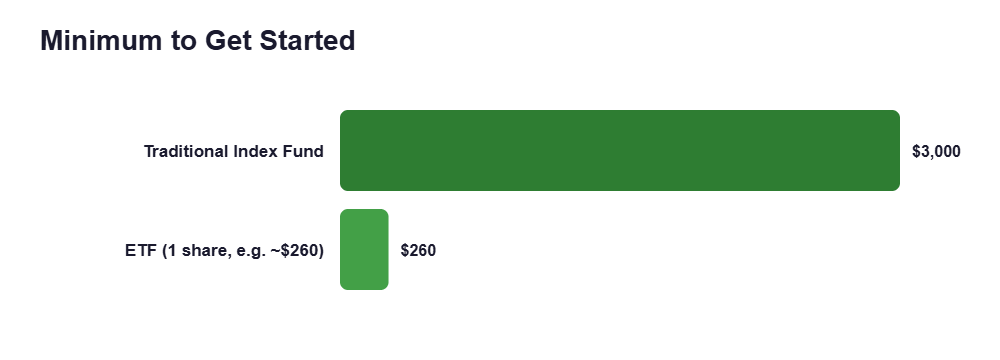
Many index mutual funds have investment minimums — Vanguard’s VTSAX requires $3,000 to start. ETFs trade as whole shares (or fractional shares at most modern brokerages), so you can often buy ETF equivalents with much less. Vanguard’s ETF equivalent of VTSAX is VTI, which trades at around $260/share — and many brokerages allow fractional shares for any dollar amount.
3. Tax Efficiency
ETFs have a structural tax efficiency advantage over traditional mutual fund index funds. When mutual fund investors redeem shares, the fund may need to sell holdings and distribute capital gains to all remaining shareholders — even those who didn’t sell. ETFs use an “in-kind” creation/redemption mechanism with institutional market makers that largely avoids this. The result: ETFs tend to produce fewer unexpected taxable capital gain distributions.
For accounts held inside a Roth IRA or traditional IRA, this distinction doesn’t matter — taxes don’t apply. For taxable brokerage accounts, ETFs generally have a slight tax efficiency edge.
4. Automatic Investing
Index mutual funds support automatic, recurring investments for any dollar amount — you can set up $200/month to go into FZROX automatically. ETFs traditionally require buying whole shares (though fractional shares are becoming standard). Mutual funds win on this dimension for investors who want set-it-and-forget-it automatic contributions.
5. Expense Ratios
Comparable index funds and ETFs tracking the same index often have nearly identical expense ratios. Fidelity’s ZERO funds (FZROX, FZILX) at 0.00% have no ETF equivalent at that price point, giving the mutual fund an edge there. For most Vanguard and Schwab comparisons, the ETF and mutual fund versions of the same index carry identical expense ratios.
Are There Situations Where One Is Clearly Better?
For taxable brokerage accounts, ETFs have a mild structural advantage due to tax efficiency. For automatic investing with recurring contributions, index mutual funds are typically easier to set up. For IRA accounts, the difference is largely academic — choose whichever you prefer. If you’re using Fidelity and want the absolute lowest expense ratio, their ZERO mutual funds beat any ETF on cost.
What About Actively Managed ETFs?
Not all ETFs are passive index trackers — there’s a growing category of actively managed ETFs that employ portfolio managers trying to beat an index. These are more expensive and don’t carry the cost and performance advantages of passive index ETFs. When comparing “index fund vs ETF,” the most relevant comparison is passive index mutual funds vs passive index ETFs — not all ETFs are index funds.
The Verdict
For most investors, the index fund vs ETF distinction is far less important than simply starting to invest in low-cost, broadly diversified products. If you’re using a platform like Fidelity or Schwab and want to set up automatic monthly contributions, use mutual fund index funds (FZROX, SWTSX). If you’re using a broker like Robinhood or want to invest fractional amounts across any brokerage, buy index ETFs (VTI, SCHB). Both will serve you extremely well over a long investing horizon.
Frequently Asked Questions
Is an ETF the same as an index fund?
Not exactly. All index ETFs track indexes, but ETFs and index funds differ in how they trade (intraday vs end-of-day), their minimums, and their tax structure. Most major index ETFs and their mutual fund equivalents track the same indexes at very similar costs.
Are ETFs better than index funds for taxes?
ETFs generally have a mild tax efficiency advantage in taxable brokerage accounts due to their creation/redemption mechanism, which reduces unwanted capital gain distributions. Inside a Roth or traditional IRA, this distinction doesn’t matter.
Can I invest in both an index fund and an ETF tracking the same index?
Yes, but it’s redundant — you’d be duplicating your exposure. Choose one. Vanguard’s VTSAX (mutual fund) and VTI (ETF) both track the CRSP US Total Market Index at the same 0.03% expense ratio.
What is the cheapest index fund?
Fidelity’s ZERO funds — FZROX (US total market) and FZILX (international) — carry 0.00% expense ratios, the lowest available. They’re only available through Fidelity accounts.
Which is better for a Roth IRA: index fund or ETF?
Either works equally well inside a Roth IRA — the tax efficiency distinction doesn’t apply since both grow tax-free. If your brokerage supports automatic investing, mutual fund index funds are slightly more convenient for recurring contributions.