Betterment vs Vanguard Digital Advisor (2026): Head-to-Head Comparison
Betterment vs Vanguard Digital Advisor: a full comparison of fees, tax-loss harvesting, human advice access, and portfolio tools to help you choose the right robo-advisor.
Betterment vs Vanguard is one of the highest-stakes robo-advisor comparisons you can make — these are two of the largest and most trusted names in automated investing, and choosing between them has real long-term consequences. Betterment built the robo-advisor category. Vanguard built the index fund revolution. Which one actually wins for your money?
This comparison covers fees, tax tools, portfolio construction, human advisor access, and exactly who each platform serves best.
Quick Verdict
Betterment wins for taxable investors and feature depth. Its tax-loss harvesting, goal-based interface, and broader account options give more active optimizers more to work with. Vanguard Digital Advisor wins for retirement-focused investors already in the Vanguard ecosystem — its lower all-in cost, whole-portfolio coordination, and included advisor access are genuinely hard to beat for long-term IRA investors. If you’re starting fresh with a taxable account, Betterment. If you’re consolidating a retirement picture, Vanguard.
| Feature | Betterment | Vanguard Digital Advisor |
|---|---|---|
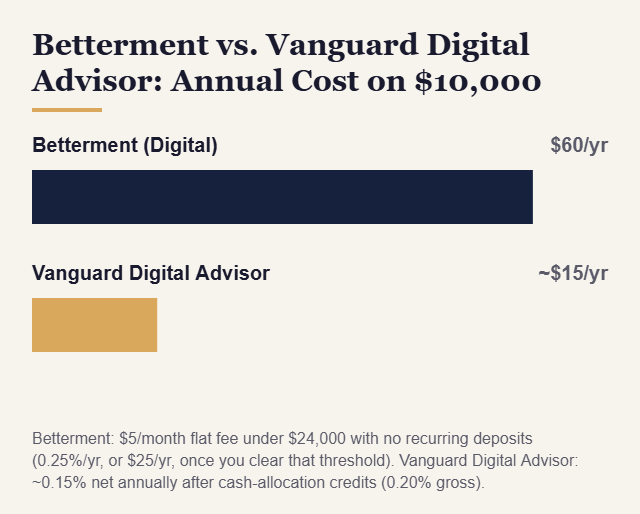
| Management Fee | $5/mo (<$24k) / 0.25%/yr | ~0.15%/yr net |
| Minimum Balance | $0 | $3,000 |
| Tax-Loss Harvesting | ✅ All taxable accounts | ❌ Not available |
| Fund Expense Ratios | ~0.08–0.15% | ~0.05% |
| Human Advisor Access | CFP at $100k (Premium) | ✅ Included |
| SRI Portfolio | ✅ | ❌ |
| Crypto Allocation | ✅ | ❌ |
The Fee Picture in Full
Vanguard Digital Advisor targets a net advisory fee of approximately 0.15% per year, on top of the underlying Vanguard fund expense ratios of about 0.05%, for an all-in cost near 0.20%. That is among the lowest total cost structures in the robo-advisor market.
Betterment charges $5/month for accounts under $24,000 without recurring deposits — which works out to 6.0% annually on a $1,000 balance and 0.40% on a $15,000 balance. Above $24,000 (or with $200+/month in recurring deposits) Betterment switches to a flat 0.25% per year, plus fund expense ratios of roughly 0.08–0.15%, landing near 0.33–0.40% total all-in.
The cost edge belongs to Vanguard at nearly every balance level. The question is whether Betterment’s features — especially tax-loss harvesting — justify the higher fee. For taxable investors in higher brackets, they often do.
Portfolio Construction
Betterment allocates across a diversified mix of ETFs from Vanguard, iShares, and Goldman Sachs, spanning US stocks, international stocks, bonds, real estate, and other asset classes. It also offers specialty portfolios: a socially responsible portfolio, an income-focused portfolio, a Goldman Sachs Smart Beta option, and a crypto allocation option. The breadth of choices is one of Betterment’s real advantages over more constrained platforms.
Vanguard Digital Advisor is deliberately simpler: four Vanguard index funds covering US equities, international equities, US bonds, and international bonds. This isn’t a limitation — it’s Vanguard’s core philosophy, and it produces portfolios with expense ratios that competitors can’t match. Critically, Vanguard also looks across all your Vanguard accounts to avoid asset overlap. If your 401(k) is already 80% US equities, the Digital Advisor won’t stack more of the same in your IRA.
Tax-Loss Harvesting: Betterment’s Key Weapon
Betterment automatically harvests tax losses in taxable accounts — selling declining positions to lock in deductible losses, then reinvesting in correlated assets to maintain market exposure. At higher balances and higher tax rates, this can add 0.10–0.77% in after-tax annual returns according to various analyses, which more than covers the advisory fee.
Vanguard Digital Advisor offers no tax-loss harvesting. For investors holding only IRAs and 401(k)s, this distinction is irrelevant. For taxable brokerage investors, it’s Betterment’s decisive advantage.
Human Advisor Access
Vanguard Digital Advisor includes access to human financial advisors as a standard part of the service. You can call or message a fiduciary advisor for retirement planning questions, Social Security timing, and general financial guidance at no additional cost beyond the advisory fee. This is a meaningful benefit many investors don’t know to value until they have a question that needs a real answer.
Betterment offers message-based access to CFPs on its standard plan, and unlimited phone/video access through Betterment Premium (0.40% fee, $100,000 minimum). The advisor access is real but costs more to unlock fully.
Goal-Based Planning
Betterment’s platform is organized around financial goals — you create separate “buckets” for retirement, a home down payment, emergency savings, or any custom target, each with its own timeline and risk allocation. This makes it easy to visualize progress toward multiple distinct targets simultaneously.
Vanguard Digital Advisor is primarily oriented toward a single retirement goal, though it can model multiple retirement accounts together. The retirement-first focus is appropriate for most users but less flexible for investors managing multiple competing financial goals.
Who Should Choose Betterment
Betterment is the better fit for investors actively building a taxable brokerage account, for investors who want SRI or alternative portfolio options, for those who want goal-based multi-bucket planning, and for investors who don’t yet have $3,000 to meet Vanguard’s minimum.
Who Should Choose Vanguard Digital Advisor
Vanguard Digital Advisor wins for long-term retirement savers who want the lowest all-in cost structure, for investors who already use Vanguard for their 401(k) and want coordinated portfolio management, and for anyone who values the ability to speak with a fiduciary advisor without paying extra for it. The $3,000 minimum and retirement-first focus make it a slightly more specialized product — but within that niche, it’s difficult to beat.
The Bottom Line
Betterment vs Vanguard Digital Advisor ultimately comes down to whether you’re optimizing for features or for cost. Betterment is the more capable robo-advisor for a broader range of goals. Vanguard Digital Advisor is the lower-cost, retirement-focused platform with an ecosystem advantage that multiplies as you add accounts. Both are excellent. Pick the one that matches your primary use case.
Frequently Asked Questions
Is Betterment or Vanguard Digital Advisor cheaper?
Vanguard Digital Advisor has a lower all-in cost — approximately 0.15–0.20% net annually vs. Betterment’s 0.33–0.40% (once above Betterment’s $24,000 flat-fee threshold). However, Betterment’s tax-loss harvesting can more than recover this difference for taxable investors in higher tax brackets.
Does Betterment have a minimum balance?
No, Betterment has no minimum balance. Accounts under $24,000 without recurring deposits pay $5/month. Vanguard Digital Advisor requires a $3,000 minimum.
Can I get human financial advice through Vanguard Digital Advisor?
Yes — human advisor access is included with Vanguard Digital Advisor at no extra cost. Betterment includes message-based CFP access on the standard plan, and full advisor access through Betterment Premium ($100,000 minimum).
Which is better for a Roth IRA: Betterment or Vanguard?
For a Roth IRA, Vanguard Digital Advisor’s lower cost and retirement focus make it the stronger choice — especially if you already have Vanguard accounts to coordinate. Tax-loss harvesting doesn’t apply inside a Roth IRA, removing Betterment’s main advantage.
Does Vanguard Digital Advisor offer tax-loss harvesting?
No. Tax-loss harvesting is not available through Vanguard Digital Advisor. If you’re building a taxable investment account and want automated tax efficiency, Betterment is the better option.