Acorns vs Stash (2026): Which Micro-Investing App Is Right for You?
Acorns vs Stash: comparing fees, automation, investment quality, and educational value to help you pick the right micro-investing app for your situation.
Acorns vs Stash are two of the most popular micro-investing apps for beginners — both designed for people who want to start investing without a lot of money, knowledge, or time. They’re often mentioned in the same breath, but they take fundamentally different approaches. Acorns is fully automated: it invests your spare change with no decisions required. Stash is education-first: it teaches you to invest by letting you pick your own funds and stocks.
Understanding which one fits your situation can mean the difference between an app you actually use and one you download and forget.
Quick Verdict
Acorns wins for pure automation — if you want to set it up once and let it invest in the background with zero decisions, Acorns is cleaner and more focused. Stash wins for investors who want to learn — it guides you toward age-appropriate portfolios and lets you gradually build knowledge as you build a portfolio. For most complete beginners who just want to start investing without thinking about it, Acorns is the better first app. For people who want to understand what they’re doing and eventually self-direct, Stash builds useful habits.
| Feature | Acorns | Stash |
|---|---|---|
| Monthly Fee | $4/mo (Bronze) | $12/mo (single plan) |
| Minimum Balance | $0 (invest at $5) | $0 |
| Round-Ups | ✅ Core feature | ✅ Available |
| Portfolio Control | ❌ Fully automated | ✅ Pick your own |
| Individual Stocks | ❌ | ✅ Fractional shares |
| Roth IRA | ✅ (Acorns Later) | ✅ |
| Checking Account | ✅ | ✅ |
| Kids Account | ✅ (Acorns Early) | ❌ |
How Acorns Works
Acorns is built around its round-up feature: link your debit or credit cards, and Acorns rounds each purchase up to the nearest dollar and sweeps the difference into a diversified ETF portfolio. Spend $3.75 on a coffee, Acorns invests $0.25. Spend $47.12 on groceries, Acorns invests $0.88. It’s frictionless investing that works in the background without any active decisions.
You choose a risk level (conservative to aggressive) when you sign up, and Acorns builds your portfolio from a handful of ETFs covering stocks and bonds. You have no control over individual fund selection beyond the broad risk level. You can also set up recurring investments and one-time deposits. Acorns Later is the IRA option; Acorns Early is a UTMA custodial account for kids.
The Acorns Bronze plan is $4/month. The Acorns Gold plan ($12/month) adds an Acorns Early account and some banking perks.
How Stash Works
Stash takes an educational, self-directed approach. After you sign up, it doesn’t just hand you a portfolio — it walks you through concepts, recommends age-appropriate investments, and lets you choose your own ETFs and fractional shares of individual stocks from a curated marketplace. The idea is to help you understand what you’re investing in and why, rather than just handing control to an algorithm.
Stash’s portfolio recommendations are guided (it suggests appropriate allocations) but the decisions are yours. You can invest in themed ETFs (like a “clean energy” or “technology” basket), diversified index funds, or fractional shares of large-cap stocks. This flexibility is educational but also introduces more risk for investors who pick poorly.
Stash’s single plan ($12/month) covers the investment account, IRA access, banking with Stock-Back® rewards, and a 3% retirement match.
The Fee Problem at Small Balances
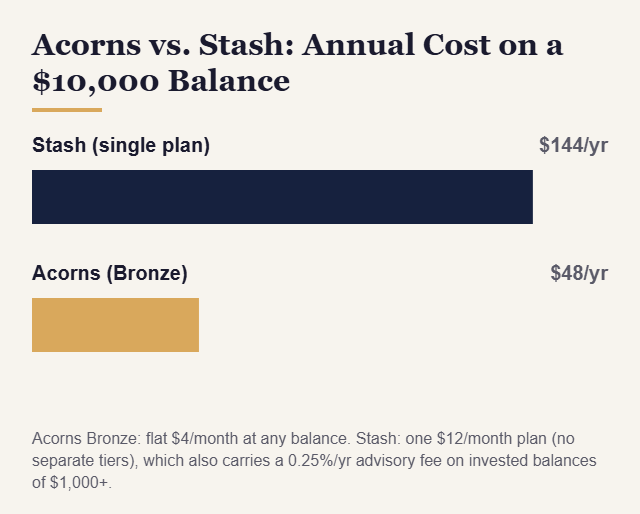
Acorns Bronze charges $4/month flat ($48/year); Stash charges $12/month flat ($144/year) — a much steeper flat fee. On a $100 balance, that’s 48% annually for Acorns and a punishing 144% for Stash. On $500, it’s 9.6% (Acorns) vs. 28.8% (Stash). On $3,000, it’s 1.6% (Acorns) vs. 4.8% (Stash). Both flat-fee structures punish small balances, but Stash’s higher fee makes it especially expensive until your balance is substantial — this isn’t a secret, but it’s worth being explicit: if you have only a few hundred dollars invested, you’re paying a very high effective fee rate on either platform, and Stash’s is roughly 3x Acorns’s. The goal should be to grow your balance to a point where the monthly fee represents a reasonable percentage — or to graduate to a lower-cost platform like Betterment or Fidelity once you’ve built the investing habit.
Investment Quality
Acorns’ portfolios are built from low-cost ETFs from Vanguard and BlackRock, covering US equities, international equities, bonds, and real estate. Solid, diversified, passively managed. The expense ratios on underlying funds are modest.
Stash’s curated marketplace includes both strong low-cost index ETFs and branded thematic ETFs that carry higher expense ratios (0.40–0.65%). Investors who gravitate toward the “Clean and Green” or “American Innovators” baskets instead of the basic S&P 500 index are paying more and adding concentration risk. Left to their own devices, many Stash users build less optimal portfolios than Acorns’ automated alternative.
Who Should Use Acorns
Acorns is best for people who won’t invest otherwise — who need the friction removed so completely that money goes in without any active decision. It’s also good for parents who want Acorns Early for their kids alongside their own account. If your primary barrier to investing is inertia and decision fatigue, Acorns solves those problems elegantly.
Who Should Use Stash
Stash is better for investors who actually want to learn — who want to understand what they own and gradually build investment literacy. The educational overlay and guided marketplace work well for people who intend to eventually become self-directed investors. If you find Acorns too passive and want some control over what you own, Stash gives you that without the complexity of a full brokerage.
The Bottom Line
Both apps charge similar fees and deliver similar value. Acorns wins on automation and consistency — ideal for investors who need everything simplified. Stash wins on education and investment flexibility — ideal for investors who want to learn by doing. Both are best used as a gateway to more capable, lower-cost platforms (Betterment, Fidelity) once the investing habit is established and the balance grows past $5,000–$10,000.
Frequently Asked Questions
Is Acorns or Stash better for beginners?
For complete beginners who want zero complexity, Acorns is the better choice — it automates everything and requires no investment decisions. For beginners who want to learn as they invest, Stash’s guided approach builds useful financial literacy.
How much does Acorns cost?
Acorns Bronze costs $4/month. Acorns Gold is $12/month and adds Acorns Early (custodial account for kids) and additional banking features.
Does Stash let you pick individual stocks?
Yes. Stash allows fractional share purchases of individual stocks from a curated marketplace, alongside ETFs. This differentiates it from Acorns, which only offers ETF-based portfolios.
Are Acorns and Stash safe?
Both are registered as investment advisors with the SEC, and customer assets are held in SIPC-insured brokerage accounts (up to $500,000 in securities). The apps themselves are legitimate regulated platforms.
Should I use Acorns or Stash instead of Betterment or Fidelity?
Acorns and Stash are best as entry points for very new investors. Once you have $5,000+ and are comfortable investing, Betterment or Fidelity offer more features at lower effective cost. Many investors start on Acorns or Stash and graduate to a more capable platform as their balance grows.