Best Brokerage Accounts for Beginner Investors in 2026
The best brokerage accounts for beginners in 2026: $0 minimums, $0 trades, and real index funds. Here's who to open an account with.
KatchingStacks is reader-supported. When you open an account through links on this page, we may earn a commission at no extra cost to you. See our affiliate disclosure and editorial policy.
Every “best brokerage account” list on the internet reads like it was written for someone who already day-trades options on their lunch break. You don’t need Level 2 quotes, a deep dive on futures spreads, or 47 order types. You need a place to put money in, buy a couple of index funds, and not get nickel-and-dimed while you figure the rest out. That’s it. That’s the whole job a brokerage account has to do for a beginner.
The good news is that the “best brokerage accounts for beginners” question has gotten a lot easier to answer over the last decade, because the entire industry converged on the same baseline: $0 account minimums and $0 commissions on stock and ETF trades are now table stakes, not a perk. So the real differences between platforms in 2026 come down to four things: whether they support fractional shares (so you can invest $20 instead of needing $400 for a single share), whether they offer genuinely cheap or free index funds, how good the mobile app is when you have no idea what you’re doing yet, and whether there’s a standout feature — like an IRA match or in-person branches — that tips the scale for a specific kind of beginner.
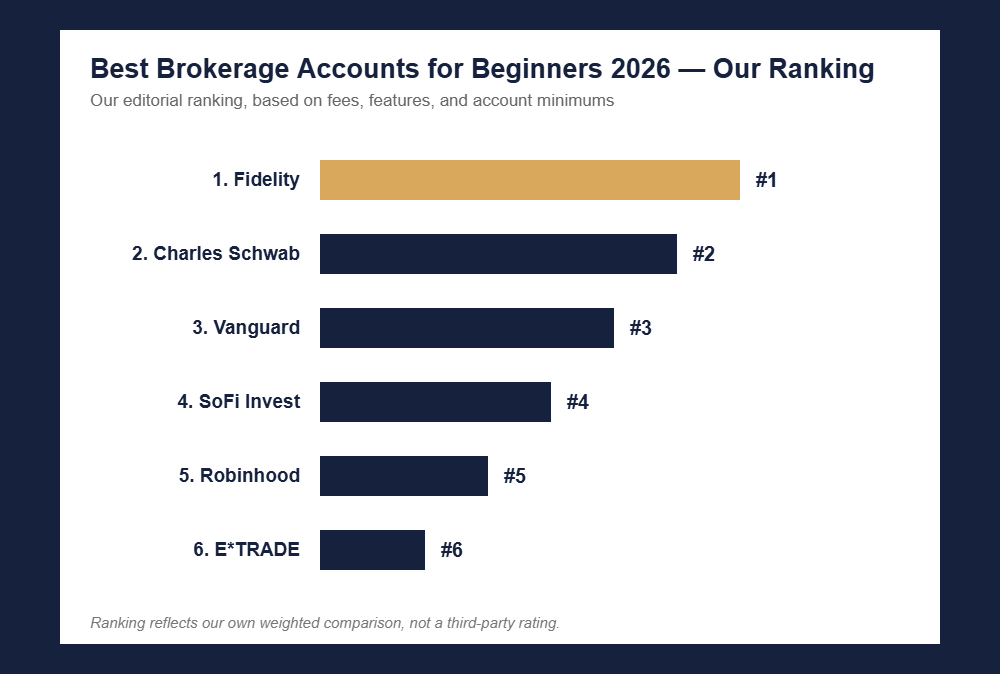
Below is a rundown of the brokerages that actually clear that bar in 2026, roughly ordered from “best all-around starting point” to “great if you have a specific need.” If you haven’t already, it’s worth a quick read of What Is an Index Fund? before you pick a platform, since the fund selection is arguably more important than the app it lives in.
1. Fidelity — Best All-Around Pick for Beginners
Fidelity is the default answer for a reason. Account minimum is $0, stock and ETF trades are commission-free, and fractional shares are supported so you can start with whatever you’ve got — even $5. Fidelity also runs its own lineup of “Zero” index funds with a literal 0.00% expense ratio, plus thousands of other no-transaction-fee mutual funds, so there’s essentially no cost drag on a simple long-term portfolio. The mobile app is polished and consistently rated among the best for first-timers, and Fidelity backs it up with 24/7 phone support and actual physical branches if you’re the type who wants to talk to a human being before you commit your paycheck. It also offers every account type a beginner could need — Roth IRA, traditional IRA, taxable brokerage, even custodial accounts for kids — so you’re not stuck opening a second account somewhere else in a year. Best for: pretty much anyone who wants one account that does everything well without a learning curve.
2. Charles Schwab — Best for Combining Investing and Banking
Schwab is Fidelity’s closest rival, and the two trade the “best overall” crown depending on which review site you ask. Like Fidelity, it’s $0 to open, $0 per stock and ETF trade, and fractional shares are available through Schwab Stock Slices starting at $5, which is about as beginner-friendly as fractional investing gets. Schwab’s mutual fund lineup (Schwab Mutual Fund OneSource) is deep and low-cost, and its “Schwab Starter Kit” is literally built for first-time investors, pre-packaging a handful of fractional shares in well-known companies so you’re not staring at a blank search bar wondering what to buy. The standout, though, is Schwab’s integrated banking — a linked checking account with no monthly fees and ATM fee rebates worldwide — which makes it a genuinely good “one login for my whole financial life” option. If you’d rather have Schwab pick your funds for you instead of choosing them yourself, check out our full Schwab Intelligent Portfolios review — it’s the robo-advisor version of the same brokerage. Best for: beginners who also want their checking account and brokerage account under one roof.
3. Vanguard — Best for Buy-and-Hold, Low-Fee Purists
Vanguard invented the low-cost index fund, and it still runs the cheapest ones on the market — its funds average around a 0.07% expense ratio, with some as low as 0.02%. Account minimum for the brokerage itself is $0, and stock/ETF trades are free, but Vanguard is the one platform on this list where you should manage expectations a little: fractional shares only work for Vanguard’s own ETFs (with a $1 minimum), not for individual stocks, and the mobile app is noticeably more basic than Fidelity’s or Schwab’s — no fancy research tools, no slick interface, just the essentials. That’s honestly fine, because Vanguard isn’t trying to be exciting. It’s built for people who want to buy a broad-market index fund, set up automatic contributions, and never open the app again except to check their balance twice a year. Best for: beginners who already know they want a simple index-fund portfolio and don’t care about bells and whistles.
4. SoFi Invest — Best for Beginners Who Want Everything in One App
SoFi Invest is the newest name on this list relative to the legacy players, and it leans hard into the “your entire financial life in one app” pitch — checking, savings, credit card, student loan refinancing, and investing all live under the same SoFi login. Account minimum is $0, stock and options trades are commission-free, and fractional shares are supported, so the on-ramp is just as smooth as the bigger firms. It also offers access to IPO shares and automated investing if you want a managed option later without switching platforms. The tradeoff is a smaller fund lineup than Fidelity or Vanguard and fewer advanced research tools — but for a true beginner who just wants to open one app, see everything, and not feel overwhelmed, that simplicity is a feature, not a bug. Best for: beginners who bank with SoFi already or want investing bundled with everything else.
5. Robinhood — Best for the Absolute Simplest Mobile Experience
Robinhood is the app that popularized $0 commissions and fractional shares in the first place, and it’s still the easiest interface on this list to poke around in without feeling intimidated. $0 minimum, $0 trades, and fractional investing down to a dollar. Its most genuinely useful feature for beginners in 2026 is the IRA match — Robinhood adds 1% on every retirement contribution automatically (3% if you pay for Robinhood Gold), which is essentially free money on top of your own savings, up to the annual IRA contribution limit. The catch is that Robinhood doesn’t offer mutual funds, so if you want broad diversification you’re leaning entirely on ETFs — which is workable, just less flexible than Fidelity or Vanguard. It’s also worth going in with your eyes open that Robinhood’s slick, game-like interface and prediction-market features are designed to keep you engaged, which is exactly the opposite of what a beginner buy-and-hold investor usually wants. Use it for the match and the simplicity, not as a reason to check your portfolio five times a day. Best for: beginners who want the single easiest app to use and like the idea of a free IRA match boost.
6. E*TRADE from Morgan Stanley — Best for Growing Into More Advanced Tools
E*TRADE rounds out the list as the pick for a beginner who suspects they’ll want more firepower eventually. It has the standard $0 minimum and $0 stock/ETF commissions, plus fractional shares, but its real advantage is that it offers two different interfaces: a clean, simple app for day-to-day investing, and the more powerful “Power E*TRADE” platform with deep charting and analytics sitting right behind it, available the moment you’re ready to use it. Backed by Morgan Stanley, it also has physical branch access for anyone who wants in-person help. It’s not the cheapest or simplest option out of the gate, but it’s the one you’re least likely to outgrow. Best for: beginners who like the idea of starting simple but not being boxed in as they learn more.
Brokerage Account or Robo-Advisor?
Here’s the actual decision underneath all of this: a self-directed brokerage account means you pick your own funds and manage your own portfolio — which costs less and gives you more control, but requires you to actually make a few decisions (like which index fund to buy and how to rebalance). A robo-advisor, by contrast, hands that decision-making to an algorithm: you answer a few questions about your goals and risk tolerance, and it builds and automatically rebalances a diversified portfolio for you, usually for a small annual fee.
If you’re the type of person who’s fine picking one or two total-market index funds and leaving them alone, a brokerage account like the ones above will save you money and give you more flexibility over time — there’s genuinely not much to “manage” once it’s set up. But if the idea of choosing funds yourself is the thing standing between you and actually starting to invest, a robo-advisor removes that friction entirely, at the cost of a modest management fee (often 0% to 0.25% depending on the provider). Several brokerages on this list, including Schwab, offer both — you can open a self-directed account today and move to a managed portfolio later without leaving the platform. For a full breakdown of who does automated investing best, see Best Robo-Advisors 2026.
Bottom Line
The differences between the best brokerage accounts for beginners in 2026 are smaller than the marketing makes them sound. Every platform on this list charges $0 to open an account and $0 to trade stocks and ETFs, so you genuinely cannot make an expensive mistake by picking any of them. Fidelity and Schwab are the safest, most well-rounded starting points for almost anyone. Vanguard is unbeatable if you already know you want cheap index funds and nothing else. SoFi and Robinhood win on sheer simplicity and app-based convenience, with Robinhood’s IRA match being a nice bonus if you’re opening a retirement account. E*TRADE is the one to grow into. Pick based on what will actually get you to open the account and set up an automatic contribution this week — because the brokerage you choose matters a lot less than the fact that you started.