Best Roth IRA Accounts 2026: Top Picks for Every Type of Investor
The best Roth IRA accounts in 2026: Fidelity, Vanguard, Schwab, Betterment, and Robinhood compared by fees, investment options, and who each is best for.
The best Roth IRA accounts in 2026 offer zero account fees, broad investment options, and strong platforms — because in a Roth IRA, every basis point of fees you avoid stays in your account compounding tax-free for decades. Choosing the right provider doesn’t change what the Roth IRA is or how the tax benefits work, but it absolutely changes how much it costs you and what you can do inside it.
This guide covers the top Roth IRA providers for different types of investors, what to look for, and how to open one.
What Is a Roth IRA?
A Roth IRA is an individual retirement account where contributions are made with after-tax dollars. Your money then grows completely tax-free, and qualified withdrawals in retirement are tax-free as well. You pay taxes on the money before it goes in — and never again. For most investors under 50, especially those who expect their tax rate to be higher in retirement than it is today, this is an exceptionally powerful structure.
In 2026, the annual contribution limit is $7,500 ($8,600 if you’re 50 or older). Income limits apply: single filers earning above $153,000 (modified AGI) begin phasing out, with no contribution allowed above $168,000 Married filing jointly, the phase-out runs from $242,000 to $252,000.
Best Roth IRA Accounts 2026
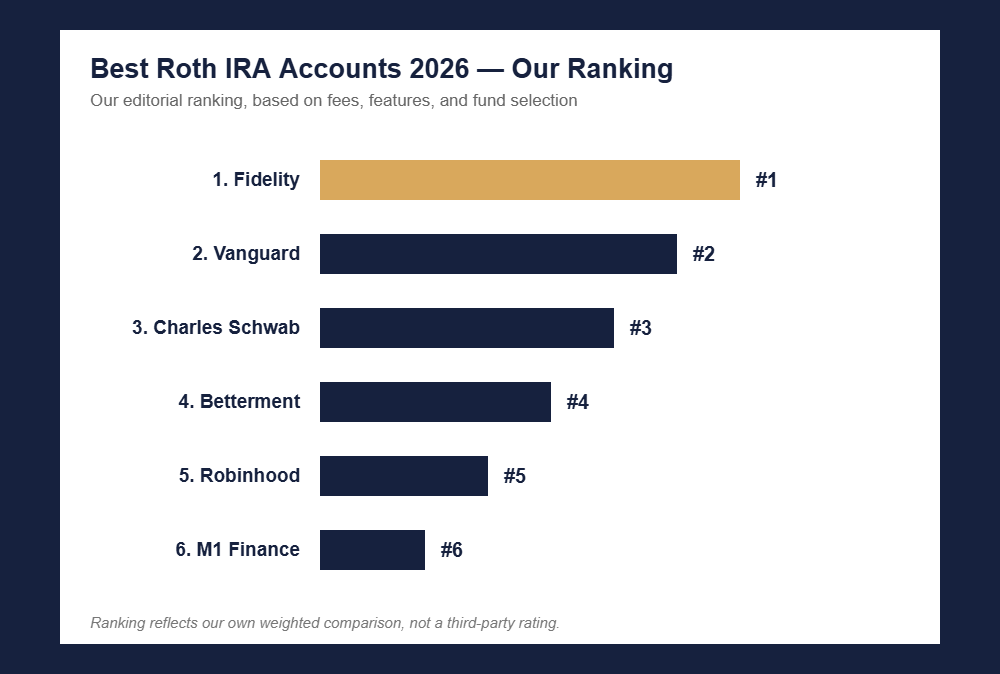
1. Fidelity — Best Overall
Fidelity is the top Roth IRA provider for most investors. No account minimums, no fees to open or maintain the account, and access to Fidelity’s ZERO index funds (FZROX, FZILX) at 0.00% expense ratios — the lowest available anywhere. The platform also supports automatic investing, making it easy to set up recurring monthly contributions. Fidelity’s customer service is excellent, and the full brokerage platform gives you access to stocks, bonds, ETFs, and mutual funds if you ever want to self-manage. For self-directed investors who want to build their own index fund portfolio, Fidelity is the clear pick.
2. Vanguard — Best for Long-Term, Low-Cost Index Investing
Vanguard invented index fund investing and still offers some of the industry’s lowest-cost funds, including VTSAX (total US market, 0.03%) and VXUS (international, 0.07%). The platform is less polished than Fidelity’s but functional, with no annual fees. Vanguard’s admiral share mutual funds require $3,000 minimums, though you can buy equivalent ETFs (VTI, VXUS) for any amount. For investors committed to the Vanguard fund lineup — or who want to eventually coordinate with Vanguard Digital Advisor — it’s a strong choice.
3. Schwab — Best for Self-Directed Investors Who Want Full-Service
Schwab offers no-fee Roth IRAs with no minimum balance, access to Schwab’s own low-cost index funds (SWTSX at 0.03%), and a full brokerage experience including ETFs, individual stocks, and options. The Schwab Intelligent Portfolios robo-advisor is also available through the same account login, making it easy to toggle between managed and self-directed investing. Schwab’s banking integration (checking account with ATM fee reimbursements worldwide) makes it especially attractive for investors who want to consolidate banking and investing.
4. Betterment — Best for Hands-Off Investors Who Want Full Automation
Betterment is the top Roth IRA choice for investors who want a fully automated, managed experience. You answer a questionnaire, Betterment builds a diversified portfolio, and it manages it automatically — rebalancing when allocations drift, adjusting glide path as you approach retirement. No investment decisions required. The fee is $4/month under $20,000 or 0.25% above. Betterment also offers goal-based planning and CFP access, making it a solid choice for investors who want occasional guidance alongside automation.
5. Robinhood — Best for the 3% IRA Match
Robinhood Gold’s 3% IRA match makes Robinhood uniquely compelling for contribution-matching alone. On a $7,500 annual contribution, 3% is $225 — more than covering the $60 annual Gold fee. With a 5-year hold requirement, this match is most valuable for investors who won’t be touching the funds soon (which is the point of an IRA). The brokerage itself is functional for buying index ETFs, though the platform is less full-featured than Fidelity or Schwab. For investors who plan to max their Roth IRA annually and want free money, Robinhood Gold is worth serious consideration.
6. M1 Finance — Best for Custom Portfolio Builders
M1 Finance offers a unique “pie” structure where you build a custom portfolio from stocks and ETFs and set target allocation percentages. Deposits automatically buy whatever is underweight, creating passive rebalancing without manual trading. There’s no management fee on the free plan (M1 Plus adds features for $3/month). For investors who want more portfolio control than a robo-advisor but more automation than a fully self-directed account, M1 is an interesting middle ground.
What to Look for in a Roth IRA Provider
The most important factors: account fees (avoid any provider charging annual maintenance fees), fund expense ratios (keep total investment costs below 0.30%/year), investment options (broad index funds are the priority), and automatic investing capability. Platform quality and customer service matter more than most people expect — you’ll likely hold this account for 30+ years.
Who Can Contribute to a Roth IRA?
Anyone with earned income who falls below the income limits can contribute. In 2026, the contribution limit is $7,500 ($8,600 if 50+). Phase-out for single filers begins at $153,000 MAGI. If you earn too much, investigate the backdoor Roth IRA conversion strategy (contributing to a traditional IRA and converting), though this involves additional tax considerations.
The Bottom Line
For most investors, Fidelity is the best Roth IRA provider — no fees, no minimum, zero-cost index funds, and a platform you’ll never outgrow. If you want full automation, use Betterment. If you want the IRA match, Robinhood Gold is hard to beat. All five options above are solid. The most important thing is to open one, start contributing, and invest in low-cost index funds — the account provider matters far less than whether you start at all.
Frequently Asked Questions
What is the best Roth IRA for beginners?
Fidelity is the best overall choice for beginners: no minimum, no fees, and access to ZERO index funds at 0.00%. For full automation with no investment decisions, Betterment is the best robo-advisor Roth IRA option.
How much can I contribute to a Roth IRA in 2026?
The 2026 Roth IRA contribution limit is $7,500 per year ($8,600 if you’re age 50 or older). Income limits apply — single filers phase out between $153,000–$168,000 MAGI.
Can I lose money in a Roth IRA?
Yes — a Roth IRA holds investments, and those investments can lose value. However, a broadly diversified index fund portfolio held for 20+ years has historically produced strong positive returns. The tax shelter doesn’t protect against market losses; it protects against taxes on gains.
Is a Roth IRA better than a traditional IRA?
A Roth IRA is generally better if you expect your tax rate to be higher in retirement than it is now (common for younger or lower-earning investors). A traditional IRA is better if you want the tax deduction today and expect a lower rate in retirement. Many investors contribute to both over time.
Can I open a Roth IRA and a 401(k) at the same time?
Yes. A Roth IRA and a 401(k) are completely separate accounts with separate contribution limits. Having both is a common and sound strategy — the 401(k) may offer an employer match, while the Roth IRA provides tax-free withdrawal flexibility in retirement.
Sources: Contribution limits: IRS: 2026 401(k) and IRA limits (checked September 30, 2026).