Fidelity vs. Charles Schwab: Which Brokerage Is Better for Beginners in 2026?
Fidelity vs Charles Schwab for beginners in 2026: we compare fees, robo-advisors, index funds, and tools to help you pick the right one.
KatchingStacks is reader-supported. When you open an account through links on this page, we may earn a commission at no extra cost to you. See our affiliate disclosure and editorial policy.
Fidelity vs. Charles Schwab is the investing equivalent of choosing between two great sandwiches at the same excellent shop — you’re not going to make a bad choice, but the details still matter. Here’s the short version: both are $0-minimum, $0-commission, no-nonsense brokerages with genuinely good customer service, so you can’t really lose. But Fidelity edges out Schwab for pure DIY investors thanks to its zero-expense-ratio index funds, while Schwab pulls ahead if you want your investing and everyday banking under one roof. Let’s break down why.
The Quick Verdict
If you want the cheapest possible way to build a long-term index portfolio and don’t need much hand-holding, go with Fidelity — its lineup of zero-fee index funds is something Schwab simply doesn’t match. If you want a brokerage account, a fee-free checking account, and a debit card that reimburses ATM fees worldwide, all connected in one login, Schwab’s ecosystem is hard to beat. Both are excellent choices for a beginner in 2026, and honestly, you could flip a coin and still end up fine. The differences below are about optimizing, not avoiding a mistake.
Costs and Fees: Basically Tied, With One Big Exception
On the surface, Fidelity and Schwab look identical on pricing. Both charge $0 commission on online stock and ETF trades, both charge around $0.65 per options contract, and neither charges a fee to open or maintain a standard brokerage account. This is table stakes in the industry now — every major broker matches it — so it’s not really a differentiator between these two specifically.
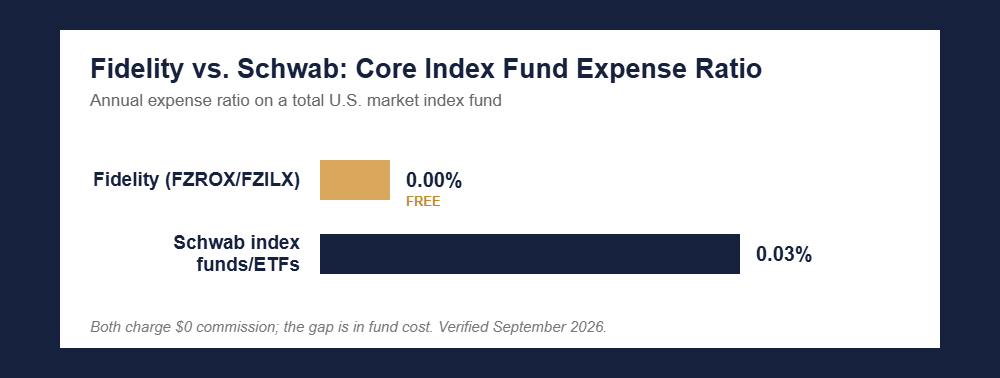
Where they actually diverge is in fund expense ratios, and this is where Fidelity has a genuine edge. Fidelity offers a family of zero-expense-ratio index mutual funds — including FZROX (total U.S. market) and FZILX (international) — that literally charge you nothing to hold. Not “low fee.” Zero. Schwab’s index funds and ETFs are also cheap by industry standards, often in the 0.02%–0.03% range, but they’re not free. Over a multi-decade investing horizon, that gap is small in dollar terms for a beginner’s account balance, but it’s a real, measurable difference, and it’s one of the few places where a brokerage’s pricing structure actually changes your long-term returns rather than just your trading costs.
Account Minimums: A Non-Issue at Both
Neither brokerage requires a minimum deposit to open a standard taxable brokerage account or a Roth/Traditional IRA — you can start with $1 if you want to. This wasn’t always true industry-wide, but it’s the norm now. Where minimums can reappear is on the managed/robo side of each platform, which we’ll get to next. For a beginner just opening a first account to start dollar-cost averaging into index funds, the minimum question is essentially settled: both firms will let you start with whatever you have.
Robo-Advisors: Fidelity Go vs. Schwab Intelligent Portfolios
If you’d rather not pick your own investments, both firms have a robo-advisor, and this is genuinely the category with the most nuance.
Fidelity Go is free for account balances under $25,000 — no advisory fee at all, though you’re still invested in Fidelity Flex mutual funds, which have their own built-in costs baked into the fund. Cross the $25,000 threshold and Fidelity Go charges roughly 0.35% annually, which also unlocks unlimited access to coaching from a Fidelity advisor. For a beginner just getting started with a smaller balance, that “free under $25k” structure is genuinely attractive — you get automated portfolio management with no advisory fee while you’re building your first nest egg.
Schwab Intelligent Portfolios takes a different approach: it charges no advisory fee at all, regardless of balance, but requires a $5,000 minimum to enroll. The catch — and it’s a real one — is that Schwab’s robo-advisor is required to hold a portion of your portfolio in cash, typically somewhere between 6% and 30% depending on your risk profile. Schwab argues this cash allocation acts as a volatility buffer and an emergency-fund-style cushion. Critics argue it’s how Schwab makes money on a “free” product, since it earns interest on that idle cash instead of charging you a management fee directly — a phenomenon commonly called cash drag, because money sitting in cash isn’t compounding in the market the way invested dollars are. We go deep on exactly how much this costs you over time in our full Schwab Intelligent Portfolios review, but the short version is: “no fee” doesn’t mean “no cost.”
So which robo wins? If your balance is under $25,000, Fidelity Go’s zero-fee structure with no forced cash allocation is the more straightforward deal. If you’re above $25,000 and want a completely fee-free option and don’t mind a chunk of your money sitting in cash, Schwab Intelligent Portfolios is worth a look. Either way, it’s worth comparing both against the broader field before committing — our Best Robo-Advisors 2026 roundup breaks down how they stack up against competitors like Betterment and Wealthfront too.
Fractional Shares: Both Have You Covered
Not being able to afford a full share of a $700 stock used to be a real barrier for beginners. Not anymore. Fidelity offers fractional share investing through its “Stocks by the Slice” feature, letting you buy a slice of pricey stocks and ETFs for as little as $1. Schwab has its own version called “Schwab Stock Slices,” which works similarly — buy any of the S&P 500 companies in dollar amounts rather than whole shares. Functionally, these are close to identical, so fractional shares aren’t a deciding factor between the two.
Research and Tools: Where Schwab’s Acquisition of TD Ameritrade Shows
This is the category where the two platforms feel most different in practice. Schwab absorbed TD Ameritrade a few years back and inherited its crown jewel: thinkorswim, a genuinely powerful trading platform with advanced charting, backtesting, options analysis, and a paper-trading mode where you can practice with fake money before risking real cash. For a beginner who wants to grow into more sophisticated investing, having thinkorswim available inside the same ecosystem is a real asset — even if you never touch half its features on day one.
Fidelity’s platform, by contrast, leans more toward clean, approachable research: solid third-party analyst reports (Fidelity gives you access to research from multiple providers rather than just one in-house view), an intuitive mobile app, and tools like the Fidelity Learning Center that are genuinely built with beginners in mind rather than day traders. It’s less flashy than thinkorswim, but for someone who just wants to understand what they’re buying and why, Fidelity’s research presentation is arguably easier to digest.
Neither platform has a customer service reputation problem — both consistently rank near the top of the industry in call wait times, phone support quality, and in-person help (Schwab and Fidelity both operate physical branch networks, which is increasingly rare among brokerages). If you like being able to walk into an office and talk to a human, you’re covered at either one.
Who Each Brokerage Is Better For
Choose Fidelity if: you’re a DIY, buy-and-hold index investor who wants the absolute lowest possible cost structure, you want a robo-advisor that’s free regardless of forced cash holdings under $25k, or you value clean, beginner-friendly research over advanced trading firepower.
Choose Schwab if: you want brokerage, banking, and checking all integrated in one login (Schwab’s fee-free checking account with worldwide ATM fee rebates is a standout, and there’s genuinely nothing comparable at Fidelity), you think you might grow into more advanced trading and want thinkorswim available when you’re ready, or you’re comfortable with a robo-advisor holding cash in exchange for paying zero advisory fee.
There’s also a real practical angle here: if you already bank with Schwab or already have a 401(k) administered through Fidelity, that existing relationship can tip the scales on its own — having everything visible in one dashboard is a genuine convenience, even if it’s not the most “optimal” financial reason to choose a broker.
Bottom Line
Fidelity vs. Charles Schwab isn’t a fight with a clear loser — it’s a fight between two brokers that both do right by beginners, which is exactly why the decision feels harder than it should. If you’re optimizing purely for the lowest-cost path to a long-term index portfolio, Fidelity’s zero-expense-ratio funds give it a small but real edge. If you want an all-in-one financial home with banking built in and room to grow into more advanced tools down the road, Schwab’s ecosystem is the stronger pick. Either way, stop agonizing over the choice and start the account — the money you’ll make from actually investing consistently will dwarf whatever fraction of a percent separates these two on fees.