Betterment vs Fidelity Go (2026): Which Robo-Advisor Is Right for You?
Betterment vs Fidelity Go: a head-to-head comparison of fees, portfolios, and tax features to help you pick the right robo-advisor for your balance and goals.
Betterment vs Fidelity Go is one of the most searched robo-advisor comparisons for good reason — both platforms are beginner-friendly, low-cost, and handle the investing work for you. But they take meaningfully different approaches to fees, tax tools, and who they’re really built for.
This comparison cuts through the marketing. We’ll cover what you actually pay at different balance levels, how the portfolios are constructed, and which platform wins for your specific situation.
Quick Verdict
Fidelity Go wins on pure cost for accounts under $25,000 — it charges zero management fee and invests in zero-expense-ratio funds. Betterment wins on features, especially tax-loss harvesting and goal-based planning, which create real value as your balance grows. If you’re starting out and watching every dollar, Fidelity Go is the obvious call. If you’re past $20,000 and building a taxable brokerage account, Betterment earns its fee.
| Feature | Betterment | Fidelity Go |
|---|---|---|
| Management Fee | $5/mo (<$24k) or 0.25%/yr | Free (<$25k) / 0.35%/yr above |
| Minimum Balance | $0 | $0 |
| Tax-Loss Harvesting | ✅ All taxable accounts | ❌ Not available |
| Human Advisor Access | Premium ($100k+, 0.40%) | Coaching at $25k+ |
| Fund Expense Ratios | ~0.08–0.15% | 0.00% (Fidelity Flex funds) |
| Crypto Option | ✅ | ❌ |
Fees at Every Balance Level
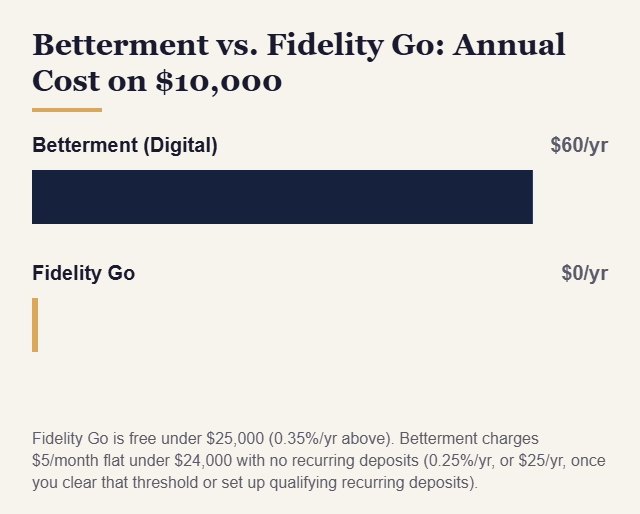
The fee structure of both platforms is easy to misread, so let’s be precise. Fidelity Go is free for balances under $25,000 — zero management fee, zero trading costs, and Fidelity Flex mutual funds carry a 0.00% expense ratio. Once your balance crosses $25,000, Fidelity charges 0.35% annually, which is actually higher than Betterment’s standard rate.
Betterment charges $5/month for accounts under $24,000 without recurring deposits. On a $1,000 balance that’s an effective 6.0% annual fee — significant. On $15,000 it’s about 0.40%, still pricier than the flat rate implies. Above $24,000 (or with $200+/month in recurring deposits) Betterment switches to a flat 0.25% per year, plus the underlying ETF expense ratios of roughly 0.08–0.15%.
The practical takeaway: under $25,000, Fidelity Go is almost always cheaper. From $25,000 to roughly $50,000, it’s close. Above $50,000, Betterment’s 0.25% fee becomes cheaper than Fidelity Go’s 0.35% — and that gap widens as the balance grows.
How the Portfolios Work
Fidelity Go builds your portfolio entirely using Fidelity Flex mutual funds — Fidelity’s own family of zero-expense-ratio products covering US stocks, international stocks, and bonds. You answer a short questionnaire about your timeline and risk tolerance, and Fidelity sets the allocation. It rebalances automatically. Simple, clean, and very low-cost.
Betterment uses a broader mix of ETFs from Vanguard, iShares, and others, offering a globally diversified portfolio across a dozen asset classes. Beyond the standard portfolio, Betterment offers socially responsible investing (SRI) options, an income portfolio, a Goldman Sachs Smart Beta option, and crypto allocation if you want exposure. The flexibility is real, though most investors will never need it.
Both platforms handle rebalancing automatically when your allocation drifts too far from target. Neither requires you to pick individual securities or make active trading decisions.
Tax-Loss Harvesting: The Feature That Changes the Math
Betterment’s automated tax-loss harvesting is its most significant differentiator. When positions in your taxable brokerage account decline in value, Betterment automatically sells them to lock in a capital loss for tax purposes, then immediately reinvests in a correlated but not identical fund to maintain your market exposure. These realized losses can offset capital gains elsewhere in your portfolio — or up to $3,000 of ordinary income per year.
At higher balances in higher tax brackets, this benefit can meaningfully exceed the cost of Betterment’s 0.25% management fee. Independent analyses have estimated TLH can add 0.10–0.77% in after-tax returns annually, depending on market conditions and your tax situation.
Fidelity Go does not offer tax-loss harvesting. If you’re investing inside a Roth IRA or traditional IRA, this distinction doesn’t matter at all — those accounts are already tax-advantaged. But if you’re building a taxable brokerage account alongside your retirement accounts, Betterment’s TLH is a substantial functional advantage.
Goal Setting and Financial Planning Tools
Betterment’s interface is built around goals. You can create separate “buckets” for retirement, an emergency fund, a home down payment, or any other goal, and each bucket gets its own risk profile and projected timeline. This makes it easy to see progress toward specific targets rather than watching a single portfolio balance.
Fidelity Go is simpler — a single managed account without the goal-segmentation feature. That said, Fidelity’s broader platform (if you hold other accounts there) has robust planning tools. And Fidelity Go’s coaching service, available at $25,000+, provides access to financial professionals for general guidance.
Account Types Available
Both support Roth IRAs, traditional IRAs, and taxable brokerage accounts. Betterment adds SEP IRAs, trusts, and joint accounts. Fidelity has the edge in ecosystem — because it’s a full-service brokerage, you can manage your 401(k), HSA, and other accounts in the same login, which simplifies your financial picture considerably.
Who Should Choose Betterment
Betterment makes the most sense if you have a taxable brokerage account where tax-loss harvesting generates real value, if you want goal-based buckets to organize your investing, if you’re interested in SRI or alternative portfolio options, or if you’re building toward the $100,000 threshold for CFP access. It’s also the stronger choice if you want crypto exposure within a robo-advisor.
Who Should Choose Fidelity Go
Fidelity Go is the right choice if you’re starting with under $25,000 and want zero management costs, if you already use Fidelity for a 401(k) or other accounts (consolidation has real value), or if you want the absolute simplest, lowest-cost structure. Fidelity’s zero-expense index funds are genuinely exceptional, and the coaching access at $25,000+ is a useful bonus for straightforward questions.
The Bottom Line
Neither platform is wrong. Fidelity Go is the cost leader for smaller balances and anyone already in the Fidelity ecosystem. Betterment is the features leader for investors who want tax efficiency, goal segmentation, and a clearer path to human advice. Pick based on where your balance is today and how much complexity you actually need.
Already reviewed both individual platforms? See our Fidelity Go review and Betterment review for deeper dives into each.
Frequently Asked Questions
Is Fidelity Go actually free?
Yes — for balances under $25,000, Fidelity Go charges no management fee and uses Fidelity Flex funds with a 0.00% expense ratio. Above $25,000, the fee rises to 0.35% annually.
Does Betterment have a minimum balance?
No. Betterment has no minimum balance. However, accounts under $24,000 without recurring deposits pay $5/month instead of the 0.25% annual rate, making the effective fee higher for smaller balances.
Which is better for a Roth IRA?
For a Roth IRA under $25,000, Fidelity Go’s zero-fee structure makes it the cost winner. Tax-loss harvesting doesn’t apply inside a Roth IRA, removing Betterment’s main advantage. Once you’re above $25,000, Betterment’s 0.25% beats Fidelity Go’s 0.35%.
Does Fidelity Go offer tax-loss harvesting?
No. Tax-loss harvesting is not available with Fidelity Go. If you’re building a taxable brokerage account and want automatic tax efficiency, Betterment is the stronger platform.
Can I talk to a human advisor through either platform?
Fidelity Go provides coaching from financial professionals at balances above $25,000. Betterment offers message-based CFP access on standard plans and unlimited phone/video access through Betterment Premium at $100,000+.