How to Invest in Index Funds: A Step-by-Step Beginner’s Guide (2026)
How to invest in index funds: choosing the right brokerage, picking funds, setting your allocation, and building a portfolio that grows for decades.
How to invest in index funds is one of the most valuable financial skills you can build — and it’s far simpler than most people expect. Index funds track a market benchmark (like the S&P 500) and require no stock-picking, no research, and almost no active management. For the last 30+ years, they’ve consistently outperformed the majority of actively managed funds. Here’s exactly how to get started.
What Is an Index Fund?
An index fund is a mutual fund or ETF designed to replicate the performance of a specific market index. The S&P 500, for example, is an index of the 500 largest US companies. An S&P 500 index fund holds all 500 of those companies in proportion to their market capitalization. When the S&P 500 rises 10%, the fund rises approximately 10%. When it falls, so does the fund.
Unlike actively managed funds — where a portfolio manager picks individual stocks trying to beat the market — index funds simply follow the market. Because they don’t require expensive research teams or active trading, their fees are dramatically lower. That fee difference, compounded over decades, is the primary reason index funds tend to outperform most actively managed alternatives.
Why Index Funds Work
The case for index funds rests on one straightforward observation: most professional fund managers fail to beat their benchmark index after fees. The S&P SPIVA scorecard (published by S&P Dow Jones Indices) consistently shows that over 15-year periods, more than 85% of actively managed large-cap funds underperform the S&P 500 after fees. Index funds don’t try to beat the market. They are the market — and over long time horizons, owning the market at low cost is a winning strategy.
Step 1: Choose Where to Open Your Account
Before you invest in any index fund, you need a brokerage account. For most investors, the choice comes down to three options: Fidelity, Vanguard, or Schwab. All three offer excellent index funds with extremely low expense ratios, no trading commissions, and fractional shares (letting you invest any dollar amount regardless of the share price).
Fidelity is particularly compelling for beginners: Fidelity’s ZERO funds (FZROX, FZILX) have 0.00% expense ratios — lower than any competitor. There’s no account minimum and the app is well-designed. Vanguard is the godfather of index investing and still offers industry-leading low costs with funds like VTSAX and VOO. Schwab offers similarly low-cost index funds (SWTSX, SCHB) with no minimum balance and excellent customer service.
Step 2: Choose the Right Account Type
Where you hold your index funds matters as much as which funds you pick. Prioritize tax-advantaged accounts first. A Roth IRA lets your investments grow completely tax-free — you pay taxes on contributions now, and all gains and withdrawals in retirement are tax-free. A traditional IRA or 401(k) gives you a tax deduction on contributions, deferring taxes until withdrawal. Taxable brokerage accounts have no special tax treatment but also no contribution limits or withdrawal restrictions.
The typical priority order: max out any employer 401(k) match first (free money), then Roth IRA ($7,500 annual limit in 2026), then your 401(k) up to the full $24,500 limit, then taxable brokerage for anything beyond that.
Step 3: Choose Your Index Funds
You don’t need many funds to build a great portfolio. The “three-fund portfolio” is one of the most widely recommended simple strategies in personal finance: one total US stock market fund, one total international stock market fund, and one total US bond market fund. Together, these three funds give you exposure to thousands of stocks and bonds across the entire global market.
Specific examples at each major brokerage:
Fidelity: FZROX (US total market, 0.00%), FZILX (international, 0.00%), FXNAX (US bonds, 0.025%)
Vanguard: VTSAX / VTI (US total market, 0.03%), VXUS (international, 0.07%), BND (US bonds, 0.03%)
Schwab: SWTSX / SCHB (US total market, 0.03%), SWISX / SCHF (international, 0.06%), SWAGX / SCHZ (bonds, 0.03%)
Step 4: Choose Your Asset Allocation
Asset allocation is how you split your money between stocks and bonds. Stocks offer higher long-term growth with more volatility. Bonds are more stable but grow more slowly. Your allocation should reflect your time horizon and risk tolerance.
A simple rule of thumb: subtract your age from 110 to get your stock percentage. A 30-year-old would hold roughly 80% stocks / 20% bonds. A 55-year-old would hold 55% stocks / 45% bonds. This is a starting point — many investors in their 20s and 30s hold 90–100% stocks given their long time horizon.
Within your stock allocation, a typical split is 60–70% US / 30–40% international, though some investors simplify to 100% US with a fund like VTSAX.
Step 5: Set Up Automatic Contributions
Dollar-cost averaging — investing a fixed amount on a regular schedule regardless of market conditions — is one of the most effective behavioral tools in investing. Most brokerages let you set up automatic monthly contributions from your bank account. This removes the temptation to time the market and ensures you buy more shares when prices are low and fewer when they’re high.
Step 6: Stay the Course
The hardest part of index fund investing is not selling during market downturns. The S&P 500 has declined 20%+ at least 12 times since 1950 and recovered to new highs every time. Investors who stayed invested through every crash and continued buying on the way down compounded wealth dramatically. Investors who sold during the panic locked in losses and missed the recovery.
Your job once you’ve set up your index fund portfolio: contribute regularly, rebalance once per year (sell overweight asset classes, buy underweight ones), and otherwise leave it alone.
How Much Does It Cost?
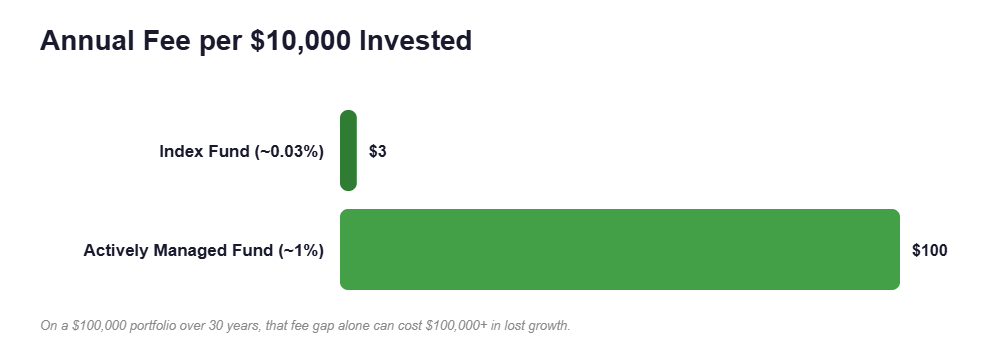
Index funds are genuinely cheap. The expense ratios listed above — 0.00–0.07% — mean you pay between $0 and $7 per year for every $10,000 invested. Compare this to the 0.5–1.5% expense ratios on many actively managed mutual funds, which cost $50–$150 per $10,000. On a $100,000 portfolio over 30 years, the difference in fees alone can account for $100,000+ in lost wealth.
Frequently Asked Questions
How much money do I need to start investing in index funds?
Many brokerages require $0 to open an account. Fidelity’s ZERO index funds have no minimum. Vanguard’s popular ETF VTI can be purchased for the price of one share (currently around $260), and many brokerages offer fractional shares allowing you to invest any dollar amount.
What’s the best index fund for beginners?
For simplicity, a total US stock market fund is a strong starting point: Fidelity FZROX (0.00%), Vanguard VTI (0.03%), or Schwab SWTSX (0.03%). These funds hold thousands of US companies and require no other diversification within US equities.
Should I invest in index funds through a Roth IRA or a brokerage account?
Prioritize the Roth IRA if you’re eligible — the tax-free growth over decades is enormously valuable. Once you’ve maxed your Roth IRA ($7,500/year in 2026), invest additional savings in a taxable brokerage account.
How often should I rebalance my index fund portfolio?
Once per year is sufficient for most investors. Rebalance when any asset class has drifted more than 5–10% from your target allocation. Many robo-advisors rebalance automatically if you prefer a fully hands-off approach.
Are index funds safe?
Index funds are not risk-free — their value fluctuates with the market. However, a broadly diversified index fund tracking the total stock market is among the least risky ways to own stocks, because no single company’s failure significantly impacts the fund. Over any 15-year period in S&P 500 history, the index has produced positive returns.
Sources: Contribution limits: IRS: 2026 401(k) and IRA limits (checked September 30, 2026).