Best Robo-Advisors for Beginners in 2026 (Ranked and Reviewed)
Not sure which robo-advisor to start with? We ranked the best options for beginners in 2026 — including Acorns, Betterment, and Wealthfront — so you can stop overthinking and start investing.
Not sure which robo-advisor to start with? We ranked the best options for beginners in 2026 — including Acorns, Betterment, Wealthfront, and Fidelity Go — so you can stop overthinking and start investing.
Getting started with investing is the hardest part — not because investing is complicated, but because there are dozens of platforms, each claiming to be the best. If you’re a beginner, the last thing you need is analysis paralysis. This guide cuts through the noise and tells you exactly which robo-advisors are worth your attention and why.
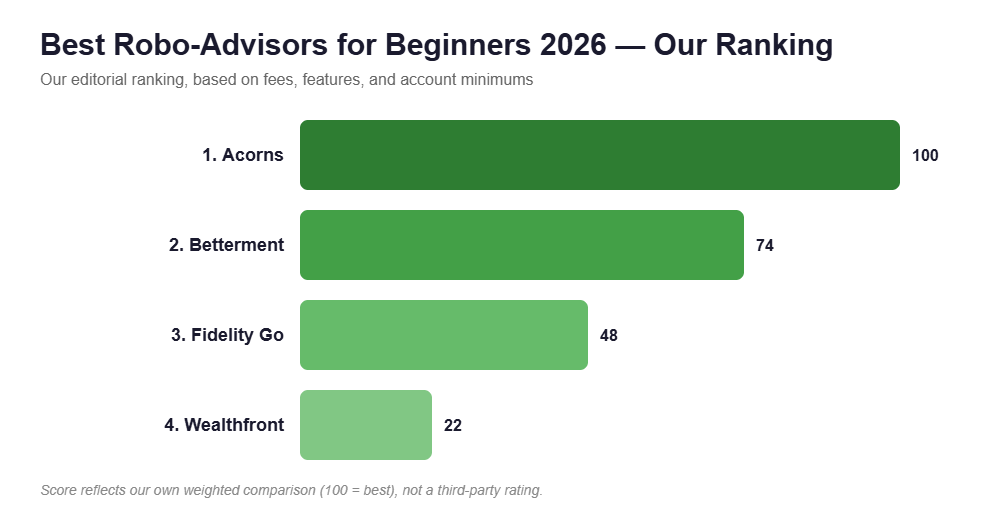
Why this order differs from our other lists: this ranking is built for first-time investors with small balances, so low minimums and habit-building features (like Acorns’ round-ups) carry more weight. Our main robo-advisor ranking weighs fees, features and tax tools for all investors and puts Betterment first, and our investment apps roundup also includes brokerages. Different audiences, different orders.
What Makes a Robo-Advisor Good for Beginners?
Not all robo-advisors are created equal when it comes to first-time investors. The best options for beginners share a few key traits: low or no minimum balance requirements, a simple onboarding process that doesn’t require financial knowledge, clear fee structures with no hidden costs, educational resources to help you understand what you’re investing in, and automatic rebalancing so you don’t have to think about maintenance.
A note on methodology: this list ranks robo-advisors specifically for beginners just starting out — weighing low (or no) minimums, simple onboarding, and affordable costs at small balances most heavily. If you’re comparing robo-advisors more broadly rather than specifically as a first-time investor, see our Best Robo-Advisors of 2026 ranking. If you’re also weighing investing apps outside the robo-advisor category, see Best Investment Apps for Beginners 2026. Rankings can differ slightly between these guides because each one is answering a different question.
The Best Robo-Advisors for Beginners in 2026
1. Acorns — Best for Micro-Savers and Complete Beginners
Minimum: $0 | Fee: $4–$12/month
If you struggle to save at all, Acorns is the best place to start. Its Round-Ups feature automatically invests your spare change from everyday purchases — you barely notice the money leaving, but it compounds over time. There’s no minimum investment and no financial knowledge required to get started.
The $4/month flat fee ($48/year) is easy to justify once you’re saving consistently, but the math is worth knowing: on a small balance, that flat fee works out to a higher effective rate than a 0.25%/year fee would — for example, $48/year on a $1,000 balance is nearly 5%. The crossover point is around $19,200: below that balance you’re effectively paying more than Betterment’s or Wealthfront’s 0.25%, and above it Acorns’ flat fee actually costs less. Acorns is the perfect starter platform for building the habit — just don’t assume the flat fee stays cheap on a very small balance. Acorns is the perfect starter platform, not the one you stay on forever.
Best for: People who have trouble saving, complete beginners with no savings yet, anyone who wants to start with under $100.
2. Betterment — Best All-Around for Beginners
Minimum: $0 | Fee: $5/month under $24,000, or 0.25%/year above that (or with $200+/month in recurring deposits)
Betterment is the best overall robo-advisor for beginners who are serious about building long-term wealth. It has no minimum balance requirement, a clean goal-based interface that makes your investing purpose crystal clear, and a fee structure ($5/month under $24,000, or 0.25%/year above that) that stays affordable as your account grows. The onboarding is the most educational in the industry — you actually learn something about investing as you set up your account.
Betterment offers tax-loss harvesting on all taxable accounts, access to certified financial planners through its Premium tier (available with a $100,000 minimum, at 0.65%/year total), and a cash reserve account. It’s the platform most beginners can start with and never need to leave.
Best for: Beginners who want a platform they can stick with long-term, goal-oriented investors, anyone wanting $0 minimum with percentage-based fees.
3. Fidelity Go — Best Free Option for Beginners
Minimum: $0 | Fee: 0% under $25K, then 0.35%
Fidelity Go is the most beginner-friendly robo-advisor for people who want zero fees while they’re getting started. There’s no minimum balance and no management fee on accounts under $25,000 — making it completely free for most beginners. Once you exceed $25K, the fee is 0.35%, which includes unlimited access to human financial advisors.
Fidelity Go invests exclusively in Fidelity Flex mutual funds, which have zero expense ratios. That means your true all-in cost while under $25K is literally $0. The platform is simple, clean, and backed by the reliability of one of the world’s largest financial institutions.
The main limitation: no tax-loss harvesting. If tax efficiency is a priority, Betterment or Wealthfront are better choices for taxable accounts.
Best for: True beginners who want to start for free, investors who want access to human advisors as they grow, people who prefer a major established institution over a startup.
4. Wealthfront — Best for Beginners Who Are Tech-Savvy
Minimum: $500 | Fee: 0.25%/year
Wealthfront requires $500 to start, which puts it out of reach for absolute beginners with nothing saved. But if you have $500+ ready to invest, Wealthfront’s feature set is unmatched — daily tax-loss harvesting, a high-yield cash account, a 529 college savings plan, and Self-Driving Money automation that connects your paycheck to your investments. It’s the most feature-rich robo-advisor available.
Best for: Beginners with at least $500 saved, people who want maximum automation, tech-comfortable investors who prefer no human advisor contact.
Side-by-Side Comparison: Best Robo-Advisors for Beginners 2026
| Feature | Acorns | Betterment | Fidelity Go | Wealthfront |
|---|---|---|---|---|
| Minimum | $0 | $0 | $0 | $500 |
| Annual Fee | $3–$12/mo | 0.25% | 0% / 0.35%* | 0.25% |
| Tax-Loss Harvesting | ❌ | ✅ | ❌ | ✅ |
| Human Advisors | ❌ | ✅ ($100K min, 0.65%/yr) | ✅ (free $25K+) | ❌ |
| Round-Ups | ✅ | ❌ | ❌ | ❌ |
| Cash Account | ❌ | ✅ | ❌ | ✅ |
| Best For | Micro-savers | Most beginners | Free investing | Tax efficiency |
*Fidelity Go is free under $25K, then 0.35% with unlimited human advisor access included.
Which One Should You Pick?
Here’s a simple decision framework based on where you are right now:
- If you have trouble saving at all → Start with Acorns. Use Round-Ups to build the habit. Acorns’ flat fee is fine while your balance is small — but if cost matters more than the Round-Ups habit, Fidelity Go (free under $25,000) is the cheaper choice at any balance.
- If you want to start with $0 and pay nothing → Go with Fidelity Go. Zero fees until $25K, zero minimums, backed by a trusted institution.
- If you can commit to saving monthly and want to grow long-term → Go with Betterment. No minimum, clear goal tools, and a 0.25% fee that scales fairly as your balance grows.
- If you have $500+ and want maximum automation and tax efficiency → Go with Wealthfront. Daily tax-loss harvesting and Self-Driving Money are best-in-class.
How Much Should a Beginner Invest?
Start with whatever you can afford to not touch for at least three years. For most beginners, that’s $25–$100/month. The amount matters less than the consistency. A beginner who invests $50/month starting at 25 will retire with more money than someone who invests $500/month starting at 45 — even though the late starter put in more total dollars. Time in the market is the actual variable that matters.
A practical framework: contribute enough to your employer 401(k) to get the full match first — that’s a guaranteed 50–100% return. Then fund a Roth IRA (maximum $7,500/year in 2026 if under 50). Then invest additional savings in a taxable robo-advisor account.
Understanding Your Risk Tolerance
Every robo-advisor will ask you about risk tolerance during onboarding. Most beginners overestimate theirs because they’ve never watched a portfolio drop 30% in three months. A simple calibration: if your portfolio dropped $5,000 tomorrow, what would you do? If you’d sell everything, you’re a conservative investor regardless of what you told the algorithm. If you’d add more money, you’re aggressive. Answer honestly — your portfolio allocation should match your actual behavior, not your aspirational behavior.
Most beginners do well with a moderate allocation (60–70% stocks, 30–40% bonds) until they have enough experience to know how they actually react to market volatility.
Common Beginner Mistakes to Avoid
- Checking your portfolio daily. Robo-advisors are set-and-forget. Watching daily fluctuations triggers anxiety and poor decisions. Check quarterly at most.
- Stopping contributions when the market drops. Market dips are when your regular contributions buy more shares at lower prices. Keep the auto-deposit running.
- Withdrawing early for non-emergencies. Build a 3–6 month emergency fund in a high-yield savings account before investing, so you never need to touch your investment account in a crunch.
- Chasing returns by switching platforms. Past performance doesn’t predict future returns. Stay consistent with your platform and strategy.
What to Expect in Your First Year
Here’s what a typical first year with a robo-advisor looks like for a beginner investing $200/month:
- Months 1–3: Your portfolio may barely move. You’re building position size. The market might go up or down 5–8% and your $400–$600 account will reflect that directly. This is normal.
- Months 4–6: You start to feel the rhythm. Contributions hit, the platform allocates them, you check in and see modest growth. The UI feels familiar and you stop worrying about it.
- Months 7–12: Your portfolio has meaningful size — $1,500–$2,500 if you’ve been consistent. You can see rebalancing happening. If you’re in a taxable account with Betterment or Wealthfront, you may get your first tax-loss harvesting notification. It starts to feel real.
When to Consider Switching or Upgrading
- Acorns users on a tight budget: Your flat $4/month fee costs more, in percentage terms, than a 0.25%/year fee would on a small balance. Fidelity Go (free under $25,000) is the cheaper switch if cost matters more than the round-up habit.
- Fidelity Go users approaching $25K: Decide whether the 0.35% fee (with advisor access) is worth it, or switch to Betterment/Wealthfront at 0.25%.
- Betterment users with $100,000+: Consider Betterment Premium for advisor access, or evaluate Wealthfront’s more sophisticated tax features.
- Anyone with $500,000+: A fee-only financial planner (charging hourly, not a percentage) may add value with estate planning, insurance, and complex tax strategy that no algorithm provides.
- Ready to graduate past $5,000 with a $0 management fee: Schwab Intelligent Portfolios charges no advisory fee at all, though a mandatory cash allocation means it is not free for everyone — worth the math once you are past the beginner minimums.
The Bottom Line
The best robo-advisor for beginners is the one you’ll actually use. Acorns, Betterment, Fidelity Go, and Wealthfront are all legitimate, regulated, and will serve you well. Our overall pick for most beginners is Betterment — no minimum, fair fees, excellent goal tools, and a platform you can grow with for years. If you want to start completely free, Fidelity Go is hard to beat.
Stop overthinking the choice and start investing. Time in the market beats everything else.
Want deeper dives? Read our full reviews: Acorns Review, Betterment Review, Wealthfront Review, Fidelity Go Review.
Frequently Asked Questions
Which robo-advisors have no minimum balance requirement to get started?
Acorns, Betterment, and Fidelity Go all have $0 minimum balance requirements — you can open an account with any amount. Betterment and Fidelity Go are the strongest $0-minimum options for serious investors: Betterment for its goal tools and tax-loss harvesting, Fidelity Go for its completely free fee structure under $25K. Wealthfront requires $500 to start investing.
What is the best robo-advisor to start with under $100?
If you’re starting with under $100, Acorns or Betterment are your best options. Acorns requires no minimum and will invest your spare change automatically — ideal for building the savings habit with very little. Betterment also has no minimum and charges 0.25% annually, which on $100 works out to about $0.25/year. Both are excellent starting points. Fidelity Go is also $0 minimum and completely free. Avoid Wealthfront until you have $500.
Is it safe to put my money in a robo-advisor?
Yes, if you’re using a reputable, regulated platform. Betterment, Wealthfront, Acorns, and Fidelity Go are all registered investment advisers with the SEC. Your investments are held at SIPC-member broker-dealers, which protects up to $500,000 per account if the brokerage fails. Note that SIPC protection covers brokerage failure — not market losses. Your portfolio can still go down when markets decline, which is normal for any investment account.
Can I lose all my money in a robo-advisor?
Technically possible but extraordinarily unlikely in practice. Robo-advisors invest in diversified ETFs — baskets of hundreds or thousands of stocks and bonds. For your portfolio to go to zero, every company in every ETF would need to go bankrupt simultaneously. Market downturns are normal; total losses are not.
Should I use a robo-advisor or a 401(k)?
Both, if possible — they serve different purposes. Your 401(k) is a workplace retirement account with tax advantages and often employer matching. A robo-advisor is an individual account you control. The recommended order: contribute to your 401(k) up to the employer match, then max your Roth IRA (a robo-advisor works great here), then return to the 401(k), then use a taxable robo-advisor account for additional savings. Never leave free employer matching on the table to fund a robo-advisor.
How do robo-advisors make money?
Primarily through management fees — 0.25%/year is typical for Betterment and Wealthfront. Fidelity Go makes money on the underlying Fidelity funds. Acorns charges flat monthly fees ($3–$12). No reputable robo-advisor earns commissions on specific investments — the major platforms use low-cost ETFs and pass the savings to you.
What is the cheapest robo-advisor for beginners?
Fidelity Go is completely free for accounts under $25,000 — $0 management fee, $0 fund expense ratios (it uses Fidelity’s zero-expense Flex funds). For beginners who want the lowest possible cost while building their first portfolio, it’s the strongest option. Betterment and Wealthfront at 0.25% are also very affordable — on a $1,000 account that’s $2.50/year.
Is Betterment or Wealthfront better for beginners?
For most beginners, Betterment is the better starting point. It has no minimum ($0 vs. Wealthfront’s $500), offers optional access to human financial advisors, and has a goal-based interface that’s more intuitive for first-time investors. Wealthfront edges ahead once you have $500+ and want maximum tax automation — but as a starting platform, Betterment is more accessible and flexible. See our full Betterment vs Wealthfront comparison.
Sources: Contribution limits: IRS: 2026 401(k) and IRA limits (checked September 30, 2026).